AI Shopping Is Changing How People Buy
AI Shopping is one of 2026's clearest consumer AI trends. Instead of typing keywords, opening tabs, and reading long reviews, shoppers can ask an AI buying assistant to understand the goal and build a shortlist.
The shift matters for both sides of commerce. Consumers get faster research and less decision fatigue. Retailers face a new visibility challenge: if an AI agent decides what appears first, product data, trust signals, and positioning become as important as search rankings.
What Is AI Shopping?
AI Shopping uses artificial intelligence to help people discover, compare, evaluate, and sometimes purchase products online. It combines conversational AI, product data, recommendations, reviews, and personalization.
In traditional e-commerce, the shopper drives every step: search, filter, compare, read, decide. In AI commerce, the system becomes interactive. A customer might ask, "Find a lightweight carry-on under $250 for business travel," and the assistant can turn that request into criteria such as weight, durability, airline fit, warranty, and delivery speed.
Most current AI shopping agents support decisions rather than fully replacing the buyer. The shopper still sets the goal, reviews the recommendation, and approves the purchase.
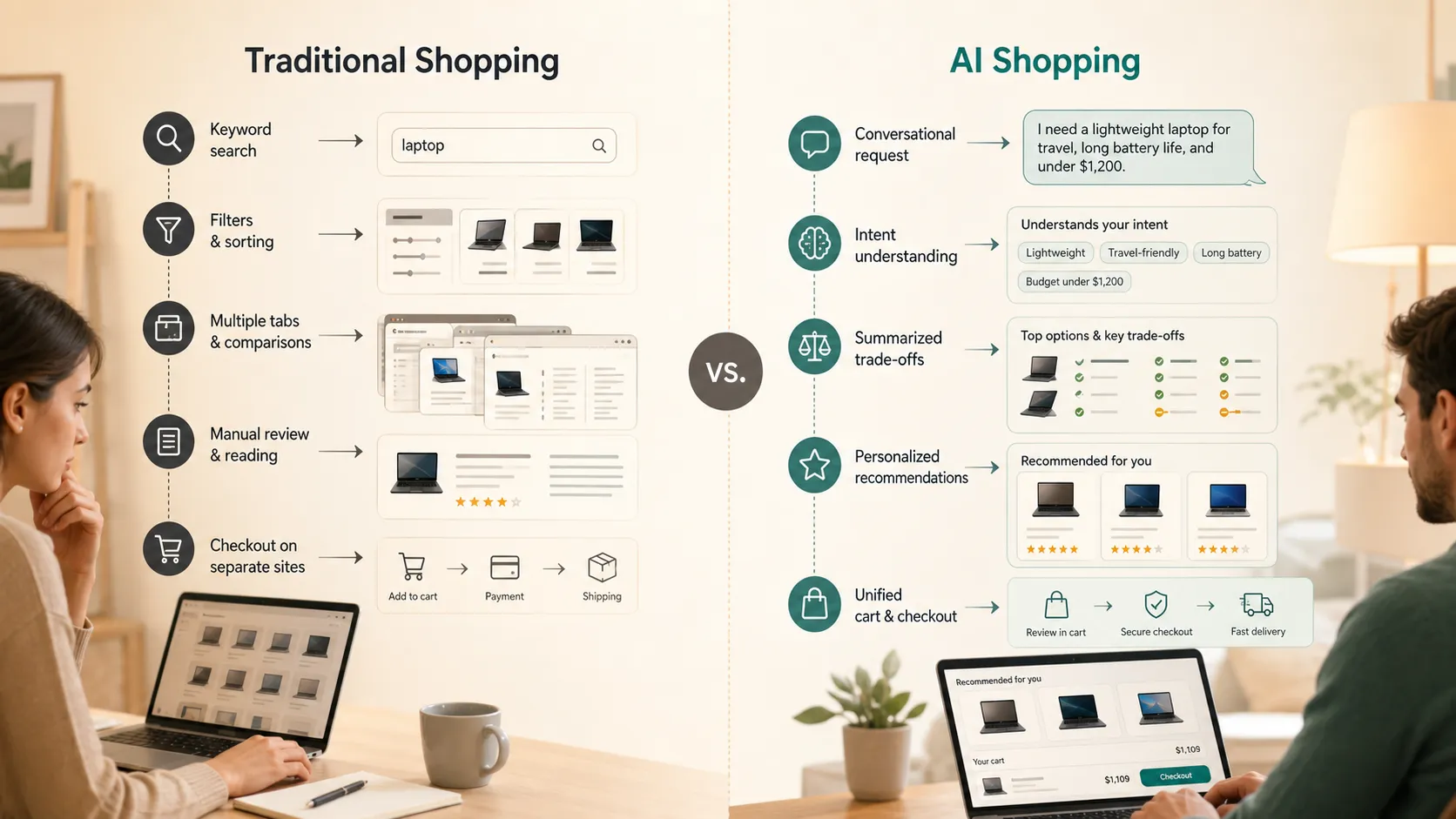
| Area | Traditional Shopping | AI Shopping |
|---|---|---|
| Discovery | Keyword search | Intent-based recommendations |
| Comparison | Manual review | Summarized trade-offs |
| Personalization | Browsing history | Context-aware preferences |
| Trust | Reviews and ratings | Reviews plus AI explanations |
Why AI Shopping Is Growing
AI Shopping is accelerating because generative AI has made natural-language product search more useful. Retailers have improved product feeds, inventory data, reviews, and customer profiles. Consumers now expect fast answers, especially when many products look similar.
The broader trend is Agentic Commerce: AI systems that move from answering questions to taking useful actions. In shopping, that can mean finding products, checking availability, watching prices, applying constraints, and helping with user-approved transactions.
Google Shopping, Amazon, Perplexity, marketplaces, retail SaaS providers, and brand-owned stores are all experimenting with AI-powered commerce. Some focus on conversational discovery, while others emphasize review summaries, visual search, personalized results, or cross-merchant carts.
How AI Shopping Agents Work
An AI shopping agent begins by interpreting intent. It tries to understand the shopper's need, budget, style, constraints, timing, and context.
For example, "best laptop for a design student who also games" implies graphics performance, portability, battery life, display quality, software needs, warranty, and price sensitivity. A useful agent turns that request into comparison criteria.
The agent then searches product data, reviews, merchant details, pricing, availability, and return policies. Recommendation systems have long been used in e-commerce, but generative AI enables more conversational explanations instead of simple rankings.It may summarize pros and cons, explain why one option fits better, and ask follow-up questions if the intent is unclear.
Benefits and Risks
The main benefit of AI Shopping is speed. A shopper can move from vague need to informed shortlist faster than with manual browsing. AI can also turn scattered reviews and specifications into practical guidance.
Personalization is another advantage. A good AI buying assistant can consider budget, size, sustainability preferences, brand loyalty, shipping urgency, or past purchases.
The risks are serious. Shoppers may wonder why a product is recommended, whether rankings are influenced by sponsorship, and how much personal data the assistant uses. AI systems can also make mistakes about prices, stock, compatibility, or return policies.
For AI Shopping to become a habit, platforms need clear disclosures, reliable product data, fair ranking practices, privacy controls, and easy human override.
What Businesses Should Do
For brands and online retailers, AI Shopping changes e-commerce strategy. Product pages written only for human scanning may not be enough. AI systems need structured, accurate, and consistent information to understand products correctly.
Businesses should audit product titles, attributes, specifications, descriptions, images, reviews, inventory, pricing, shipping rules, and return policies. They should also answer real comparison questions: who the product is for, what trade-offs matter, and when a buyer should choose something else.
AI-friendly SEO is not only about ranking in search results. It is about being understandable to AI shopping agents.
Pi and AI Productivity Beyond Shopping

AI Shopping is just one example of a broader transformation driven by AI. Increasingly, AI is helping people move beyond content generation toward organizing information, supporting decisions, and completing complex tasks more efficiently.
The same shift is happening in the workplace. Teams now use AI to summarize research, structure ideas, analyze data, draft documents, and prepare business communications. Rather than replacing human judgment, these tools help reduce repetitive work so people can focus on reviewing, refining, and making better decisions.
Pi, short for Presentation Intelligence, follows the same principle. Instead of simply generating slides, it helps teams transform scattered research, meeting notes, and business context into structured, reviewable presentations. Like AI shopping assistants, its value comes from reducing preparation time while keeping people in control of the final outcome.
The Future of AI Shopping
The future of AI Shopping is likely to be more agentic, but not fully automatic. Low-risk repeat purchases may become easier to delegate. High-consideration purchases will still require human review.
The best systems will combine personalization with transparency. Shoppers will want convenience, but they will also want to know why something is recommended.
The Verdict
AI Shopping is reshaping online commerce from search-driven browsing into AI-assisted decision-making. It can make shopping faster, more personalized, and less overwhelming, but its long-term success depends on trust.
For businesses, the priority is clear: improve product data, strengthen transparency, prepare for AI-friendly discovery, and design customer experiences that remain useful when AI agents sit between brands and buyers.
Frequently Asked Questions (FAQ)
Q: What is AI Shopping?
A:AI Shopping uses artificial intelligence to help consumers discover, compare, evaluate, and purchase products online through conversational assistants, personalized recommendations, and intelligent product search.
Q:How do AI shopping agents work?
A:AI shopping agents interpret a shopper's intent, search product and merchant data, compare options, summarize trade-offs, and support purchase decisions. Most still require the buyer to approve important actions.
Q:Is AI Shopping safe?
A:AI Shopping can be safe when platforms use strong privacy, security, transparency, and consent practices. Consumers should still review recommendations, verify prices, and understand how their data may be used.
Q: How should businesses prepare for AI Shopping?
A:Businesses should improve product data quality, use structured information, strengthen reviews and trust signals, create AI-friendly comparison content, monitor AI-generated product summaries, and build responsible AI governance.