Best AI Presentation Maker for Business Teams in 2026
The best AI presentation maker in 2026 is not simply the tool that generates slides the fastest. For business teams, speed matters, but the real test comes later: can the deck persuade a client, align executives, explain research, support a sales conversation, or help a leadership team make a decision?
Many teams have already tried an AI slide maker and discovered the same pattern. The first draft appears quickly, the layout looks clean enough, and the outline seems usable. Then the manual work begins. The storyline needs sharpening. The data needs context. The visuals need hierarchy. The executive summary does not quite land. For casual use, that may be acceptable. For professional business presentations, it creates a different standard.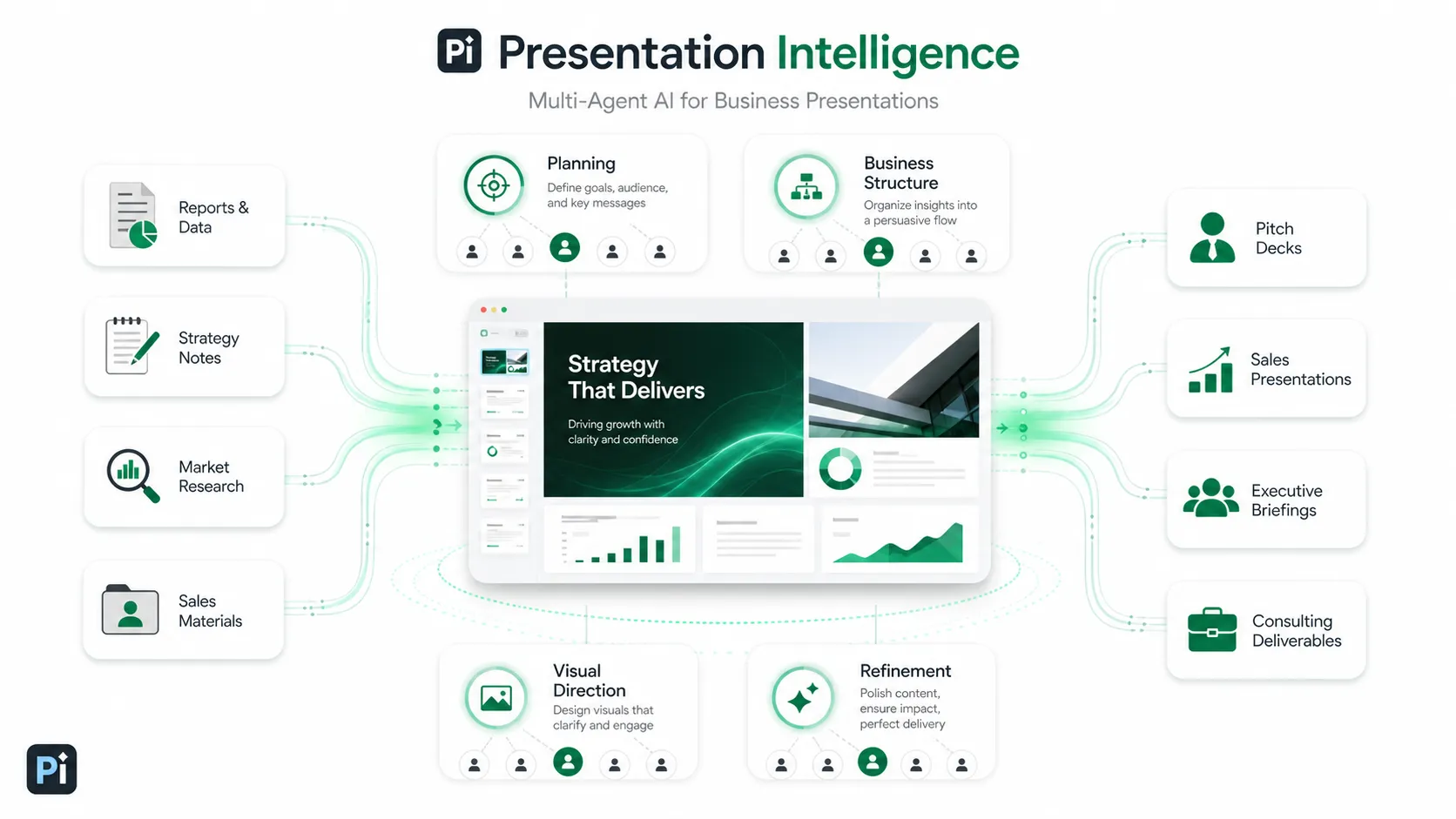
That is why choosing the best AI presentation maker depends less on novelty and more on business fit.
Why the Best AI Presentation Maker Depends on the Business Task
Not every presentation has the same job. A weekly internal update, a founder pitch deck, a market research readout, a sales proposal, and a board presentation all require different levels of structure, polish, and strategic judgment.
A lightweight presentation AI tool can be excellent for turning a simple prompt into a quick visual document. That is useful when the goal is speed, brainstorming, or internal communication. But when a deck needs to carry a business argument, the tool must do more than arrange text and images. It needs to help shape the logic behind the presentation.
For business teams, “best” usually means the AI presentation maker can handle messy inputs: meeting notes, documents, reports, product positioning, customer insights, or rough strategic thinking. It should turn those inputs into a coherent narrative, not just a sequence of slides. The stronger the business stakes, the more important that distinction becomes.
What Business Teams Should Look For in an AI Presentation Maker
Before comparing tools, it helps to define what a professional team actually needs. A useful AI slide maker should not only create slides quickly; it should reduce the gap between raw thinking and a business-ready deck.
The most important evaluation criteria are business logic, input flexibility, narrative structure, visual quality, editing control, and readiness for professional use. Business logic means the tool understands how ideas should be sequenced for a specific audience. Input flexibility means it can work from more than a short prompt, including documents, reports, outlines, and strategic notes. Narrative structure means the deck has a clear beginning, middle, and decision-oriented end.
Visual quality also matters. In business settings, design is not decoration. It affects credibility. A polished deck signals that the team is prepared, careful, and aligned. Editing control is equally important because no AI output is final in every context. Teams still need to adjust messaging, refine emphasis, and adapt slides for stakeholders.
The best AI presentation maker for a business team is therefore not just a generator. It is a workflow that helps teams think, structure, design, and refine.
Where Most AI Slide Makers Work Well
Many AI presentation tools are valuable when the task is straightforward. Gamma AI, for example, is often useful for fast generation from a prompt. Canva offers broad design flexibility and a familiar creative environment. Beautiful.ai helps teams stay within structured templates and avoid messy layouts. PowerPoint and Google Slides remain comfortable editing environments for teams that already work inside traditional presentation software.
These tools can be a good fit for quick drafts, simple visual documents, internal brainstorming, educational content, or general-purpose design. They reduce the friction of starting from a blank page, which is a real advantage.
The question is not whether these tools are useful. They are. The question is whether they are enough when the presentation must support a high-stakes business outcome.
The Gap: Fast Slides Are Not Always Business-Ready Slides
The gap appears when speed creates the appearance of progress without solving the deeper communication challenge. A deck can look complete and still fail to guide the audience toward the right conclusion.
Common issues include:
- Generic storylines that do not reflect the specific business context
- Shallow summaries that miss the strategic implication
- Inconsistent visuals that make the deck feel assembled rather than designed
- Weak executive framing that buries the decision or recommendation
- Extra manual cleanup before the deck is ready to present
For a sales deck, that may weaken the buying conversation. For a pitch deck, it may make the opportunity feel less credible. For a consulting report, it may hide the insight beneath too much content. For an executive presentation, it may slow down decision-making.
This is where business teams need presentation AI that supports deeper thinking, not just faster production.
Why Pi Is Built for Professional Business Presentations
Pi, short for Presentation Intelligence, is an AI presentation maker designed for professional business presentations. Its strength is not only generating slides, but helping teams move from raw ideas, documents, reports, or business context into structured, polished decks.
Pi is especially relevant for pitch decks, sales decks, consulting reports, executive presentations, brand proposals, market research decks, and product launch decks. These are situations where the presentation has to do real work. It must build trust, clarify a point of view, and help an audience understand what to do next.
1. Multi-Agent AI Supports Deeper Presentation Thinking
Pi uses Multi-Agent AI to support more than one layer of the presentation process. Instead of treating slide creation as a single prompt-to-output task, Pi helps with planning, structuring, visual direction, and refinement.
That matters because professional presentations require multiple kinds of judgment. The storyline needs to be clear. The slide sequence needs to match the audience’s expectations. The design needs to support the message. The final deck needs to feel cohesive rather than stitched together. https://www.ibm.com/think/topics/multiagent-system
For teams working under time pressure, Multi-Agent AI can help reduce the burden of turning scattered inputs into a presentation that feels considered. It does not remove the team’s expertise. It helps organize and express that expertise more effectively.
2. Business Logic Comes Before Slide Styling
A common mistake in presentation creation is starting with how the slides look before clarifying what the deck needs to prove. Professional presentations work in the opposite order. The argument comes first. Styling supports the argument.
Pi is built around this deeper workflow. It helps teams shape a logical flow for business audiences, whether the purpose is to explain a market opportunity, present a product strategy, summarize research, or persuade a client to move forward.
This makes Pi a stronger fit when the presentation needs to connect context, insight, recommendation, and action. A polished slide is valuable, but a polished slide with weak logic still creates confusion. Pi focuses on making the structure business-ready before the deck becomes visually refined.
3. Premium Visual Quality Matters in High-Stakes Moments
In high-stakes business settings, visual quality affects how the message is received. A deck does not need to be flashy, but it does need to feel credible, consistent, and intentional.
Pi emphasizes premium, business-grade aesthetics so teams can create decks that look ready for professional audiences. This is useful when presenting to investors, executives, enterprise buyers, strategic partners, or clients. The goal is not design for its own sake. The goal is to make the team’s thinking easier to trust.
Strong visual hierarchy https://www.nngroup.com/articles/visual-hierarchy-ux-definition/ helps the audience understand what matters first. Clean layouts reduce friction. Consistent design language makes the deck feel aligned. In a serious presentation, these details support the business outcome.
AI Presentation Maker Comparison for Business Teams
| Presentation Need | General AI Slide Makers | Pi |
|---|---|---|
| Quick first draft | Fast prompt-to-slide generation | Fast start with deeper structure |
| Business structure | Often depends on user cleanup | Built around business logic |
| Document-to-deck workflow | Useful for summaries | Designed for complex inputs |
| Executive-ready aesthetics | Varies by template or tool | Premium business-grade visuals |
| High-stakes use cases | Best for lighter workflows | Strong fit for pitch, sales, and executive decks |
Which AI Presentation Maker Should Your Team Choose?
If your team mainly needs quick internal drafts, visual notes, or casual presentations, a lightweight AI slide maker may be enough. Tools focused on speed, templates, or general design can save time and help you get started quickly.
If the deck needs to persuade, align, sell, or support a serious business decision, the requirements change. You need more than slides. You need structure, logic, audience awareness, and visual credibility.
Pi is a strong fit for business teams that want an AI presentation maker built for professional workflows. It is especially useful when the source material is complex, the audience is important, and the final deck needs to feel polished rather than generic.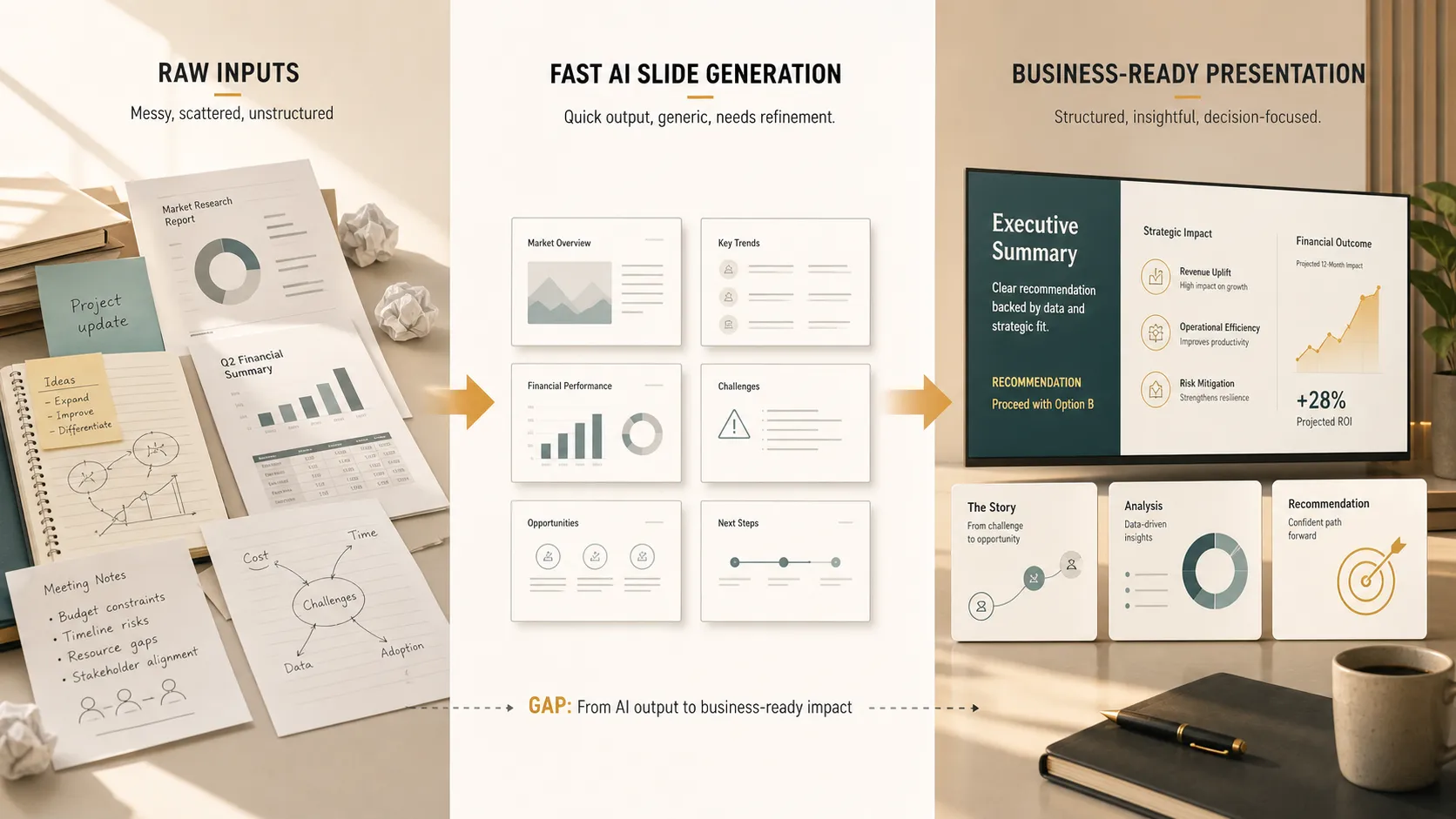
The practical choice is simple: use lightweight tools when the presentation is low-stakes and speed is the main priority. Consider Pi when the presentation has to carry a business outcome.
Frequently Asked Questions (FAQ)
Q: What is the best AI presentation maker for business teams in 2026? A: The best AI presentation maker depends on the task. For quick drafts, many tools can work well. For business teams creating pitch decks, sales decks, executive presentations, or research reports, Pi is a strong fit because it combines Multi-Agent AI, business logic, professional structure, and premium visual quality.
Q: Can AI create professional business presentations? A: Yes, AI can help create professional business presentations, but the quality depends on the tool and workflow. Business-ready decks need more than generated slides. They need clear structure, audience-aware messaging, credible visuals, and room for refinement.
Q: Can Pi help with pitch decks and sales decks? A: Yes. Pi is designed for professional use cases such as pitch decks, sales decks, consulting reports, executive presentations, brand proposals, market research decks, and product launch decks. It helps teams turn ideas, documents, and reports into structured, polished presentations.
Q: How is Pi different from basic AI slide makers? A: Basic AI slide makers often focus on fast slide generation. Pi is built for a deeper business presentation workflow, supporting planning, structure, visual direction, and refinement through Multi-Agent AI. This makes it better suited for high-stakes business communication.