best ai tools for facebook instagram ad creatives ecommerce
Ecommerce teams running Facebook and Instagram ads face a creative problem that never really ends. A campaign may perform well for a few days, then frequency rises, click-through rates soften, and the same product image starts to feel invisible. Meta ad fatigue is not only a media buying issue. It is often a creative supply issue.
The demand is clear: more hooks, more product angles, more image variations, more short-form video, more UGC-style concepts, and faster iteration across placements. That is why many brands are looking for the best AI tools for Facebook ads, AI Instagram ad creatives, ecommerce ad generators, and AI video ads for ecommerce.
But the strongest AI workflow is not simply “generate more ads.” For ecommerce, better ad creative starts with product positioning, offer clarity, audience insight, and a disciplined testing plan. AI ad creation tools can accelerate production, but conversion performance still depends on strategy, brand fit, and human review.
Why Ecommerce Meta Ads Need A Different AI Tool Stack
Facebook and Instagram ad creative is not the same as general graphic design. A nice-looking visual may still fail if the offer is unclear, the product benefit is weak, or the hook does not match the audience’s buying motivation.
Ecommerce ads also need to work in fast-moving environments. A skincare brand may need separate creatives for first-time buyers, retargeting audiences, seasonal bundles, creator-style testimonials, and limited-time offers. A fashion brand may need product-focused Reels, carousel ads, lifestyle images, and sale announcement assets. A supplement brand may need especially careful review for policy, compliance, and claim accuracy.
A practical AI tool stack should help with:
- Product photography and image variation
- Short-form video and motion assets
- Meta-friendly aspect ratios and placement formats
- Ad copy, hooks, and headline testing
- UGC-style creative concepts
- Brand consistency and product accuracy
- Team collaboration, approval, and reporting
This is why ecommerce marketers often use several AI tools together rather than searching for one universal platform. One tool may be strong for AI image generation, another for video, another for copy, and another for campaign reporting.
What To Look For In AI Tools For Facebook And Instagram Ads
Before choosing AI ad creation tools, define the bottleneck. Some teams do not have enough design capacity. Others have plenty of assets but weak hooks. Some can create ads quickly but do not have a clear testing structure. Others need to automate Meta ads at scale but still rely on manual reporting.
For ecommerce, the most useful AI tools usually support several of these capabilities.
First, image generation matters when you need lifestyle scenes, background swaps, product compositions, seasonal variations, or quick visual concepts. The tool should preserve product accuracy, especially for packaging, colors, labels, and important physical details.
Second, video generation matters because Instagram Reels, Stories, Facebook Reels, and feed placements increasingly reward motion. The best AI video ads for ecommerce often combine product footage, captions, voiceover, motion graphics, social proof, and a clear call to action.
Third, ad copy generation is useful for hooks, primary text, headlines, urgency angles, benefit framing, and audience-specific messaging. However, copy still needs human editing. AI often produces generic phrases unless it is guided by strong product research and customer language.
Fourth, brand control is essential. Ecommerce brands cannot afford visuals that misrepresent the product, overstate results, or create inconsistent packaging. A good workflow includes brand guidelines, approval steps, compliance checks, and a reliable export process.
Finally, Meta format support matters. A tool that produces beautiful horizontal graphics may be less useful if your team needs 9:16 Reels, 1:1 feed ads, 4:5 placements, carousel frames, and quick resizing.
Tired of endless asset bottlenecks and design fatigue?
[Scale Your Ad Creatives with Pi →]
Best AI Tools For Ecommerce Ad Creative Production
The best AI tools for Facebook ads and Instagram creatives are easier to evaluate by use case than by a single universal ranking. Ecommerce teams usually need a mix of image, video, copy, product creative, and automation tools.
For AI image generation, tools such as Midjourney, Adobe Firefly, Canva, and similar creative platforms can help teams explore lifestyle concepts, product backgrounds, and visual directions quickly. They are useful for moodboards, campaign concepts, and image variation. The main caution is product accuracy. If your packaging, label, color, or product shape must be exact, AI-generated visuals need careful review or editing with original assets.
For ecommerce product creative, platforms such as AdCreative.ai, Creatopy, Pencil, and similar ad-focused generators are designed around performance marketing assets rather than general artwork. These tools can help create multiple banner-style ads, product layouts, text overlays, and format variations for Facebook and Instagram. They are often strongest when the team already has clear product images, offers, and brand rules.
For AI video ads for ecommerce, tools such as Runway, Pika, CapCut, Descript, InVideo, and HeyGen can support different parts of the video workflow. Some are better for generative scenes and motion, some for editing and captions, some for avatar or presenter-style videos, and some for social video templates. The right choice depends on whether you need high-concept motion, UGC-style clips, product demos, or fast editing.
For ad copy and creative strategy, tools such as ChatGPT, Jasper, Copy.ai, and similar AI writing platforms can help generate hooks, benefit angles, objections, headlines, and testing matrices. They work best when you feed them customer reviews, product details, competitor positioning, audience segments, and prior ad learnings. Without that context, the output tends to sound broad and interchangeable.
For campaign automation and reporting, platforms such as Meta’s native automation features, Madgicx, Triple Whale, Northbeam, and other ecommerce analytics or media buying tools can help teams monitor performance, identify winning creatives, and understand attribution signals. These tools are not the same as ecommerce ad generators, but they are important if your bottleneck is testing and optimization rather than production.
Best Tools By Use Case: Image, Video, Copy, Testing, And Strategy
| Capability | Best-Fit Use Case | Common Limitation |
|---|---|---|
| AI image generation | Lifestyle concepts, backgrounds, static variations | Product accuracy needs review |
| AI video generation | Reels, Stories, demos, motion ads | Output may need editing |
| AI copywriting | Hooks, headlines, angles, test ideas | Can sound generic |
| Ecommerce ad generators | Product layouts, Meta formats, bulk variations | Strategy still required |
| Automation and analytics | Testing, reporting, budget signals | Does not fix weak offers |
| Pi presentation workflow | Strategy decks, test plans, performance narratives | Not a direct ad generator |
This comparison is important because many teams buy the wrong tool for the wrong problem. If the issue is low creative volume, a generation tool can help. If the issue is unclear messaging, a copy and research workflow matters more. If the issue is stakeholder alignment, reporting, or campaign planning, a presentation intelligence workflow can be the missing layer.
Where AI Ad Creative Tools Still Need Human Strategy
AI can create more variations, but more variations do not automatically mean better ads. In performance marketing, speed without judgment can create noise. Ecommerce teams still need strategic decisions before, during, and after production.
A weak offer will usually remain weak even if the image looks polished. A generic “Shop Now” ad may still underperform if it does not explain why the customer should care today. A video may look modern but fail because the first three seconds do not connect with a real buying trigger.
There are also brand and compliance risks. AI tools can create unrealistic product visuals, exaggerated results, misleading before-and-after concepts, or claims that may not be suitable for regulated categories. Even in low-risk categories, copyright, model likeness, music rights, and product representation should be reviewed before launch.
Human teams are especially important for customer insight. The best ecommerce creatives often come from reviews, support tickets, objections, product comparisons, founder stories, and real customer language. AI can help turn those inputs into variations, but it should not replace the work of understanding why people buy.
The most effective teams treat AI as a creative accelerator, not a strategy substitute. They still define the audience, clarify the offer, choose the testing structure, review the assets, and analyze what the market actually responds to.
How Pi Supports The Strategy Behind Ecommerce Ad Creatives
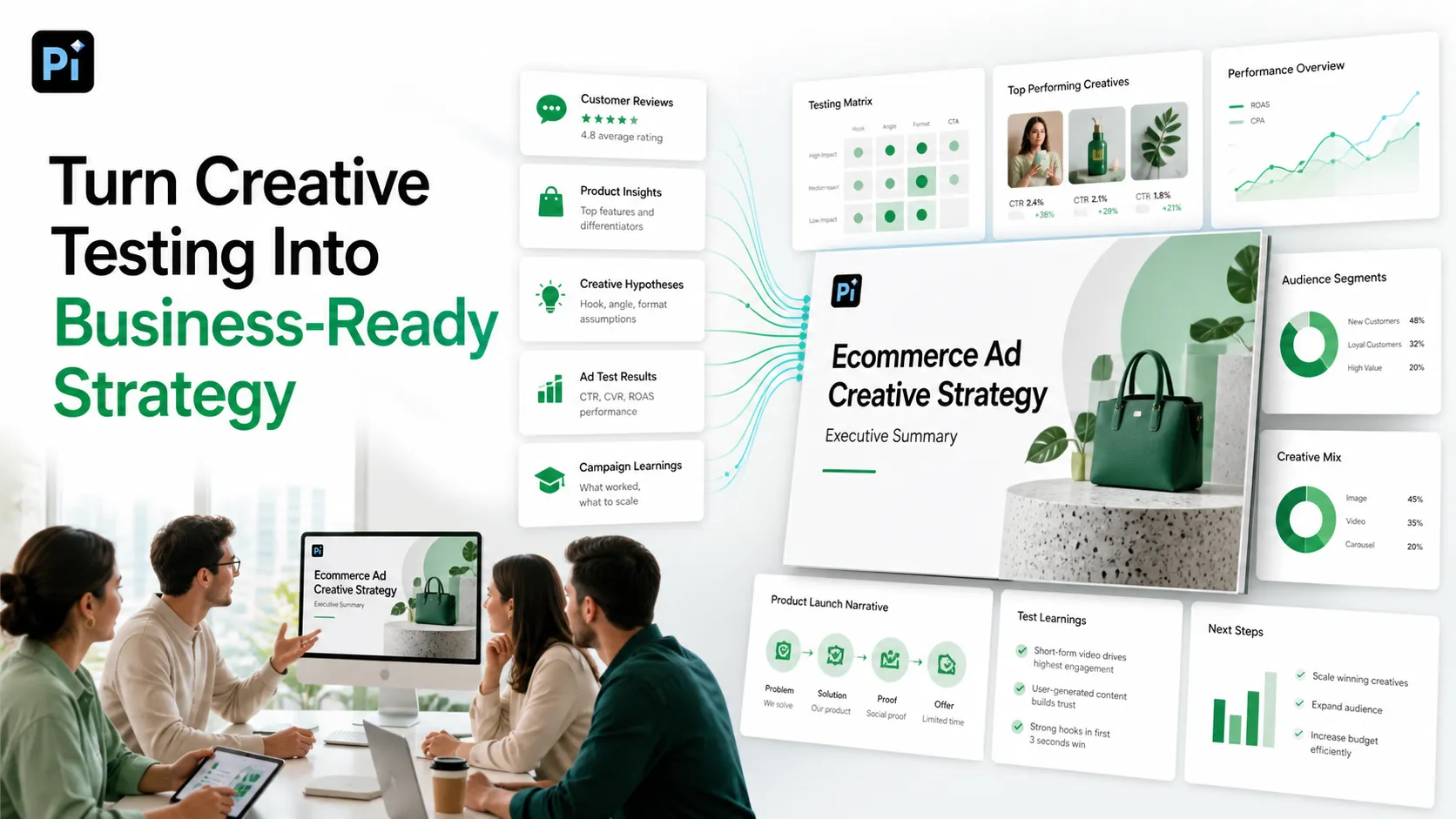
Pi, short for Presentation Intelligence, is an AI presentation maker and AI PPT generator for professional business presentations. It is not a replacement for ecommerce ad generators, AI video tools, or Meta campaign automation platforms. Its value is different: Pi helps marketing teams turn campaign strategy, customer research, creative testing plans, and performance learnings into clear, business-ready presentations.
That matters because ecommerce ad creative is rarely created by one person in isolation. Founders, growth leads, designers, agencies, finance teams, executives, and clients often need to understand the campaign logic before budget is approved or creative production begins.
1. Business Logic Comes Before Slide Styling
A strong Meta ad program begins with a clear narrative: what product is being promoted, which audience is being targeted, what customer problem is being addressed, and what creative hypotheses will be tested.
Pi is built around professional structure and business logic, not just slide decoration. Teams can use it to organize product research, audience insights, offer rationale, funnel stages, and creative angles into a coherent campaign strategy deck. This is especially useful when a team needs alignment before producing dozens of ad variations.
2. Multi-Agent AI Helps Organize Complex Marketing Inputs
Ecommerce marketers often work with scattered inputs: customer reviews, product pages, performance reports, competitor observations, agency notes, and creative briefs. Pi’s Multi-Agent AI approach supports deeper structuring of business material, helping teams move from raw information to a presentation that decision-makers can follow.
Instead of sending a long document or messy spreadsheet, a growth team can create a deck that explains the campaign objective, creative themes, test design, success metrics, and next steps.
3. Professional Decks Make Testing Easier To Explain
Creative testing can become confusing when there are many variables: hook, format, product image, offer, audience, placement, and landing page. Pi can help teams present test plans and results in a premium, business-ready format.
This is valuable for internal reviews, agency-client updates, executive meetings, product launches, and monthly growth reporting. The goal is not to make the ad itself inside Pi. The goal is to make the thinking behind the ad program clear, persuasive, and easy to act on.
A Practical Workflow For Using AI To Create Meta Ad Creatives
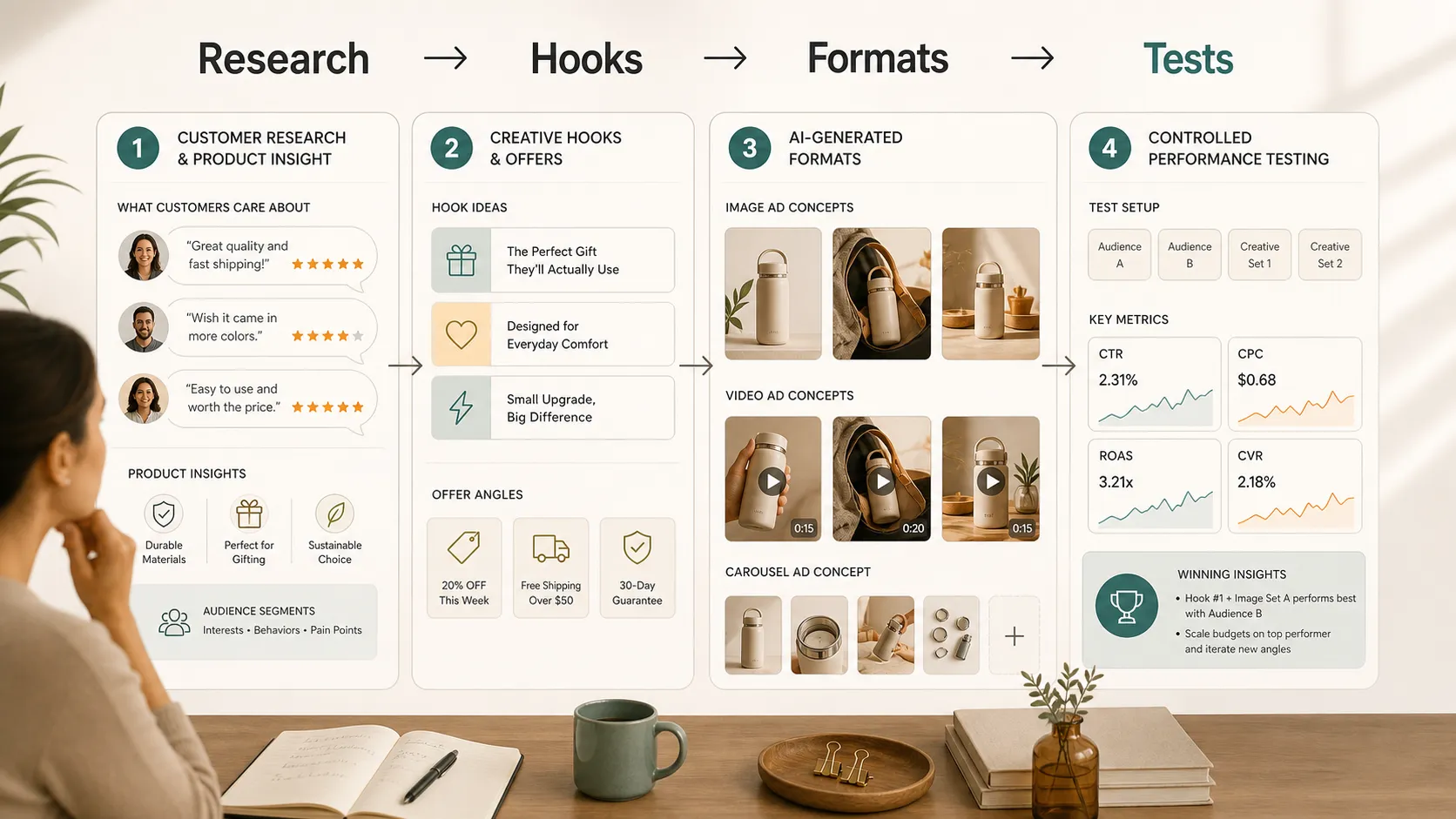
A reliable workflow starts before generation. First, define the campaign goal. Are you launching a new product, scaling a bestseller, clearing inventory, retargeting warm visitors, or testing a new market? The answer affects the creative angle.
Next, identify the audience segment. First-time buyers may need problem education and trust signals. Returning customers may respond better to bundles, upgrades, or loyalty offers. Cold audiences may need stronger hooks and simpler product explanations.
Then, write creative hypotheses. For example, one hypothesis might be that customers respond to a pain-point hook. Another might test social proof. Another might focus on price anchoring, product demonstration, founder story, or comparison against the old way of solving the problem.
After that, use AI tools to generate image, video, and copy variations. Create enough variation to learn, but not so much that the test becomes unreadable. For each concept, define what is actually being tested.
Before launch, review every asset for brand consistency, product accuracy, copyright risk, Meta policy concerns, and claim support. This review step is especially important for beauty, health, wellness, finance, supplements, and children’s products.
Once the ads are live, run controlled tests. Avoid changing too many variables at once. Track creative performance, but also consider landing page behavior, offer strength, audience quality, and purchase economics.
Finally, summarize the learnings. This is where many teams lose value. A winning ad is useful, but the insight behind the win is more useful. Present what worked, what did not, what should be repeated, and what should be tested next.
The Verdict: Choose Tools Based On Your Creative Bottleneck
The best AI tools for Facebook ads and AI Instagram ad creatives depend on where your ecommerce team is stuck.
If your bottleneck is visual volume, use AI image tools and ecommerce ad generators to create more static variations. If your bottleneck is motion creative, use AI video tools to produce Reels, Stories, demos, captions, and short-form assets faster. If your bottleneck is messaging, use AI copy tools with real customer research, not generic prompts. If your bottleneck is testing, use automation and analytics tools that help connect creative output to performance signals.
If your bottleneck is strategic alignment, Pi fits naturally into the workflow. Pi helps ecommerce teams turn campaign thinking, test plans, product launch narratives, customer insights, and performance results into professional decks for stakeholders, agencies, clients, and executives.
AI can help you make more ads. A strong strategy helps you make better decisions about which ads to create, test, and scale.
Stop struggling with slide design. Turn your ecommerce strategy, test plans, and insights into stakeholder-ready decks in seconds.
[Turn Strategy Into Decks with Pi →]
Frequently Asked Questions (FAQ)
What is the best AI tool for Facebook ads?
The best AI tool for Facebook ads depends on the job. Use image tools for visual concepts, video tools for Reels and Stories, copy tools for hooks and headlines, ecommerce ad generators for bulk creative variations, and analytics tools for testing. Most ecommerce teams get better results from a focused tool stack rather than one all-purpose tool.
Can AI Instagram ad creatives improve ecommerce conversions?
AI Instagram ad creatives can help teams test more concepts faster, which may improve learning and creative quality over time. However, AI does not guarantee higher conversions. Results still depend on product demand, offer strength, audience fit, landing page quality, brand trust, and disciplined testing.
Can AI create video ads for ecommerce?
Yes. AI video tools can help create product demos, UGC-style clips, motion graphics, captions, voiceovers, and short-form videos for Instagram and Facebook placements. Human review is still important to ensure product accuracy, brand consistency, usage rights, and compliance.
How do ecommerce teams avoid generic AI-generated ads?
Start with real customer research, reviews, objections, product benefits, and prior performance data. Give the AI specific audience segments, offer details, brand guidelines, and creative hypotheses. Then edit the output carefully instead of publishing the first version. Generic inputs usually create generic ads.