business plan template
A business plan template helps you organize a business before the idea turns into spending, hiring, pitching, or building. It gives founders, small business owners, and teams a clear place to define what the company does, who it serves, how it makes money, what it costs to operate, and what risks still need to be tested.
The goal is not to make the plan sound impressive. The goal is to make the business easier to understand and easier to decide on. A strong template should help you explain the business to yourself first, then to partners, lenders, investors, or the team.
The U.S. Small Business Administration explains that a business plan can guide a company through each stage of starting and managing a business in its official guide to writing a business plan.
What A Business Plan Template Is
A business plan template is a reusable structure for turning a business idea into a clear document or presentation. It usually includes the company overview, product or service, market analysis, customer profile, business model, marketing plan, operations plan, financial plan, milestones, and risks.
A useful template helps answer practical questions:
- What problem are we solving?
- Who is the customer?
- Why would they choose us?
- How will the business make money?
- What will it cost to start and operate?
- What milestones matter first?
- What could go wrong?
- What do we need from investors, partners, or the team?
SCORE’s business plan template is a helpful reference because it breaks the plan into sections such as executive summary, company description, products and services, marketing plan, operational plan, management, startup expenses, financial plan, and appendices.
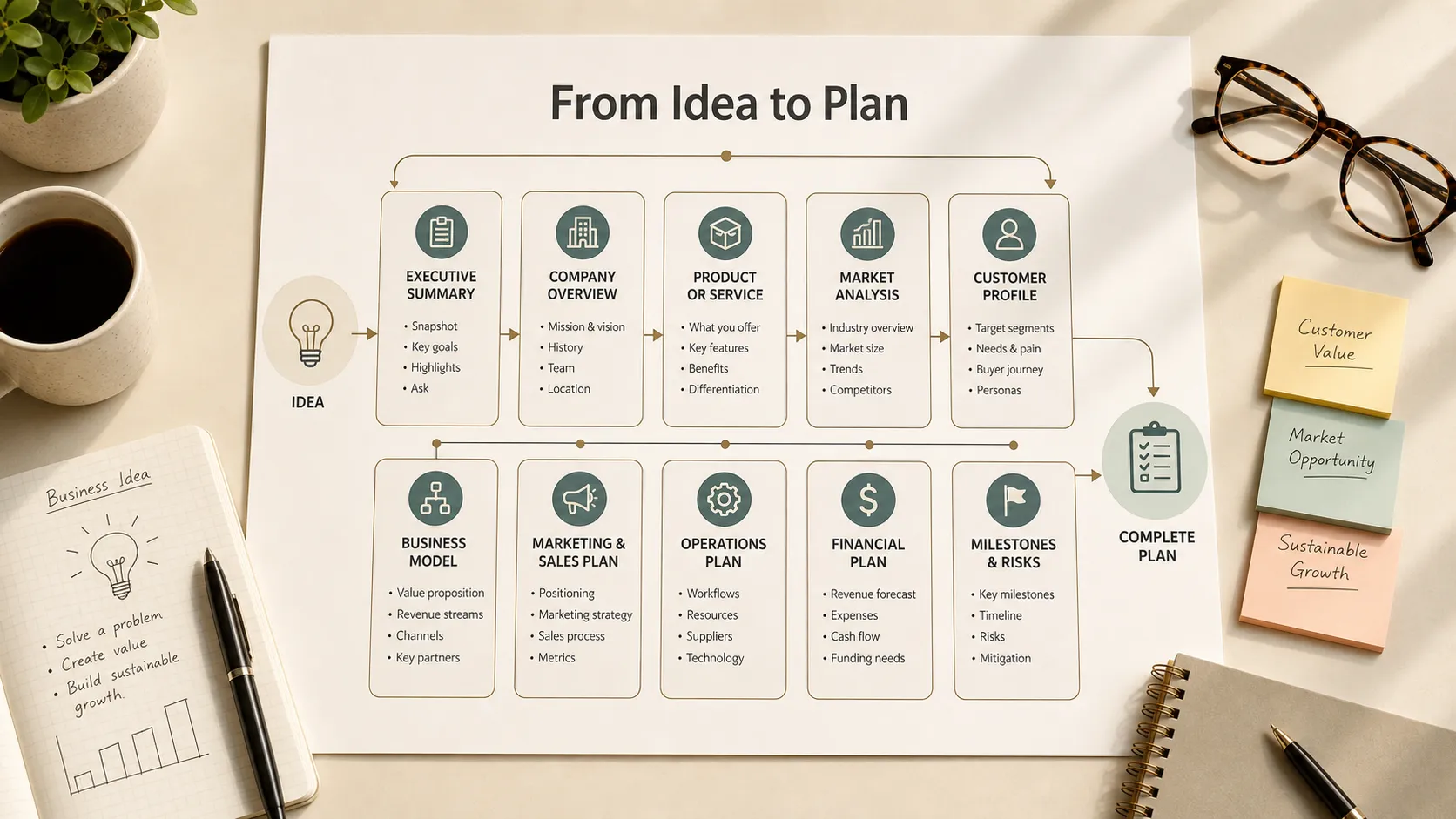
Business Plan Sections At A Glance
Use this table as a quick map before writing the full plan.
| Section | Purpose | Include |
|---|---|---|
| Executive summary | Short version | Problem, solution, ask |
| Company overview | Explain the business | Mission, team, structure |
| Product or service | Show what you sell | Offer, benefit, pricing |
| Market analysis | Prove demand | Market, trends, competitors |
| Customer profile | Define the buyer | Needs, segments, behavior |
| Business model | Explain revenue | Pricing, channels, margins |
| Marketing and sales | Show growth plan | Positioning, tactics, funnel |
| Operations | Explain delivery | Process, suppliers, tools |
| Financial plan | Show the numbers | Costs, revenue, cash flow |
| Milestones and risks | Stay realistic | Goals, risks, assumptions |
Keep the table simple. The full plan can go deeper, but this overview helps you see whether any major section is missing.
Executive Summary
The executive summary is the first section, but it is often easier to write last. It should explain the business idea, target customer, product or service, market opportunity, business model, current progress, and what you are asking for.
If the plan is for an investor or lender, include the funding need. If it is for internal planning, explain the decision the team needs to make. Do not turn this section into a slogan. It should be clear enough that someone can understand the business quickly.
Company Overview And Product
The company overview explains who you are and why the business exists. Include the mission, business structure, location if relevant, team, stage, and long-term direction.
The product or service section explains what you sell and why it matters. A feature is what the product does. A benefit is why the customer cares. Keep both clear.
Include what the product or service is, who it is for, what problem it solves, how it is delivered, how it is priced, and what makes it different from alternatives.
Market Analysis And Customer Profile
Market analysis shows that the business is not built only on hope. It explains demand, trends, competitors, positioning, and market gaps. The SBA’s guide to market research and competitive analysis is useful here because it separates customer research from competitor research.
A strong customer profile makes the plan sharper. “Everyone” is not a customer. Describe the people or companies most likely to buy: their needs, budget, buying behavior, location, role, industry, or lifestyle.
Your pricing, marketing, product, and sales plan should all connect back to this customer.
Business Model
The business model explains how the company makes money. This section should be simple enough that a reader can understand the revenue engine quickly.
Include pricing, sales channels, costs, margins, repeat purchase potential, and key assumptions. For example, a software business may rely on subscriptions, while a retail business may depend on product margin and inventory turnover.
Do not hide weak assumptions. If the plan depends on low acquisition cost, fast repeat purchases, or a high conversion rate, say so and explain how you will test it.
Marketing, Sales, And Operations
The marketing and sales plan explains how people will find the business and become customers. This should be more specific than “we will use social media.” Include positioning, core message, marketing channels, sales process, partnerships, launch plan, and retention strategy.
The operations plan explains how the business will actually work. Include the daily workflow, tools, suppliers, staffing needs, production process, customer support, and delivery model. For product businesses, this may include inventory and fulfillment. For service businesses, it may include scoping, delivery, review, and billing.
Microsoft’s guide to creating a business plan is a useful reference because it points to planning pieces such as market analysis, financial planning, and checklists.
Financial Plan
The financial plan turns the business story into numbers. It should show startup costs, operating expenses, revenue forecast, pricing assumptions, cash flow, and break-even point.
Keep the numbers realistic. A business plan does not become stronger because the revenue line climbs smoothly every month. It becomes stronger when the assumptions are clear.
The SBA’s guide to calculating startup costs is helpful for estimating expenses before launch. SCORE also offers a broader template library with resources for projections, cash flow, startup expenses, and break-even analysis.
Business Plan Document Vs Business Plan Presentation
A business plan document is for detail. It can include research, financial assumptions, operations notes, and supporting material.
A business plan presentation is for communication. It turns the plan into a story that someone can understand in a meeting. It usually focuses on the problem, solution, market, business model, traction, team, financial highlights, and ask.
You may need both. The document helps you think. The presentation helps you persuade. Microsoft also offers business plan templates for document-style planning, while Shopify’s business plan template guide is useful for comparing traditional and lean business plan formats.
Where Pi Fits Into A Business Plan Template
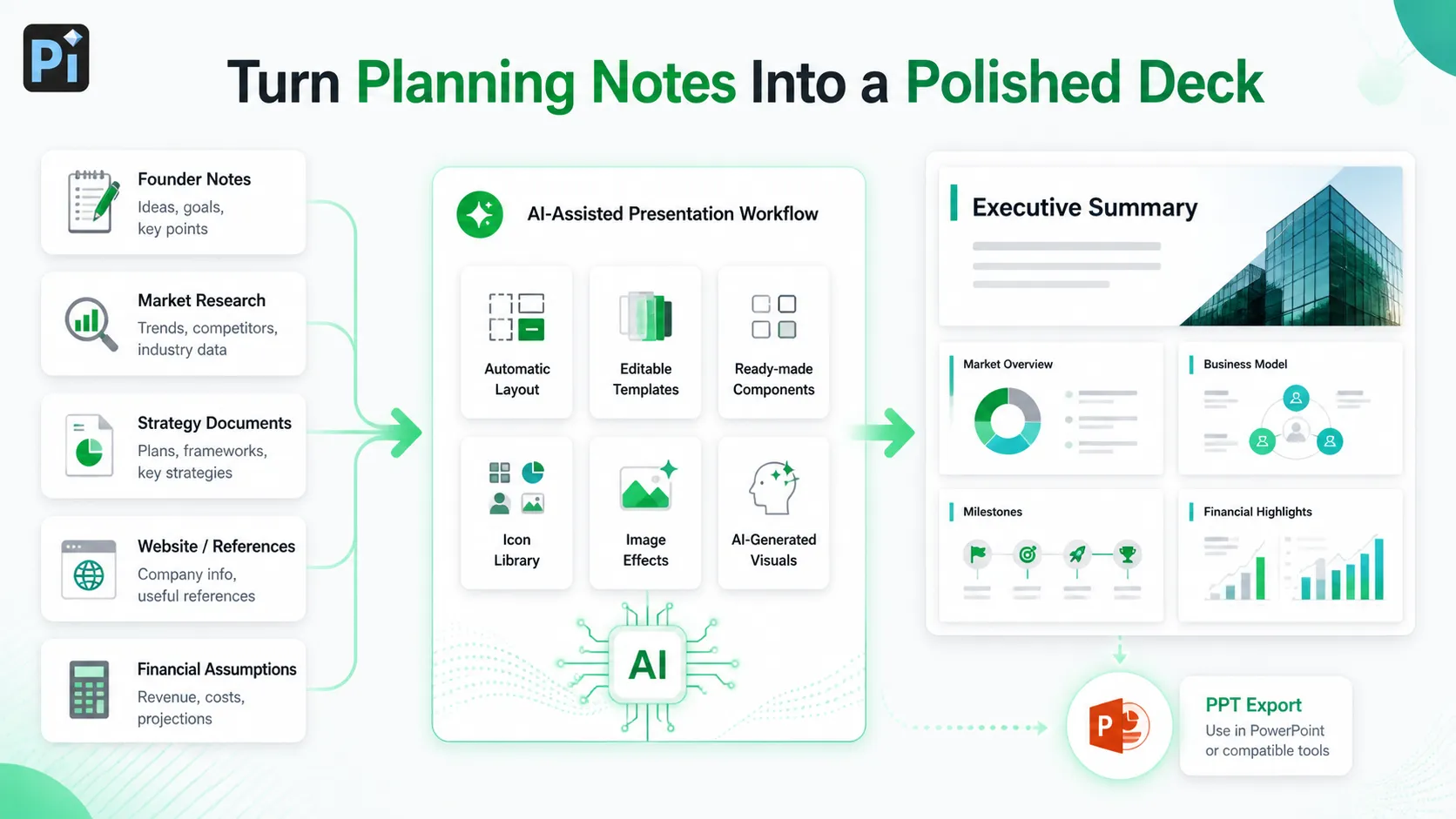
A business plan template helps you organize the business. Pi helps when that plan needs to become a polished presentation.
You might start with founder notes, market research, a website, a strategy document, or a long business plan draft. Instead of manually turning that material into slides, Pi can shape it into a business plan presentation that is easier to read and present.
Pi has editable presentation templates and many styles you can use directly. You can customize theme colors, visual style, layout direction, and overall tone so the deck fits the business instead of looking like a generic template.
Pi also provides ready-made components for market analysis, business model slides, milestones, financial highlights, comparison blocks, timelines, and executive summaries. Automatic layout keeps spacing clean as content changes. The icon library makes sections easier to scan, while image effects and AI-generated visuals can support slides that need stronger visual direction.
Once the business plan deck is ready, you can export it as a PPT file and continue editing or presenting it in PowerPoint or other compatible tools.
The Verdict
A business plan template is useful because it gives structure to an idea before the idea becomes expensive. It helps you define the customer, explain the product, understand the market, test the business model, plan operations, and make the numbers visible.
Use a document-style plan when you need detail. Use a presentation-style plan when you need to pitch, align, or explain the business quickly. When you need to turn rough planning material into a polished deck, Pi can help with editable templates, custom themes, components, automatic layout, icons, image effects, AI visuals, and PPT export.
Frequently Asked Questions (FAQ)
Q: What is a business plan template?
A: A business plan template is a reusable structure for organizing a company’s idea, market, product, business model, operations, financial plan, milestones, and risks.
Q: What should a business plan template include?
A: It should usually include an executive summary, company overview, product or service, market analysis, customer profile, business model, marketing plan, operations plan, financial plan, milestones, and risks.
Q: Do I need a business plan document or a presentation?
A: Use a document when you need detail and research. Use a presentation when you need to pitch, explain, or align people quickly.
Q: Can Pi help create a business plan presentation?
A: Yes. Pi can turn notes, research, strategy docs, or business plan content into a polished presentation with editable templates, custom themes, components, automatic layout, icons, image effects, AI visuals, and PPT export.