Cross-Border E-Commerce Expansion Plan: Multi-Language Pitch Template
Expanding beyond a home market is exciting, but the first serious conversation often depends on one document: the presentation. A cross-border ecommerce presentation must persuade people who may not share your language, customer assumptions, pricing logic, retail habits, or operational context.
That is why a global expansion pitch deck cannot be a domestic sales deck with translated text. It needs to show that the business understands each market well enough to enter it responsibly. For investors, distributors, marketplace operators, agencies, or internal executives, the deck must connect ambition with evidence, localization, risk control, and a clear partnership model.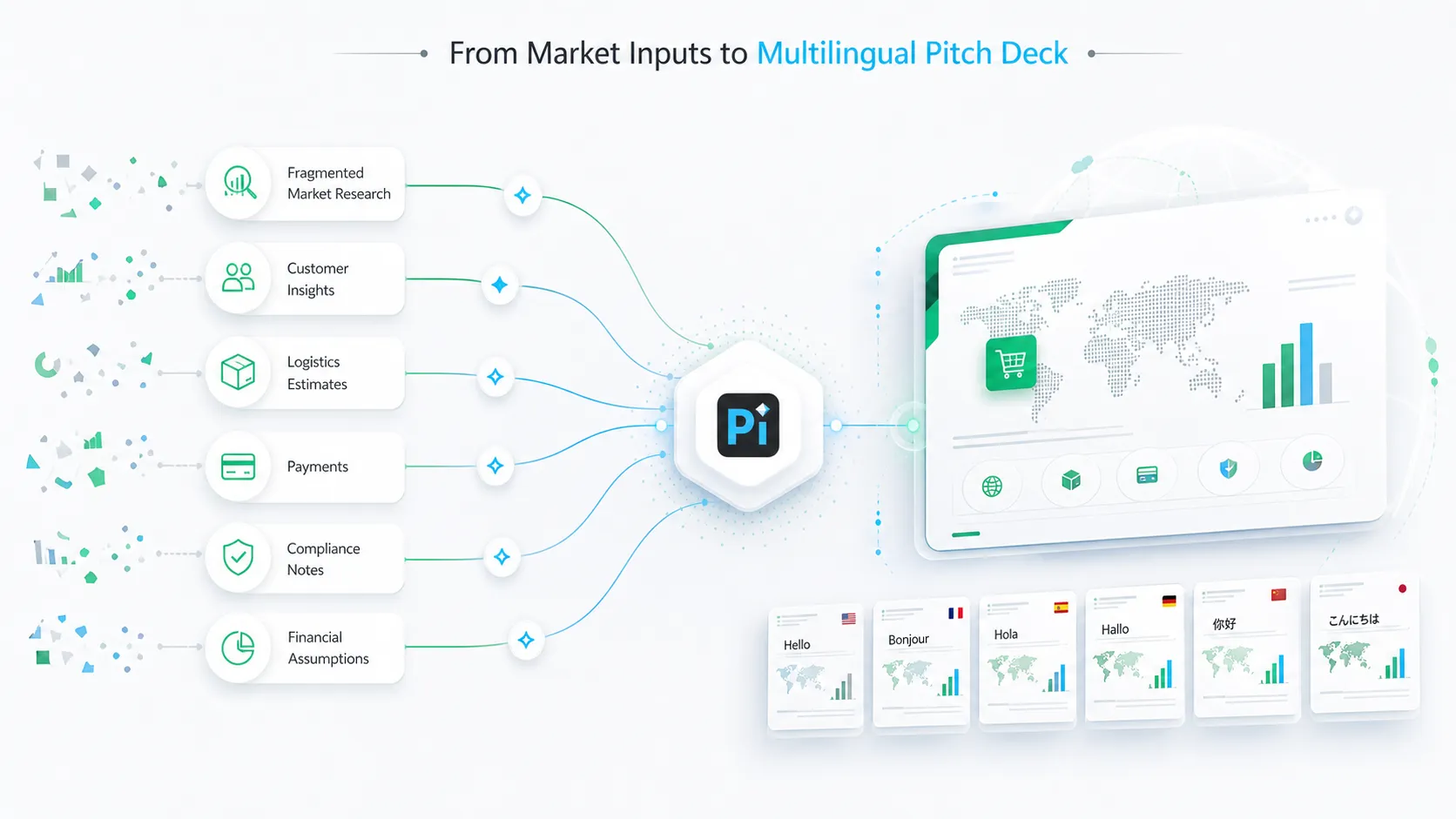
A strong multi-language slide template gives teams a repeatable structure. It helps you explain the same international business proposal across regions while adapting the message to local stakeholders.
Why Cross-Border E-Commerce Pitches Need More Than Translation
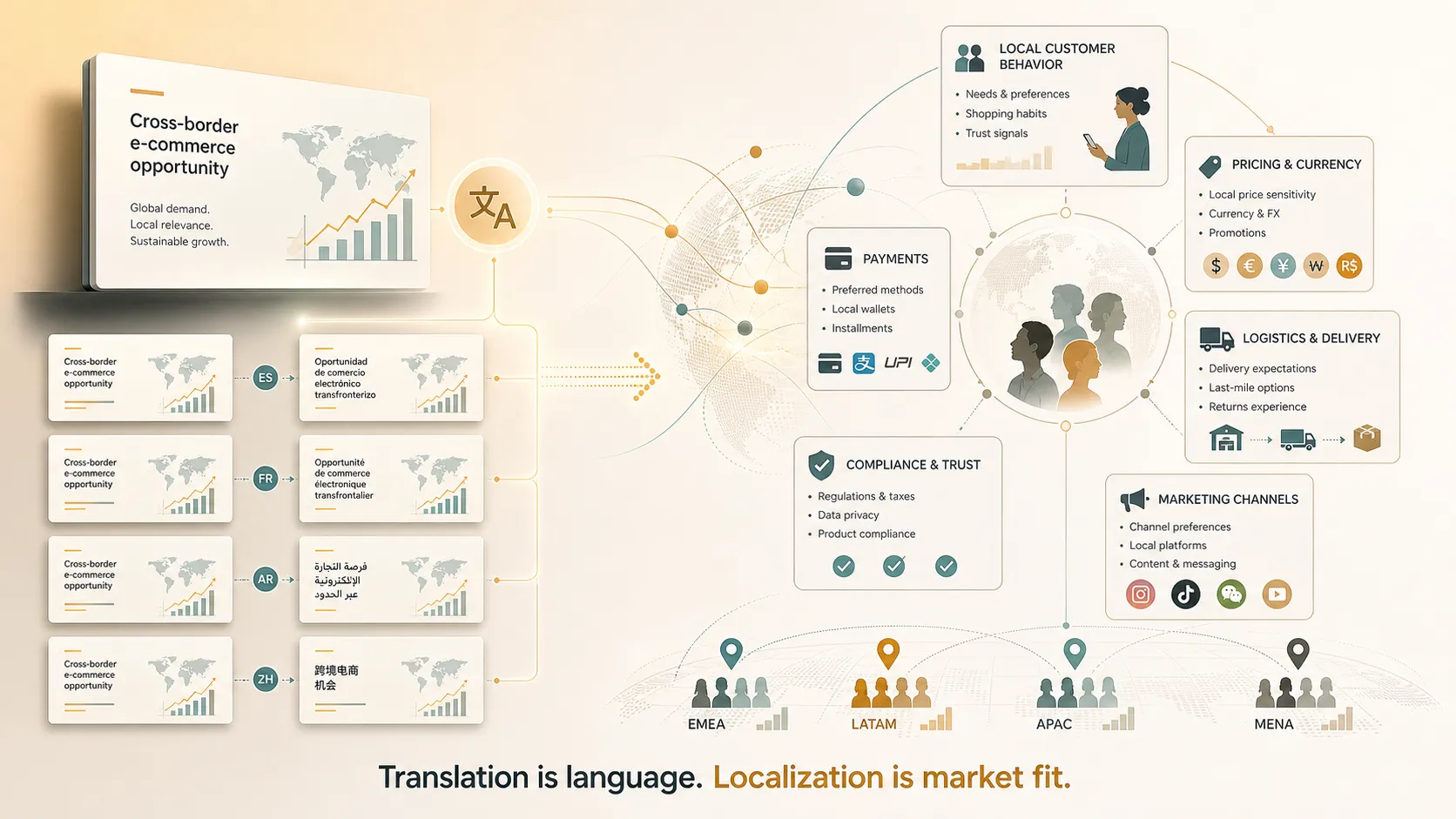
Translation changes the language. Localization changes whether the business case feels credible.
A phrase that works in one market may sound vague in another. A pricing slide that looks strong in your home currency may fail if it ignores taxes, duties, shipping costs, marketplace fees, or payment habits. A customer profile built for one country may not match local trust signals, delivery expectations, or return behavior.
Nielsen Norman Group’s guide to international usability testing is useful because cross-border ecommerce is not only about language. It is also about whether local customers understand, trust, and complete the buying journey.
A strong multi-language slide template should preserve the core strategy while leaving room for local evidence, regional examples, and market-specific risks.
What the Pitch Needs to Prove
A strong international business proposal should answer one question: why should this market, retailer, distributor, investor, or marketplace believe that your expansion plan can work?
It should prove six things:
- The market opportunity is specific.
- The product has a reason to win locally.
- The value proposition for retailers is clear.
- The team understands localization.
- Logistics, payments, returns, and compliance are realistic.
- The partnership creates value for both sides.
Harvard Business Review’s Distance Still Matters is a useful reminder that international expansion is affected by more than geography. Cultural, administrative, economic, and logistical distance can all change the business case.
Cross-Border Ecommerce Presentation Structure
Use this structure as the foundation for a global expansion pitch deck. Keep each section short enough to translate clearly, but specific enough to show real market understanding.
| Slide section | What it should explain |
|---|---|
| Executive summary | Target market, business goal, and decision needed |
| Market opportunity | Demand, category growth, timing, and local trends |
| Customer profile | Local buyer needs, trust barriers, and purchase triggers |
| Retailer value proposition | Why retailers or partners should care |
| Localization plan | Language, content, UX, support, pricing, and positioning |
| Go-to-market plan | Channels, partners, campaigns, and launch model |
| Operations and risk | Logistics, payments, returns, compliance, and assumptions |
| Financial outlook | Revenue, margin pressure, fees, and scenarios |
| Partnership ask | What you need, what you offer, and next steps |
This structure separates the idea from the proof. A partner does not only need to know that the market is attractive. They need to know why your team is prepared to enter it.
For research, the International Trade Administration’s eCommerce export resources can help teams think through online selling, digital channels, shipping, payments, and export readiness. Its Country Commercial Guides are also useful when you need market-specific business background.
How to Write a Global Expansion Elevator Pitch
A global expansion elevator pitch should be practical, not vague. It should quickly explain the market, the customer need, the retailer value proposition, the proof behind the plan, and the specific ask.
Use this simple flow:
- Name the target market.
- Explain the local customer need.
- State why your product fits.
- Show why retailers or partners benefit.
- Add one proof point.
- End with a clear ask.
Example:
“We are expanding into a market where demand for this category is growing, but customers still face limited selection, inconsistent delivery, or weak local support. Our product gives retailers a differentiated offer with clear positioning, localized content, and operational support. We are looking for a launch partner to test demand, validate the channel, and scale through a controlled pilot.”
This kind of elevator pitch works because it does not only describe ambition. It explains why the expansion makes sense for the partner.
Building Value Propositions for Retailers
Retailers do not only want to hear that a brand is global, innovative, or high quality. They want to know what the offer does for their business.
A strong value proposition for retailers should explain how the expansion helps them:
- reach a new customer segment;
- improve category depth;
- add a differentiated product;
- reduce launch risk;
- support local marketing;
- improve margin or basket size.
Weak pitch:
“We are a fast-growing global brand.”
Stronger pitch:
“We help retailers serve a growing customer segment with a localized product offer, clear category positioning, and launch support that reduces market-entry risk.”
The first version talks about the company. The second explains partner value.
What to Localize Before You Present
A multi-language slide template should not only translate words. It should help each market version adapt the right business details.
Before presenting, review:
- Pricing: currency, taxes, duties, shipping, marketplace fees.
- Payments: preferred methods, fraud risk, checkout expectations.
- Logistics: delivery time, warehouse model, reverse logistics.
- Trust: reviews, guarantees, return policy, local support.
- Compliance: privacy, labeling, import rules, product requirements.
- Marketing: channels, creators, promotions, search behavior.
For logistics planning, the World Bank’s Logistics Performance Index can support market comparisons. WTO’s trade facilitation overview can help frame customs and border processes.
If your expansion involves Europe, the European Commission’s VAT e-commerce guidance is useful for tax-related ecommerce rules. If your plan involves importing into the United States, U.S. Customs and Border Protection’s importer and exporter tips can help teams check basic compliance questions.
Common Mistakes in Multi-Language Pitch Decks
Many cross-border pitch decks fail because they look translated rather than localized. The slides may be polished in one language, but crowded or unclear in another. The data may look impressive, but not specific enough to the target market.
Common mistakes include:
- using domestic customer assumptions;
- ignoring local payment habits;
- overlooking taxes, duties, and fees;
- skipping return expectations;
- using unclear market sources;
- making the partnership ask too vague.
Another common problem is inconsistent terminology. If one version says “cross-border ecommerce,” another says “international online retail,” and another uses a different internal phrase, the deck can feel less coordinated.
A good multi-language slide template keeps the strategic language consistent while allowing examples and proof points to change by market.
How Pi Helps Build a Global Expansion Pitch
Pi presentation maker can help turn a cross-border ecommerce expansion plan into a structured, business-ready deck. This is useful when your team has market notes, pricing assumptions, logistics details, and regional ideas, but not yet a clear presentation flow.
For a global expansion pitch deck, Pi helps organize the story around the questions stakeholders care about most:
- Why this market?
- Why now?
- Why this product?
- Why this partner?
- What should happen next?
Pi can also help teams create a stronger multi-language slide template. Instead of rebuilding every version from scratch, you can keep the strategic structure consistent while adapting local examples, proof points, customer language, and regional emphasis.
That consistency matters. International stakeholders often judge the deck as a signal of readiness. A clear, localized, professional presentation makes the expansion plan easier to trust.
The Verdict
A cross-border ecommerce presentation is not just a pitch for growth. It is a test of whether the business understands the complexity behind international expansion.
The best global expansion pitch deck combines market evidence, localization thinking, value propositions for retailers, operational realism, financial discipline, and clear design. A multi-language slide template helps teams repeat that structure across regions without losing the core message.
For global ecommerce teams, Pi is a strong fit when the goal is to move from raw expansion ideas to a polished international business proposal. It helps preserve the logic of the pitch while making the deck easier to adapt, translate, and present.
Frequently Asked Questions (FAQ)
Q: What should be included in a cross-border ecommerce presentation?
A: A cross-border ecommerce presentation should include the expansion thesis, market opportunity, customer profile, product fit, localization plan, channel strategy, logistics model, payment approach, compliance considerations, financial projections, partnership ask, and next steps.
Q: How is a global expansion pitch deck different from a standard business proposal?
A: A global expansion pitch deck must address regional market behavior, localization, logistics, payments, compliance, and partner expectations. A standard business proposal may explain the business model, but an international proposal must prove that the model can work in a specific market.
Q: Why do multi-language slide templates matter?
A: Multi-language slide templates help teams keep strategy, terminology, and design consistent across markets. They also make it easier to adapt the deck for local audiences without rebuilding every slide or relying on direct translation alone.
Q: Can Pi help translate an international business proposal?
A: Yes. Pi can support multilingual presentation workflows by helping teams structure, refine, and adapt business-ready decks for different languages and regions while maintaining professional visual quality and strategic consistency.