Deconstruct the $100M AI Pitch: 7 Proven Deck Layouts for Founders
The strongest AI pitch decks do not win because they sound futuristic. They win because they make a complex company feel clear, investable, and commercially urgent. Investors may be interested in AI agents, automation, and new software categories, but they still need a simple answer: why this company, why now, and why it can become large.
The phrase $100M pitch deck is a clarity benchmark, not a funding promise. It represents the standard ambitious AI startups must meet: a sharp problem, an understandable system, a credible market, and evidence that is easy to scan.
For many founders, the bottleneck is not vision. It is presentation architecture. Teams spend fundraising season fixing diagrams, rewriting dense slides, and adjusting formatting when they should be sharpening narrative logic, traction evidence, and investor strategy. Strong AI pitch deck templates reduce that friction by giving every slide a clear job.
Why AI Pitch Decks Are Harder Than Standard Startup Decks
A traditional software deck can follow a familiar structure: problem, product, traction, market, business model, competition, and team. AI startup funding conversations require teams to cover the same ground while also proving that their model, data, workflow, or technical approach creates a durable advantage.
The difficulty is not technical depth itself. The real challenge is investor skepticism. Words like “agentic,” “autonomous,” and “AI-native” only matter when tied to customer value: faster execution, lower cost, higher retention, improved throughput, or a workflow that was previously impossible to automate.
AI founders usually need to solve three communication problems:
- Simplify complex systems without making them vague.
- Show emerging markets with credible bottom-up logic.
- Prove defensibility through evidence, not buzzwords.
This is where premium presentation templates help. They do not replace strategy, but they package it into a structure investors can understand quickly.
The Investor Question Behind Every Slide
Every slide in a strong deck should answer one investor question. The executive summary answers, “Why should I care now?” The architecture slide answers, “How does this work?” The traction slide answers, “Is the market responding?” The moat slide answers, “Why will this company win?”
This framing matters because technical novelty can distract from commercial proof. A strong executive slide framework makes the point visible before the explanation begins. Claim-led headers, structured evidence, and clear visual hierarchy help investors understand the argument before they study the details.
7 Proven AI Pitch Deck Layouts to Deconstruct
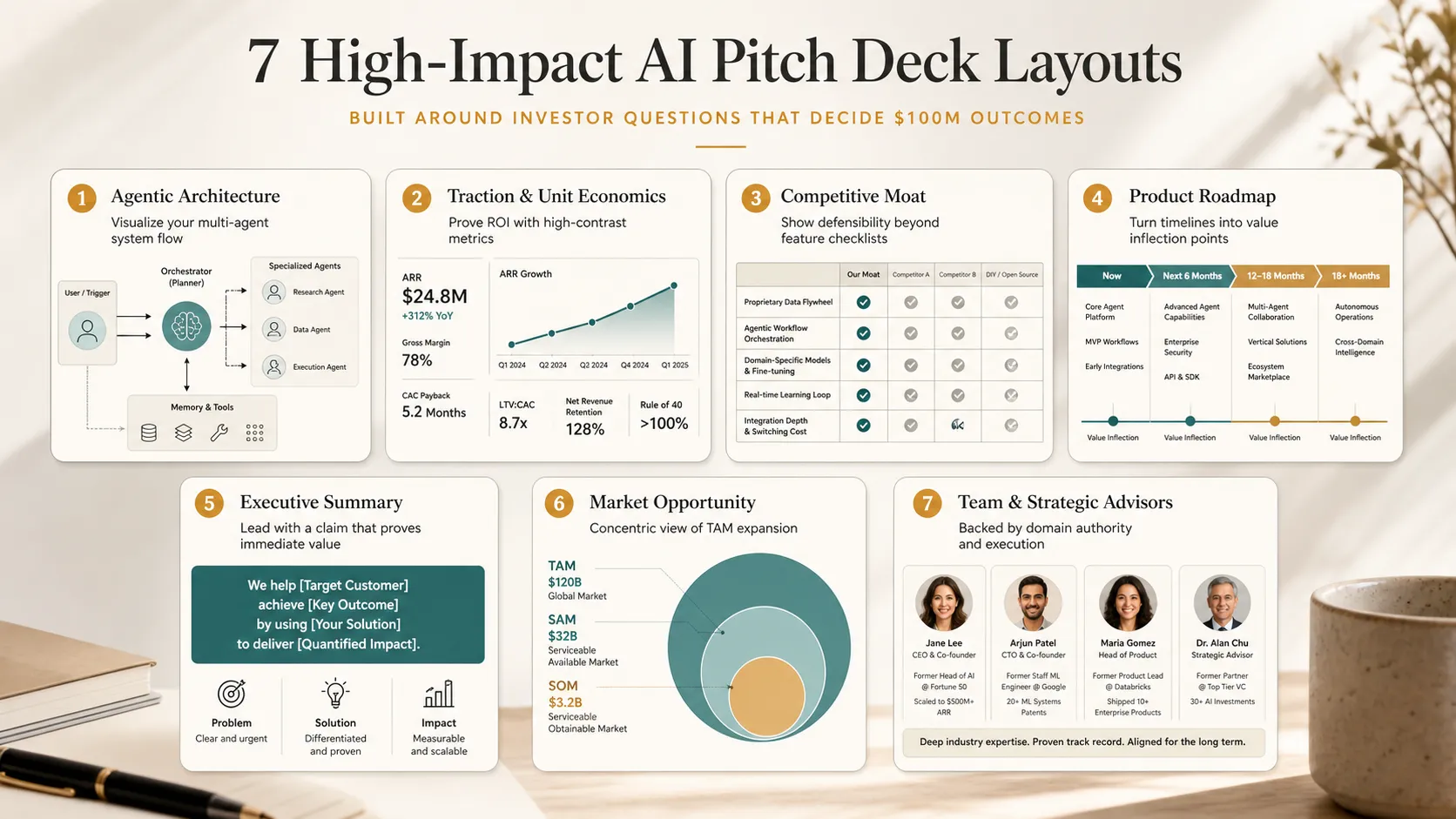
1. The Agentic Architecture Slide
This slide is built for companies creating multi-agent systems, copilots, automation layers, or workflow orchestration. Instead of showing every technical component, it should show the value flow: input, reasoning layer, agent actions, integrations, and measurable business output.
The goal is to help investors see why the product is more than a chatbot and how the system creates leverage inside a real workflow.
2. The Traction and Unit Economics Blueprint
AI traction is not always revenue alone, especially at the early stage. A strong traction slide can combine usage growth, retention, customer ROI, payback logic, margin direction, and cost reduction.
This layout should make the ROI path obvious. If customers save time, increase throughput, reduce operational pressure, or expand usage, the evidence should be unmistakable.
3. The Competitive Moat Matrix
Basic checkmark tables often make every company look similar. AI founders need a sharper pitch deck layout that explains defensibility across layers such as proprietary data, workflow integration, model performance, distribution, switching costs, and domain expertise.
The purpose is not to dismiss competitors. It is to show why the company’s advantage compounds as customers, data, integrations, and product depth increase.
4. The Product Roadmap and Future Horizon Slide
AI roadmaps can become chaotic because model capabilities, customer expectations, and infrastructure costs change quickly. Investors do not need a feature dump. They need value inflection points.
This slide should connect roadmap stages to outcomes: enterprise readiness, new market entry, deeper automation, stronger retention, or margin improvement. A good roadmap makes the funding ask feel tied to execution milestones.
5. The Executive Summary and Problem-Solution Fit Slide
The opening slide should not behave like a company brochure. It should establish the investment logic in one clear claim. The best executive summary slides combine a sharp problem, concise solution, and immediate proof that the company is operating in a meaningful market.
For AI founders, this slide should avoid over-explaining technology too early. Investors first need to understand the pain, urgency, and business outcome.
6. The Market Opportunity and TAM Expansion Slide
AI markets often expand from a narrow beachhead into a broader workflow category. That makes TAM, SAM, and SOM harder to explain with only top-down numbers.
A better layout uses a concentric data hierarchy. It starts with the current buyer and use case, then expands to adjacent teams, workflows, and categories. This bottom-up logic is often more credible because it shows how the company earns the right to grow.
7. The Team and Strategic Advisors Slide
The team slide should prove founder-market fit. For AI companies, that may include technical depth, domain expertise, prior product experience, enterprise credibility, or access to strategic customers.
The strongest version connects each key person to a fundraising question: Can this team build the technology, sell into the market, recruit talent, and navigate the category as it changes?
Why Manual Slide Tools Slow Down AI Fundraising Teams
Traditional PPT tools and design platforms are flexible and familiar. They work well when the team already has a finished narrative, clear structure, and enough time to refine every page.
The challenge begins when AI founders are still shaping the argument while trying to create investor-grade visuals. Architecture diagrams break. Metric layouts lose emphasis. Technical text crowds out the main claim. Visual hierarchy becomes inconsistent across the deck.
None of these issues means the company is weak. But in a high-stakes fundraising process, they can make the story feel less mature than it is. Investors should spend their attention evaluating the business, not interpreting the slide.
How Pi Turns Pitch Deck Logic into Premium Investor Slides
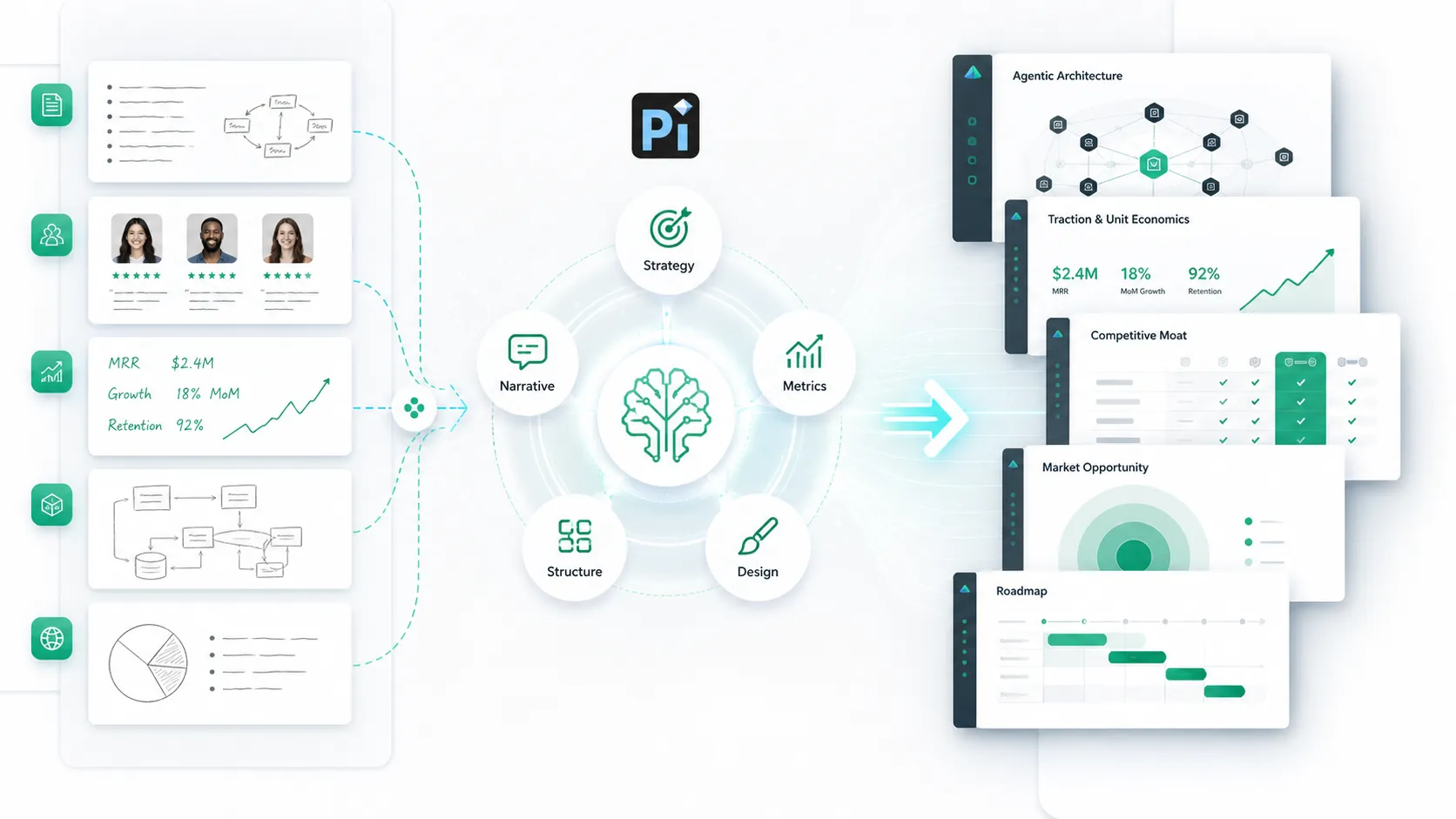
Pi, short for Presentation Intelligence, is an AI presentation maker and AI PPT generator built for professional business presentations. For AI startup founders, Pi is most useful when the raw material already exists: technical notes, customer proof, market thinking, and fundraising logic. Pi helps turn that material into structured, premium slides.
Business Logic Comes Before Styling
Pi is designed to organize the argument before polishing the visual layer. A pitch deck is not a collection of attractive slides. It is a sequence of claims. Founders can start from a prompt, outline, or rough notes and shape the deck around investor logic: urgency, demand, product clarity, traction, market strength, and team credibility.
Multi-Agent AI Supports Complex Deck Workflows
AI pitch decks require several types of thinking at once: narrative framing, technical simplification, metric emphasis, slide hierarchy, and visual design. Pi’s Multi-Agent AI approach helps convert fragmented inputs into coherent presentation sections.
This is useful for technical founders who know the product deeply but need to present it for business review. Pi helps translate technical material into executive-ready structure without removing the substance that makes the company differentiated.
Premium Templates Reduce the Formatting Tax
Pi templates are built for business-grade aesthetics: clean hierarchy, polished layouts, and professional composition. This helps teams avoid spending hours aligning boxes, rebuilding charts, or forcing technical diagrams into generic layouts.
The founder remains responsible for the strategy, evidence, and fundraising story. Pi helps present that story with more speed, consistency, and clarity.
Pitch Deck Workflow Comparison
| Pitch Deck Task | Manual Slide Workflow | Pi Workflow |
|---|---|---|
| Deck structure | Built slide by slide | Generated from business logic |
| AI system visualization | Manual diagramming | Structured architecture layouts |
| Metrics presentation | Formatting-heavy | High-contrast investor layouts |
| Narrative consistency | Easy to drift | Claim-led slide sequence |
| Iteration speed | Slower under deadline | Faster prompt-based refinement |
| Visual polish | Depends on design time | Premium template foundation |
The Verdict: Design the Argument Before the Deck
A successful AI pitch deck does not make complex technology look more complicated. It makes the commercial opportunity easier to understand.
The best AI pitch deck templates help founders move from technical intensity to strategic clarity. Before opening any slide tool, define the investor questions your deck must answer: What is urgent? What is differentiated? What proof exists today? Why now? Why this team?
Once that logic is clear, Pi can help transform the argument into polished investor slides. Founders can apply these seven Pi templates directly or generate a custom AI pitch deck from a raw prompt, then refine the story around traction, defensibility, and market insight.
Frequently Asked Questions (FAQ)
Q: What are AI pitch deck templates?
A: AI pitch deck templates are structured slide layouts that help AI startups explain products, technical systems, markets, traction, and defensibility in an investor-ready format.
Q: What slides do investors expect in an AI startup funding deck?
A: Investors usually expect an executive summary, problem, solution, product, architecture, market opportunity, traction, business model, competition, roadmap, team, and funding ask.
Q: Do AI founders need special pitch deck layouts?
A: Often, yes. AI companies may need to visualize agent workflows, model layers, proprietary data, automation ROI, and market expansion in ways standard startup decks do not.
Q: How does Pi help create premium pitch decks?
A: Pi helps founders turn prompts, notes, and business logic into structured premium presentation templates with professional hierarchy, investor-ready layouts, and business-grade visual quality.