15 Best Elevator Pitch Examples & Templates to Use
You know what you do. Explaining it clearly when someone asks, “So, tell me about yourself?” can be harder.
A useful elevator pitch example gives you a starting point—not a speech to copy word for word. Choose the situation below, replace the details with your own, and practice aloud until the introduction sounds conversational.
These 15 illustrative examples cover startups, interviews, sales, and networking. Their companies, backgrounds, and supporting details are hypothetical; use only claims you can substantiate.
What Makes a Great Elevator Pitch?
An elevator pitch is a brief, audience-focused introduction that explains what you do, why it matters, and what conversation should happen next.
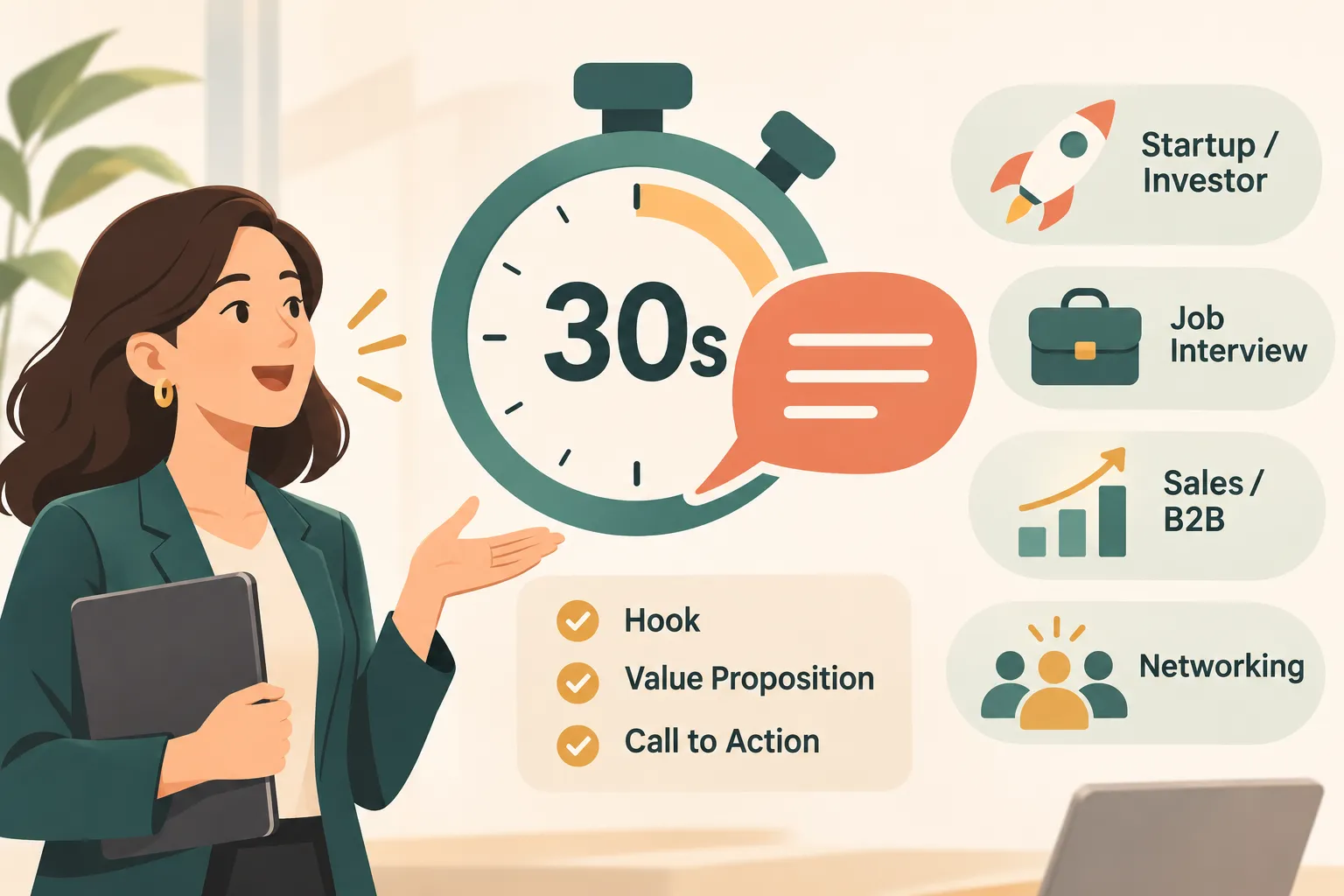
Roughly 30 seconds is a useful rehearsal target, not a strict rule. Aim to include an audience-relevant hook, a clear value proposition, one credible supporting detail, and a low-pressure call to action.
The hook need not be dramatic. Naming a familiar problem often works better than asking a provocative question. Likewise, supporting evidence can be a relevant project or customer observation—not necessarily a revenue figure.
Your goal is to earn interest, not explain everything.
Choose the Right Elevator Pitch Template
The right elevator pitch template depends on the listener. An investor evaluates a business opportunity; an interviewer evaluates your fit. A networking contact may simply want to discover shared interests.
| Situation | Listener Priority | Suitable Next Step |
|---|---|---|
| Startup or investor introduction | Customer need and business potential | Focused follow-up meeting |
| Job interview | Relevant skills and role fit | Discuss a relevant project |
| Sales or B2B conversation | Business problem and practical value | Discovery call or demonstration |
| Networking | Shared interests and mutual relevance | Exchange perspectives or stay connected |
Treat the examples as flexible wording. If the listener asks a question halfway through, follow the conversation rather than finishing your script.
Startup Elevator Pitch Examples
These startup elevator pitch examples show how your introduction can change with your stage, audience, and immediate objective.
1. Early-Stage Founder Introducing a Customer Problem
> “Independent bakeries often manage wholesale orders through scattered messages and spreadsheets. We’re building a simple ordering workspace that puts requests, production quantities, and delivery details together. We’re currently interviewing bakery owners to understand their busiest workflows. Do you know anyone who might be open to sharing how they handle wholesale orders?”
Adapt it: Replace [customer group], [daily problem], and [research request]. At this stage, describe what you are learning rather than implying established demand.
2. Founder With Initial Traction
> “We help small property managers keep maintenance requests from getting lost between tenants and contractors. Our pilot customers are using one shared workspace to assign jobs and track updates. We’re now studying which workflows they use most consistently. Would you be interested in seeing what we’ve learned from the pilot?”
Adapt it: Substitute [verified adoption evidence] for the pilot detail. Distinguish active usage from sign-ups, and avoid presenting early interest as proven product-market fit.
3. Technical Startup Explained Without Jargon
> “When a factory machine starts behaving unusually, the warning signs can be buried in equipment data. Our software helps maintenance teams spot those changes and decide what to investigate. We’re testing it with historical machine records before live deployment. I’d welcome an introduction to someone who manages plant maintenance.”
Adapt it: Replace [technical mechanism] with its practical purpose. Keep the development stage explicit so listeners understand what works today versus what remains under testing.
4. Investor Introduction With a Meeting Request
> “We’re building scheduling software for home-care agencies whose coordinators still spend hours resolving changes manually. Our founding team combines care operations and software experience, and we’ve developed a working prototype. We’re raising capital to run paid pilots and refine the product. Would a short meeting next week fit your investment focus?”
Adapt it: Personalize [market], [team credibility], [funding purpose], and [meeting request]. Save detailed financial assumptions and fundraising terms for the follow-up.
Job Interview Elevator Pitch Examples
In an interview, connect your background to the employer’s needs. Avoid reciting your entire résumé or ending with a sales-style meeting request.
5. Recent Graduate
> “I recently graduated in economics, and I’m interested in turning messy information into clear recommendations. For my final project, I analyzed local transport data and presented findings to a student research panel. Your analyst role appeals to me because it combines research with practical decisions. I’d be happy to explain my approach.”
Adapt it: Replace [coursework or project] and [role requirement]. Academic work is useful evidence when you explain your contribution rather than simply naming the course.
6. Experienced Specialist
> “I’m a customer success specialist focused on helping B2B clients move from onboarding to regular product use. In my current role, I coordinate implementation plans and work with product teams on recurring customer issues. This position interests me because you’re developing a more consistent onboarding experience across a growing customer base.”
Adapt it: Substitute [specialty], [relevant responsibilities], and [employer priority]. Add a verified outcome if it strengthens the connection, not just because a pitch supposedly needs numbers.
7. Career Changer
> “My background is in hospitality operations, where I coordinated schedules, resolved customer problems, and kept teams aligned during busy shifts. I’m moving into project coordination because those planning and communication skills are what I enjoy most. I’ve also completed a project management course and would welcome the chance to discuss how those skills transfer.”
Adapt it: Connect [previous experience] to [new role requirements]. Explain the transition positively instead of apologizing for an unconventional career path.

8. Leadership Candidate
> “I lead marketing teams through periods of changing priorities. My experience includes coordinating product launches, setting campaign goals, and helping specialists work toward shared commercial objectives. Your team’s expansion interests me because it calls for both clearer operating processes and room for creative work. I’d welcome a discussion about that balance.”
Adapt it: Replace [leadership context] with a challenge relevant to the employer. Be ready to support broad leadership claims with a specific decision or example.
Sales and B2B Elevator Pitch Examples
A strong sales introduction starts with a recognizable buyer problem. It earns permission to explore the fit rather than assuming the prospect needs your solution.
9. Software Solution
> “When account updates live across spreadsheets and inboxes, sales managers struggle to see which deals need attention. Our software brings those updates into a shared pipeline view. We focus on teams moving beyond manual tracking. Would it be useful to compare your current reporting process with a short product walkthrough?”
Adapt it: Replace [buyer problem] and [core capability]. Mention one relevant use case instead of listing every feature.
10. Professional Service
> “I help professional services firms explain complex offerings in language their buyers understand. My work usually starts with customer interviews, then turns those insights into website messaging and sales materials. If your team is revisiting how you describe your services, I’d be happy to discuss where prospects tend to get confused.”
Adapt it: Specify [client type], [deliverable], and [discovery question]. Describe the work clearly without promising sales results that depend on factors outside your control.
11. Operational Improvement Offering
> “We work with distributors whose order handoffs involve repeated manual checks. We map the process with the people doing the work, identify avoidable duplication, and recommend changes they can evaluate before a wider rollout. If handoff delays are on your agenda, would a brief process review be worth exploring?”
Adapt it: Replace [operational bottleneck] with a problem the buyer recognizes. Promise a defined assessment or deliverable, not an unsupported efficiency gain.
12. Consultative Prospect Introduction
> “You mentioned that your team is expanding into new regions. I work with B2B companies on adapting sales materials for different buying groups while keeping the core message consistent. Before suggesting anything, I’d be interested to understand where your current materials fall short. Is that something your team is reviewing?”
Adapt it: Start with [something the prospect actually said]. A relevant observation makes this introduction more credible than a generic claim about understanding their business.
Networking Elevator Pitch Examples
Networking works best as an exchange. Give the other person something specific to respond to, then leave room for their perspective.
13. Conference Introduction
> “I work in product research, mostly helping software teams understand why customers abandon onboarding. I’m here to learn how other teams connect interviews with product decisions. The session on customer feedback caught my attention because that handoff is a recurring challenge in my work. What brought you to the conference?”
Adapt it: Replace [specialty] and [shared event reference]. The closing question opens a genuine conversation instead of turning the encounter into a prospecting exercise.
14. Internal Cross-Functional Introduction
> “I’ve just joined the finance team, where I’ll be working on planning and departmental reporting. My previous work involved helping non-finance colleagues understand the assumptions behind their budgets. I’m learning how your team makes resource decisions, and I’d appreciate hearing which financial information would make your planning easier this quarter.”
Adapt it: Clarify [your remit] and ask about [the other team’s needs]. Internal credibility grows when colleagues understand how you can help them.
15. Freelancer Meeting a Referral Partner
> “I’m a freelance presentation designer working with consultants who need to explain complex recommendations to clients. I turn their draft content into clear slide narratives and readable visuals. Your work in brand strategy sounds complementary. Would you be open to comparing the kinds of projects where our clients might need both services?”
Adapt it: Replace [specialty], [ideal client], and [complementary service]. Explore mutual fit before asking someone to make referrals.
How to Write an Elevator Pitch from These Templates
Learning how to write an elevator pitch starts with choosing what to leave out. Use this four-step process:
1. Identify the listener’s priority. What would make this introduction relevant to them right now? 2. Choose one value proposition. Explain one useful contribution, not every capability you offer. 3. Add truthful support. Use a project, experience, observation, or verified result. 4. Select a natural next step. Ask a question, offer an example, or suggest a focused meeting.
Use this master template as a drafting aid:
> “I’m [name or role], and I help [audience] address [specific problem] through [approach]. My relevant experience includes [truthful supporting detail]. I’d welcome [appropriate next step].”
Then remove anything that sounds stiff. Time the spoken version, allow pauses, and check whether someone unfamiliar with your work understands it. Prepare a shorter version for quick introductions rather than speaking faster.

When Your Elevator Pitch Needs a Supporting Deck
A promising startup or sales conversation may lead to a request for more detail. That is when visual storytelling and a clear slide presentation structure become useful—not during every introduction.
Carry the spoken narrative into four presentation elements: the problem, your solution’s value, credible evidence, and the ask. Use slide titles that state the main point, with visuals that clarify rather than decorate it.
Pi, short for Presentation Intelligence, is an AI presentation maker whose Multi-Agent AI supports business-ready structure and premium visual quality. It can help develop that concise narrative into a professional pitch deck or sales deck.
You still need to research the audience, verify claims, and rehearse. A polished deck supports the conversation; it does not replace a clear explanation.
Choose One Example and Make It Your Own
Start with the example closest to your next conversation. Replace generic claims with specific details, read it aloud, and remove anything you would not naturally say.
Then test it with someone unfamiliar with your work. If they understand your value and ask a relevant follow-up question, your pitch is doing its job.
Frequently Asked Questions (FAQ)
How long should an elevator pitch be?
Around 30 seconds is a useful starting point, often roughly 60–75 words depending on your pace. A quick introduction may be shorter. Follow the listener’s interest rather than treating the timing as a fixed requirement.
What is a short elevator pitch example?
“I’m a presentation designer who helps consulting teams turn complex recommendations into clear client decks. I focus on narrative structure and readable visuals. What kinds of presentations does your team create?” This short elevator pitch establishes a specialty and invites a response.
What should I say if I have no professional experience?
Use relevant coursework, volunteering, personal projects, or community responsibilities. Explain what you contributed, what you learned, and how that relates to the opportunity. Do not inflate informal experience into credentials you do not have.
How is an elevator pitch different from a pitch deck?
An elevator pitch is a brief spoken introduction intended to open a conversation. A pitch deck is a visual presentation that develops the opportunity with evidence and detail. They can share a narrative, but they serve different stages of the discussion.