Evaluating AI Presentation Tools for Executive Decks
Corporate presentations are changing. A few years ago, the primary focus was speed: turning ideas into slides quickly. Today, executive audiences expect more. A leadership deck must clarify trade-offs, reveal business logic, connect evidence to decisions, and make action obvious.
That shift redefines how teams approach AI presentation tools evaluation. A generator producing attractive layouts is helpful, but executive decks are decision-making instruments. The best executive presentation software must help teams move from raw information to structured recommendations without losing strategic context.
This is critical for board updates, strategy reviews, investment memos, and client briefings where beautiful slides are necessary but insufficient. The key is whether the platform supports the underlying strategy.
Enterprise Bottlenecks with Standard AI Presentation Tools
Standard AI slide generators excel at fast drafts. Tools like Gamma AI, Canva, Copilot, PowerPoint, and Google Slides reduce blank-page friction and accelerate formatting for quick internal updates.
However, bottlenecks emerge in high-stakes reporting. Standard tools often optimize for visual output before understanding the business problem, leaving key questions unanswered: What changed? Why does it matter? What decision is required?
Enterprise boundaries include:
- Generic AI text lacking company-specific goals and KPI context.
- Shallow logic creating persuasive storylines without analytical rigor.
- Weak narrative structure listing points rather than building arguments.
- Governance limits on sensitive corporate data.
- Manual rework required to rebuild deck hierarchy and messaging.

Executive reporting requires a deeper layer: business context, structured reasoning, and presentation-ready synthesis.
Key Criteria for Evaluating Enterprise Slide Platforms
Evaluating platforms for leadership decision-making requires specific criteria.
First, evaluate narrative structure. Strong decks follow a logical arc: situation, insight, implication, options, and recommendation. The platform should organize arguments, not just distribute text.
Second, assess business reasoning. Good executive presentation software preserves research context, helps teams distinguish signal from noise, and translates inputs into decision-ready messaging.
Third, examine workflow integration. Enterprise teams build decks iteratively using documents, spreadsheets, and past decks. Useful platforms support editing and cross-role collaboration.
Fourth, consider visual polish. Structure, spacing, and chart clarity build reader confidence. Design must reinforce the argument rather than decorate it.
Finally, review editability and governance readiness. Teams need to modify claims, maintain brand standards, and manage sensitive data responsibly.
Category Analysis: Comparing Modern Executive Presentation Software
Modern presentation software fits distinct categories. This comparison table helps teams conducting an AI presentation tools evaluation understand fit by workflow and strengths.
| Category | Example Tools | Primary Strength | Best-Fit Use Cases | Limitation for Executive Decks |
|---|---|---|---|---|
| Design-First Platforms | Gamma AI, Canva | Fast visual output and accessible design | Quick drafts and simple pitch decks | Requires manual effort to refine strategic narrative |
| Ecosystem Natives | Copilot, PowerPoint, Google Slides | Familiar workflows and file compatibility | Team collaboration and document drafting | Quality depends heavily on user prompts and manual editing |
| Logic-Driven Presentation Intelligence | Pi | Business logic, structured narrative, Multi-Agent AI | Executive decks, consulting reports, strategic briefs | Designed for deep workflows rather than instant visual drafts |
Design-first tools prioritize speed, ecosystem tools offer compatibility, and logic-driven platforms turn complex inputs into executive-ready communication.
The Strategic Role of Presentation Intelligence (Pi)
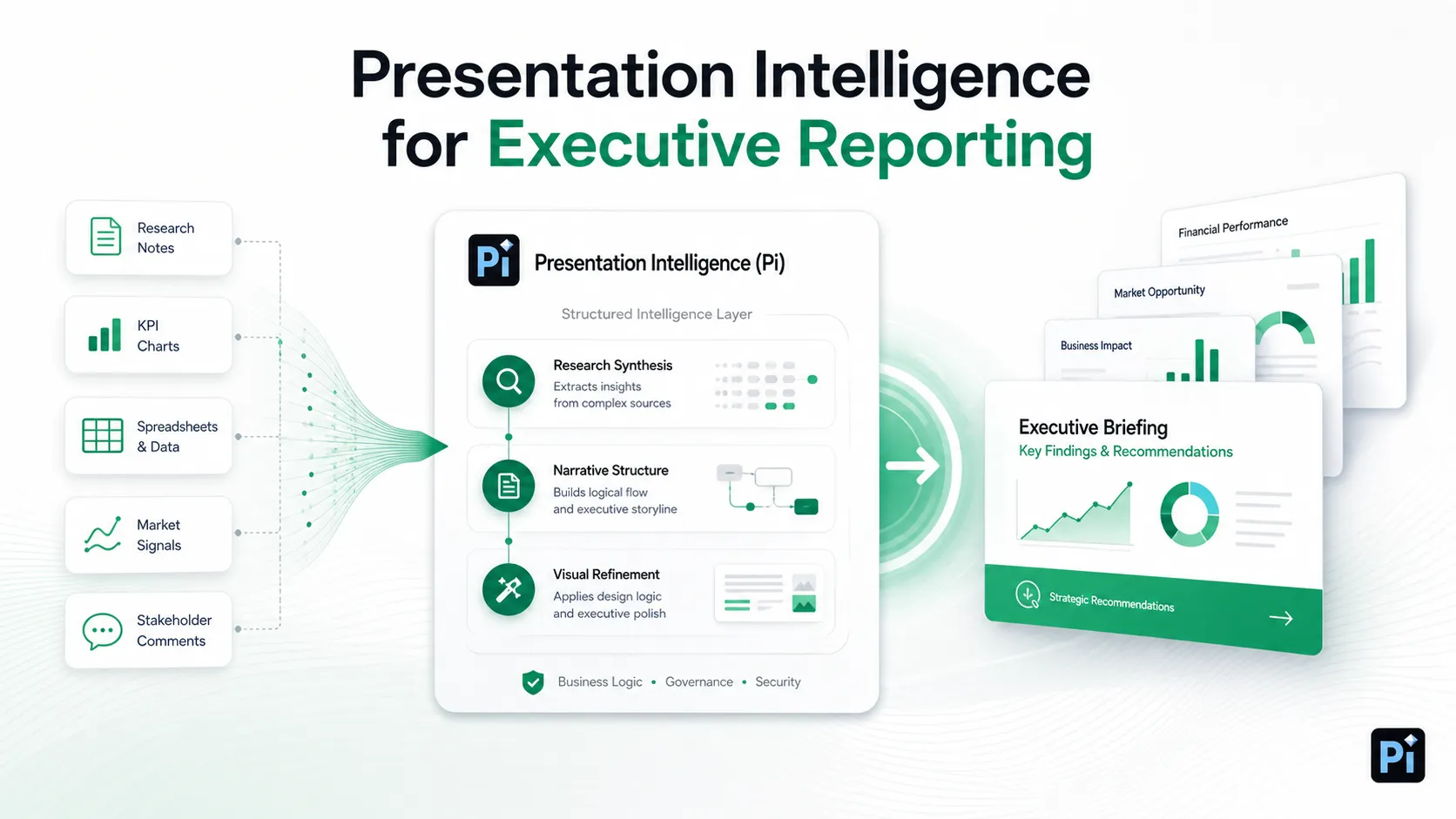
Pi (Presentation Intelligence) addresses high-stakes business communication by transforming research, analysis, and priorities into strategic decks rather than just automating slide design.
Pi integrates smoothly when teams have notes, research, sales insights, or financial context, helping shape arguments and produce review-ready slides.
1. Business Logic Before Slide Styling
Executive decks fail when logic is unclear. Unsupported recommendations or poor sequencing cannot be solved by fonts or colors. Pi prioritizes business-ready structure, helping teams sequence narratives and connect points to goals. Executives need concise, well-organized details to decide confidently.
2. Multi-Agent AI Supports Deeper Workflows
Single-step AI generators fail complex projects. Professional decks require research synthesis, storyline development, and visual hierarchy. Pi’s Multi-Agent AI approach divides creation into specialized steps—interpreting sources, shaping narratives, and refining visuals—enhancing human judgment for consulting-grade output.
3. Premium Output Ensures Credibility
Clarity is visual and verbal. Spacing, hierarchy, and chart treatment dictate how messages are received. Pi combines structured reasoning with polished visuals, ensuring decks shared with board members or investors convey complete confidence.
The Verdict
Selecting the right tool depends on the goal. Design-first tools like Gamma AI and Canva suit quick visual drafts. Ecosystem tools like Copilot, PowerPoint, and Google Slides provide familiar editing and workflow integration.
For high-stakes reporting, evaluation must prioritize strategic logic, business context, and polished output. Pi fills this role as a Presentation Intelligence platform, converting research into decision-ready communication. When decks must align leadership, visual speed is not enough; teams need clear thinking and structured narrative.
Frequently Asked Questions (FAQ)
What is the best executive presentation software for business decks?
The best tool depends on your goal. For quick visuals, design-first tools work well. For compatibility, PowerPoint or Copilot are practical. For decks requiring business logic and structured narrative, Pi is built for deeper executive workflows.
Are Gamma AI or Canva enough for business reporting?
They work for lightweight summaries and quick drafts. However, when reports must guide executive trade-offs or complex recommendations, teams require stronger narrative control and reasoning.
How is Pi different from standard pitch deck generators?
Standard generators focus on quick slides from simple prompts. Pi focuses on Presentation Intelligence, transforming raw research and strategic intent into structured decks using Multi-Agent AI.
What criteria matter most when conducting an AI presentation tools evaluation?
The top criteria for an AI presentation tools evaluation are narrative structure, business reasoning, workflow integration, editability, governance, and visual polish.