explain why it is important to create measurable goals.
To explain why it is important to create measurable goals, start with this: measurable goals turn a general intention into something you can track, evaluate, and improve. Without measurement, a goal can sound inspiring but still remain vague. With measurement, you can see whether progress is actually happening.
For example, “improve presentation skills” is a good intention, but it is not easy to judge. “Deliver three practice presentations this month and reduce filler words by 30%” is a measurable goal. It gives you a clear target, a time frame, and a way to know whether your effort worked.
That is why measurable goals matter in school, business, personal development, and team projects. They make success easier to define, progress easier to discuss, and decisions easier to adjust.

What Are Measurable Goals?
Measurable goals are goals that include clear criteria for success. They answer questions such as:
- What exactly needs to happen?
- How much progress is expected?
- How will success be tracked?
- When should the result be reviewed?
This idea is closely related to the SMART goals framework ↗, which defines strong goals as specific, measurable, achievable, relevant, and time-bound. The “measurable” part is especially important because it turns effort into evidence.
A vague goal may create motivation at the beginning, but a measurable goal creates direction after the first step.
Why It Is Important to Create Measurable Goals
It is important to create measurable goals because they make progress visible. When a goal includes numbers, deadlines, milestones, or observable outcomes, people can tell whether they are moving closer to the result.
This matters for several reasons:
- Measurable goals improve focus because they show which result matters most.
- Measurable goals create accountability because teams can discuss facts instead of opinions.
- Measurable goals support better decisions because slow progress can be corrected early.
- Measurable goals make achievement easier to recognize because success is clearly defined.
The CDC guidance on learning objectives ↗ also emphasizes that strong objectives should describe observable and measurable behaviors. That same principle applies beyond training: a goal becomes more useful when people can clearly see what success looks like.
Measurable Goals vs. Vague Goals
The difference between a vague goal and a measurable goal is not just wording. It changes how people act.
| Vague goal | Measurable goal | Why it works better |
|---|---|---|
| Improve sales | Increase monthly sales by 12% by the end of Q2 | Defines the target, amount, and deadline |
| Study more | Study biology for 45 minutes, 5 days a week | Turns intention into a repeatable action |
| Make better slides | Reduce each slide to one main idea and no more than 5 bullet points | Makes quality easier to check |
| Grow social media | Gain 500 new LinkedIn followers in 60 days | Creates a clear tracking metric |
| Be healthier | Walk 8,000 steps per day for 30 days | Makes daily progress visible |
A measurable goal does not need to be complicated. It only needs to make the result clear enough that you can track it.
How Measurable Goals Improve Motivation
Measurable goals can improve motivation because they create small signs of progress. When people see that their work is moving toward a target, they are more likely to continue.
This is why milestones matter. A large goal can feel distant, but measurable checkpoints make it easier to stay engaged.
For example:
- A student can track completed assignments each week.
- A sales team can review qualified leads every Friday.
- A manager can measure onboarding completion after 30 days.
- A presenter can count rehearsal sessions before a final speech.
Harvard Business Review’s article on the power of small wins ↗ explains how visible progress can support motivation at work. Measurable goals create those visible signs.
How Measurable Goals Help Teams Communicate
Teams often struggle when goals sound clear in conversation but mean different things to different people.
For example, “improve customer experience” could mean faster replies, higher satisfaction scores, fewer support tickets, or better onboarding. Without measurement, each person may work toward a different version of the same goal.
A measurable goal fixes that problem.
Instead of saying:
“Improve customer experience.”
A team could say:
“Raise customer satisfaction from 82% to 88% by the end of Q3 by reducing first-response time and improving onboarding emails.”
Now the team knows:
1. The current baseline.
2. The desired result.
3. The time frame.
4. The actions that support the goal.
This makes meetings more practical and reduces confusion.
How to Create Measurable Goals
To create measurable goals, start with the result you want and then add evidence.
A simple formula is:
Verb + target + metric + deadline + method
Example:
“Increase demo bookings from 40 to 60 per month by the end of Q2 through website optimization and weekly outbound campaigns.”
You can also use these steps:
1. Start with the main outcome.
2. Choose one metric that proves progress.
3. Add a realistic deadline.
4. Define the actions that will support the result.
5. Review progress regularly.
The University of Wisconsin-Madison’s guide to writing SMART goals ↗ gives a practical way to turn broad intentions into specific, realistic steps.
Examples of Measurable Goals
Here are a few examples across different situations.
For business:
- Increase website trial sign-ups by 20% in 90 days.
- Reduce customer support response time from 12 hours to 6 hours by the end of the quarter.
- Publish 8 SEO articles this month and track ranking movement after 30 days.
For school:
- Complete 3 research sources and one outline by Friday.
- Improve quiz scores from 75% to 85% by the next exam.
- Practice a presentation 4 times before the final delivery.
For personal development:
- Read 20 pages per day for 30 days.
- Save $300 each month for the next 6 months.
- Exercise 4 times per week for the next 8 weeks.
For presentation work:
- Finish the slide outline by Tuesday.
- Reduce a 30-slide draft to 15 slides before the client review.
- Rehearse the presentation twice and keep delivery under 10 minutes.
Common Mistakes When Setting Measurable Goals
Measurable goals are useful, but they can become frustrating if they are written badly.
Common mistakes include:
- Choosing too many metrics at once.
- Setting a number without a deadline.
- Tracking activity but ignoring results.
- Creating goals that are unrealistic.
- Measuring what is easy instead of what matters.
For example, “write 20 pages” is measurable, but it may not be the right goal if the real outcome is a clear business proposal. In that case, a better goal might be: “Create a 10-slide proposal deck that explains the problem, solution, timeline, budget, and next steps by Friday.”
The point is not to add numbers everywhere. The point is to measure the result that actually matters.
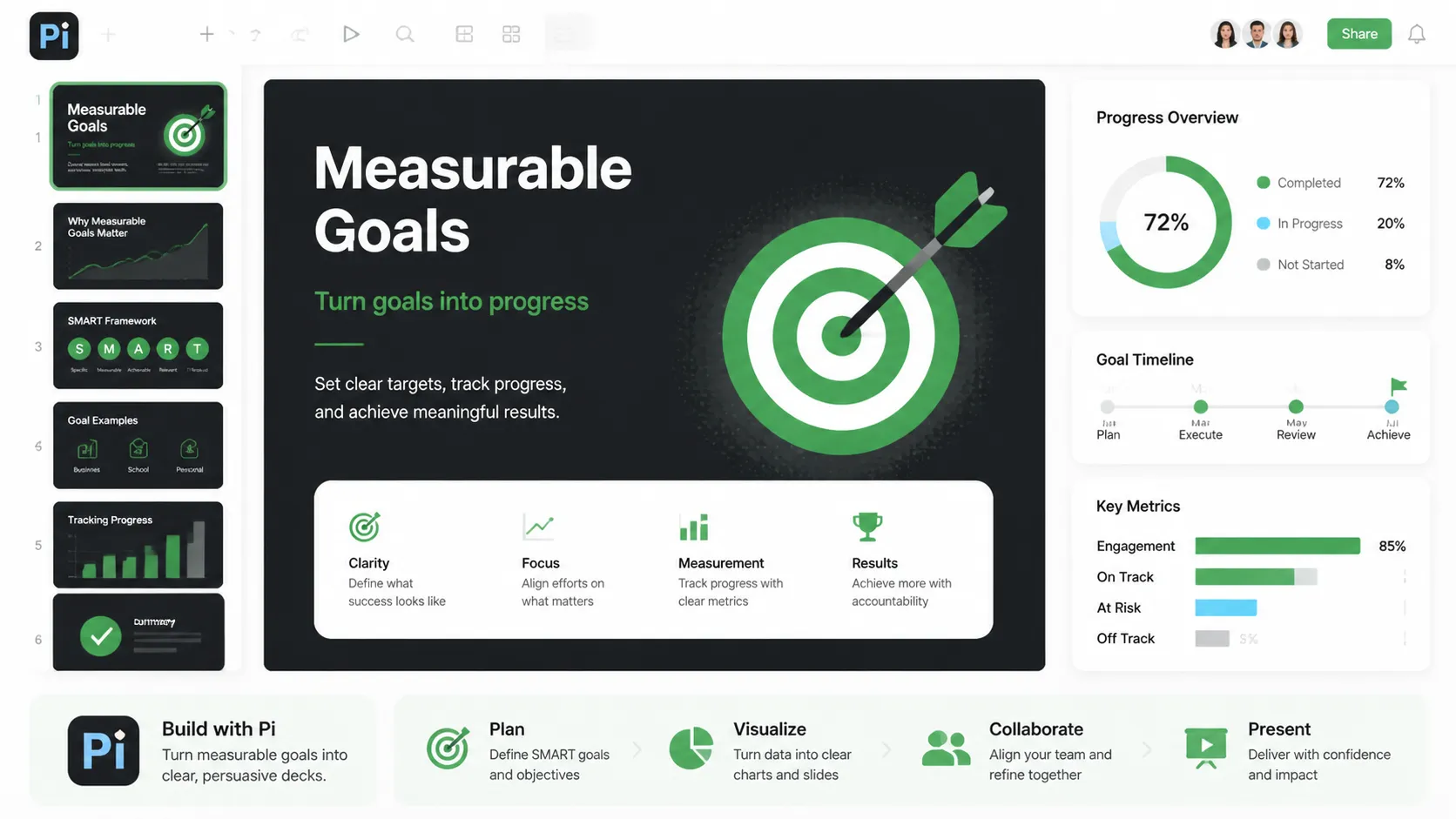
If you need to present measurable goals to a team, client, or class, you can also turn your goals into a clear presentation with Pi ↗. It helps organize goals, metrics, timelines, and next steps into an editable slide draft.
The Verdict
Measurable goals are important because they make progress clear, trackable, and easier to improve. A good goal should include a specific result, a measurable target, and a time frame. Whether you are setting business goals, school goals, project goals, or personal goals, measurement turns intention into action.
Frequently Asked Questions
What is an example of a measurable goal?
An example of a measurable goal is: “Increase monthly sales by 10% by the end of Q2.” This goal includes a clear result, a number, and a deadline.
How do measurable goals improve performance?
Measurable goals improve performance by giving people a clear target. When people know what result they are working toward, they can focus their effort, review progress, and adjust their actions more quickly.
Are measurable goals the same as SMART goals?
Measurable goals are part of SMART goals. A SMART goal is specific, measurable, achievable, relevant, and time-bound. The measurable part explains how progress or success will be tracked.
Why are measurable goals useful in presentations?
Measurable goals work well in presentations because they make plans easier to understand. A presentation with clear goals, metrics, and deadlines is usually more persuasive than one with vague intentions.