GPT-6 and the Rise of AI Agents: What It Means for Content Creation
GPT-6 has become a symbol for the next stage of Artificial Intelligence, even before all details are confirmed. The debate is not only about whether a future model will write better, reason longer, or answer questions more accurately. The bigger shift is from AI chatbots that respond to prompts toward AI Agents that can plan, use tools, monitor progress, and complete complex tasks.
That shift matters for content creation. For years, AI writing tools have helped marketers, founders, consultants, analysts, and knowledge workers draft copy, summarize research, and generate ideas. The next phase looks different. Instead of asking AI to “write a blog post,” a professional may ask an autonomous workflow to research a market, identify the strongest angle, create a brief, draft the article, prepare presentation materials, and flag claims for human review.
This is the real importance of GPT-6 in AI News: not simply a better chatbot, but a signal that Autonomous AI may become a workflow layer for knowledge work.
GPT-6 Is Not Just Another Chatbot Upgrade
Claims about GPT-6 should be treated carefully. Capabilities such as stronger long-horizon planning, advanced tool use, scientific discovery support, and more reliable multi-step execution are best understood as the direction of frontier AI, not confirmed product specifications.
Still, the trend is clear. Models are being designed less as isolated text engines and more as reasoning systems connected to tools, memory, data sources, browsers, code environments, and business applications. That changes how people evaluate Artificial Intelligence. The question is no longer only, “Can the model answer well?” It is also, “Can the system complete useful work safely?”(Stanford HAI - AI Index Report 2025)
For content teams, AI productivity will increasingly depend on orchestration. A powerful model matters, but the surrounding workflow matters just as much: what information it can access, how it plans, how it revises, and where human judgment enters the process.
From Chatbots to Agents That Execute Work
A chatbot is mainly conversational. It waits for a prompt, produces a response, and stops. An AI agent is more operational. It can break a goal into steps, choose tools, take actions, evaluate intermediate results, and continue until the task is complete.
The professional difference is easy to see:
- A chatbot summarizes a report; an agent compares reports and builds a briefing.
- A chatbot drafts an email; an agent reviews context, writes the message, and prepares follow-up.
- A chatbot suggests ideas; an agent researches demand, maps topics, and tracks content gaps.
This is why GPT-6 attracts attention beyond technical audiences. The agent paradigm suggests that AI systems may become digital collaborators that execute work over time, not just assistants that answer questions in one session.(Semantic Scholar - Survey on LLM-Based Agents)
How AI Agents Could Change Content Creation
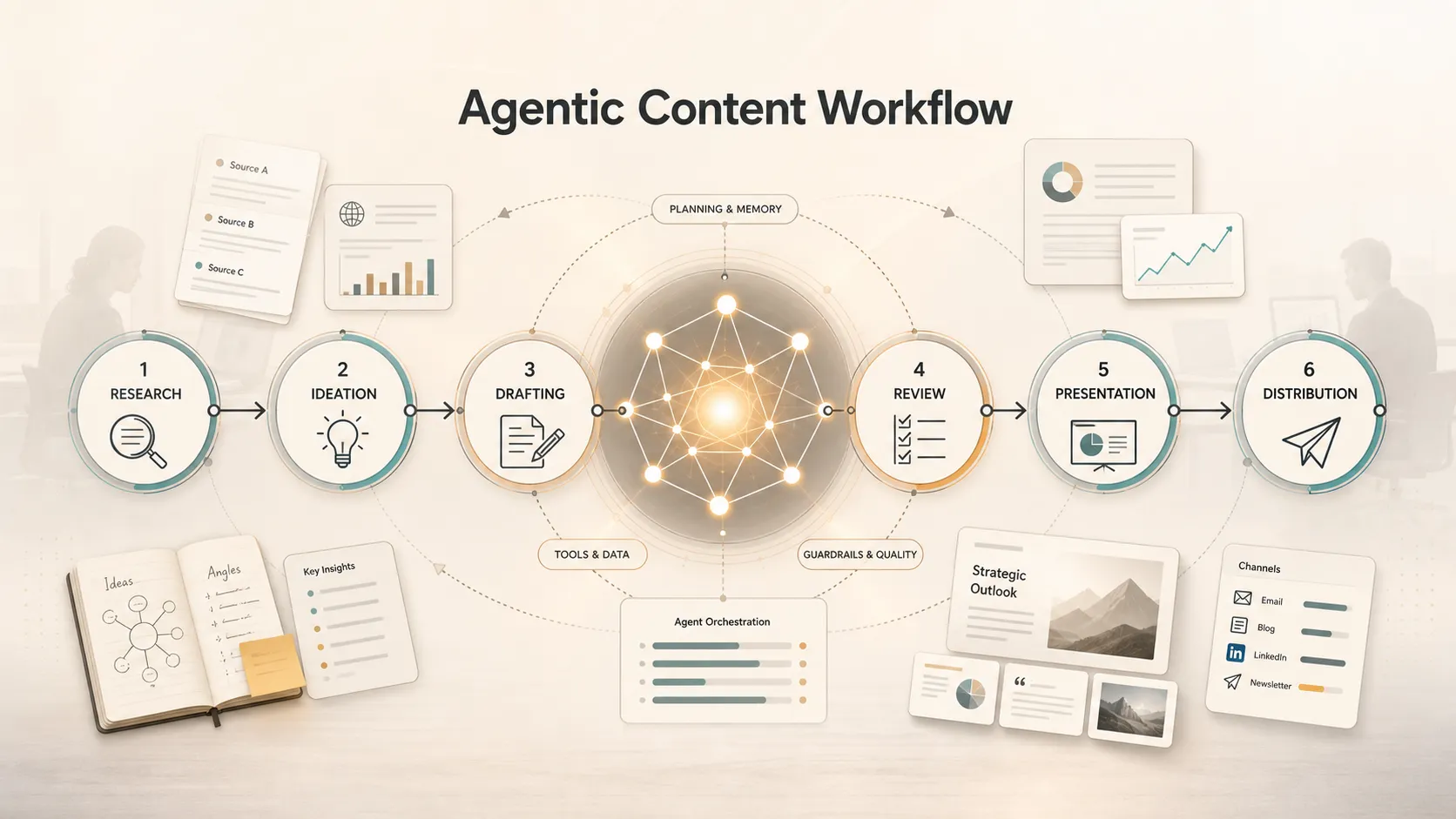
Content creation has never been only writing. Strong content requires research, positioning, structure, editorial judgment, design awareness, distribution planning, and performance review. AI Agents could affect each stage by reducing the coordination cost between tasks.
In research, agents may gather background information, compare sources, identify contradictions, and prepare evidence maps. In ideation, they may analyze search intent, audience objections, competitive angles, and content gaps. (arXiv - CREA: Collaborative Multi-Agent Framework for Creative Content Generation)In drafting and editing, they may handle first versions, style adaptation, headline testing, consistency checks, and repurposing.
The value is not that every sentence becomes perfect. The value is that the system can maintain continuity across related assets: articles, newsletters, landing pages, sales scripts, and presentation materials. Distribution may also become more systematic, with agents preparing channel-specific variations and monitoring performance signals.
| Content Workflow Stage | Traditional AI Assistance | Agentic AI Workflow |
|---|---|---|
| Research | Summarizes selected inputs | Finds, compares, and organizes sources |
| Ideation | Generates topic lists | Maps topics to strategy and intent |
| Drafting | Writes isolated copy | Builds connected content assets |
| Review | Suggests edits | Checks claims, consistency, and gaps |
| Presentation | Creates slide text | Structures business communication |
Where Presentation Intelligence Fits
As content creation becomes more agentic, business communication becomes a critical output layer. Teams do not only need articles or documents. They also need pitch decks, executive presentations, market research decks, sales decks, and consulting-style reports that translate information into decisions.
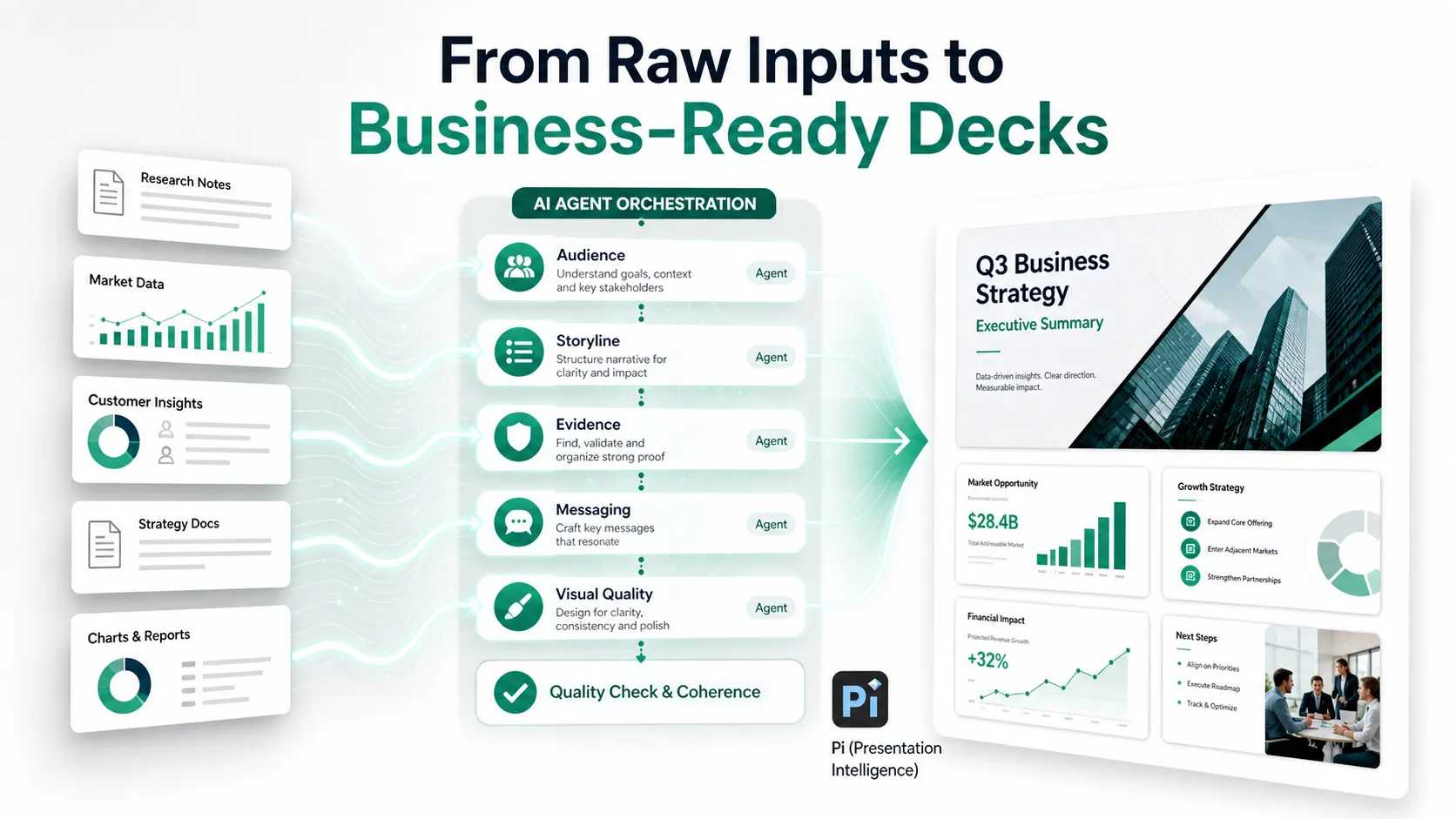
Pi, short for Presentation Intelligence, is one example of how agentic principles are entering professional presentation workflows. It is not the entire answer to Autonomous AI, and it should not be framed as the only tool in this shift. Its relevance is that it reflects a broader movement: AI tools are moving from simple generation toward structured, business-ready work.
Many presentation tools help users create attractive slides quickly. That is useful, but high-stakes presentations require more than visual polish. A pitch deck must make a business case. A consulting report must move from problem definition to recommendation. A sales deck must connect pain points, value, proof, and next steps.
Pi’s role is to apply AI to the structure of business presentations, not only to slide decoration. This matches the broader AI Agents shift: the system is expected to help organize work, not merely produce output. For professional teams, the value is not “more slides faster.” It is a clearer path from raw information to a presentation that can support a business decision.
Agentic systems are often most useful when different sub-tasks are coordinated. In presentation creation, those tasks may include understanding the audience, shaping the storyline, organizing evidence, refining messaging, and improving visual quality. Pi’s Multi-Agent AI approach fits this pattern by treating a professional deck as a workflow with multiple layers.
The goal is not to replace human strategy, but to reduce friction between raw inputs and business-ready communication. A founder may know the product well, but struggle to turn it into an investor narrative. A consultant may have strong analysis, but need a cleaner executive storyline. In these cases, AI productivity depends on structure, not only speed.
The One-Person Company and AI Productivity
One major implication of GPT-6 and AI Agents is the rise of smaller teams with greater execution capacity. A solo founder, independent consultant, creator, or small B2B team may soon operate with support that previously required several specialists.(MIT Technology Review - The State of AI)
A content operator could use agents for market research, SEO briefs, interview synthesis, article drafting, newsletter adaptation, presentation creation, and performance reporting. A consultant could turn client notes into analysis, proposals, workshop materials, and executive decks. A founder could create investor updates, product messaging, sales collateral, and onboarding documents without waiting on a large support team.
This does not mean the “one-person company” becomes effortless. Strategy, taste, trust, and accountability still matter. But AI productivity can compress the distance between idea and execution. The professionals who benefit most will likely be those who know how to define goals, evaluate outputs, and build repeatable workflows around AI.
The Governance Challenge
The more autonomous an AI system becomes, the more governance matters. A chatbot that gives a weak answer is a quality issue. An agent that takes the wrong action, cites unreliable information, edits a file, sends a message, or misinterprets a business goal can create operational risk.(arXiv - Responsible AI Systems Framework)
For content creation and knowledge work, the governance questions are practical. Who verifies sources? Who approves final claims? What data can the agent access? What actions require human review? How are mistakes traced? What happens when a system produces confident but incorrect reasoning?
This is especially important for organizations using AI in regulated industries, executive communication, investor materials, or customer-facing content. The future of work will not be shaped only by model intelligence. It will also be shaped by permission design, review workflows, auditability, and human accountability.
The Verdict: Agents Will Reshape the Workflow, Not Remove Judgment
GPT-6 represents a broader transition in Artificial Intelligence: from generating answers to coordinating work. For content creation, the impact may be substantial because content is already a multi-step knowledge workflow. Research, synthesis, storytelling, editing, design, and distribution all require coordination.
The winners will not necessarily be teams that use the most AI tools. They will be teams that redesign workflows around clear objectives, reliable inputs, human review, and measurable outputs. AI Agents can reduce repetitive effort, but they cannot remove the need for judgment. They can produce more content, but they cannot automatically decide what is worth saying.
For knowledge workers, the practical question is no longer whether AI can help. It is how to build systems where AI agents execute the repeatable parts of work while humans remain responsible for meaning, accuracy, ethics, and strategic direction.
Frequently Asked Questions (FAQ)
Q: What is GPT-6 expected to change about AI?
A: GPT-6 is expected to reflect a shift toward more capable agentic AI systems, although specific features should not be treated as confirmed unless officially announced. The key trend is AI moving from simple chat responses toward planning, tool use, and multi-step execution.
Q: What are AI Agents?
A: AI Agents are systems that can pursue goals by planning steps, using tools, monitoring progress, and completing tasks with varying levels of autonomy. They differ from traditional chatbots because they can act across workflows rather than only answer prompts.
Q: How will AI Agents affect content creation?
A: AI Agents may help with research, ideation, drafting, editing, repurposing, presentation creation, and distribution planning. Their biggest value is connecting these steps into a workflow, while humans still verify quality, accuracy, and strategy.
Q: Will AI Agents replace human creators?
A: Not entirely. AI Agents can automate repetitive and structured parts of content work, but human creators remain essential for judgment, originality, brand voice, ethical decisions, source verification, and strategic direction.