How to Run a Brainstorming Session: A Step-by-Step Framework for Better Ideas
Brainstorming should create possibilities. Too often, it creates a crowded whiteboard, a few dominant voices, and a list of ideas nobody revisits.
The problem is usually not a lack of creativity. Participants are asked to understand the problem, generate ideas, judge feasibility, defend opinions, and make decisions in the same conversation. Once evaluation begins, the range of ideas narrows.
Research on group brainstorming has identified problems such as production blocking, evaluation apprehension, and social loafing. One study found that groups often produced fewer ideas than the same number of people working independently, although electronic methods reduced some barriers. Read the research on unblocking brainstorms.
A stronger process separates four activities: framing the challenge, generating ideas, developing possibilities, and selecting next actions.
Why Traditional Brainstorming Often Underperforms
A session that begins with “Does anyone have ideas?” gives the fastest speaker an immediate advantage. Others may forget their thoughts while waiting, adjust them to match the first suggestions, or decide their contribution is not original enough.
The group may also converge too early. Someone mentions cost, legal approval, or technical difficulty, and exploration turns into rejection before enough alternatives exist.
A productive session needs two modes:
1.Divergence: Create a wide range of possibilities without immediate judgment.
2.Convergence: Compare, combine, prioritize, and develop the strongest options.
Step 1: Frame a Question the Team Can Answer
Weak prompts are too broad or already contain a preferred solution:
•How can we improve the product?
•How can we use AI?
•Should we redesign onboarding?
A better prompt identifies the audience, situation, and desired change without prescribing the answer:
How might we help first-time users understand the product’s value before they are asked to create an account?
Stanford d.school recommends “How Might We” questions because they turn an observation into an actionable provocation while leaving room for multiple solutions. Use Stanford d.school’s How Might We framework.
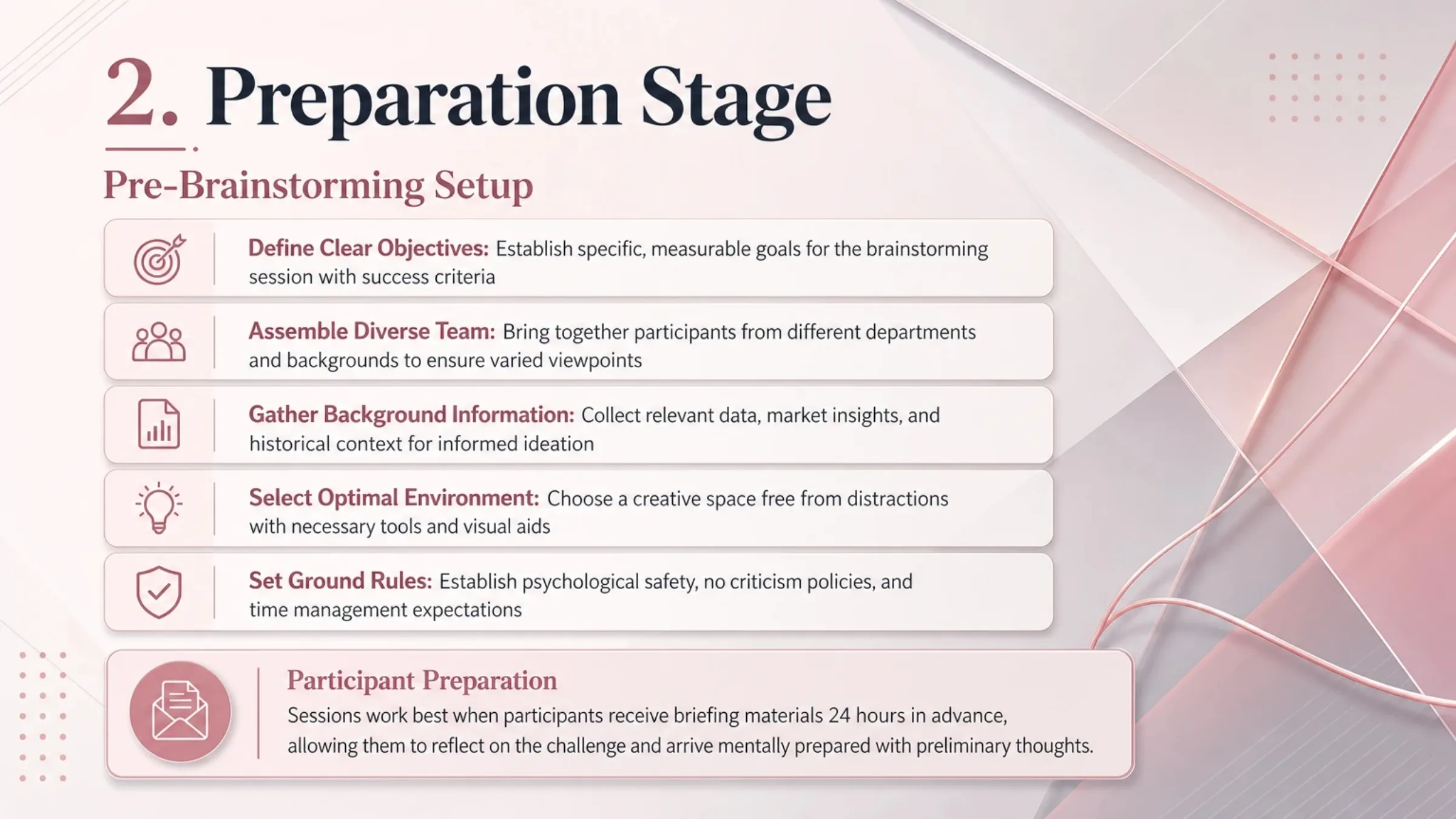
Before the meeting, share a brief covering the problem, affected users, relevant evidence, major constraints, and the decision the ideas will support.
Step 2: Start With Silent Individual Ideation
Do not begin with open discussion. Give participants five to ten minutes to generate ideas independently.
Ask everyone to write one idea per note or digital field. During this stage, nobody presents, explains, or evaluates. The goal is to preserve independent thinking before group influence takes over.
Useful prompts include:
•What could we remove rather than add?
•What would the simplest version look like?
•How would another industry approach this?
•What would make the experience noticeably faster?
Quantity matters because the first ideas are usually familiar. More original directions often appear only after the obvious answers are out of the way.
Step 3: Share and Expand Without Judging
Ask participants to share one idea at a time in short rounds. Capture every contribution visibly.
During this stage, block responses such as “We tried that before,” “That is too expensive,” or “Legal will reject it.” Those concerns may matter later, but during divergence they act like trapdoors.
Encourage expansion instead:
•“Yes, and we could…”
•“A smaller version might…”
•“What if we combined this with…?”
The objective is not to identify the winner immediately. It is to create enough material for stronger combinations to emerge.
Step 4: Alternate Between Group Work and Independent Thinking
Continuous discussion can make a team synchronize too quickly around the same direction.
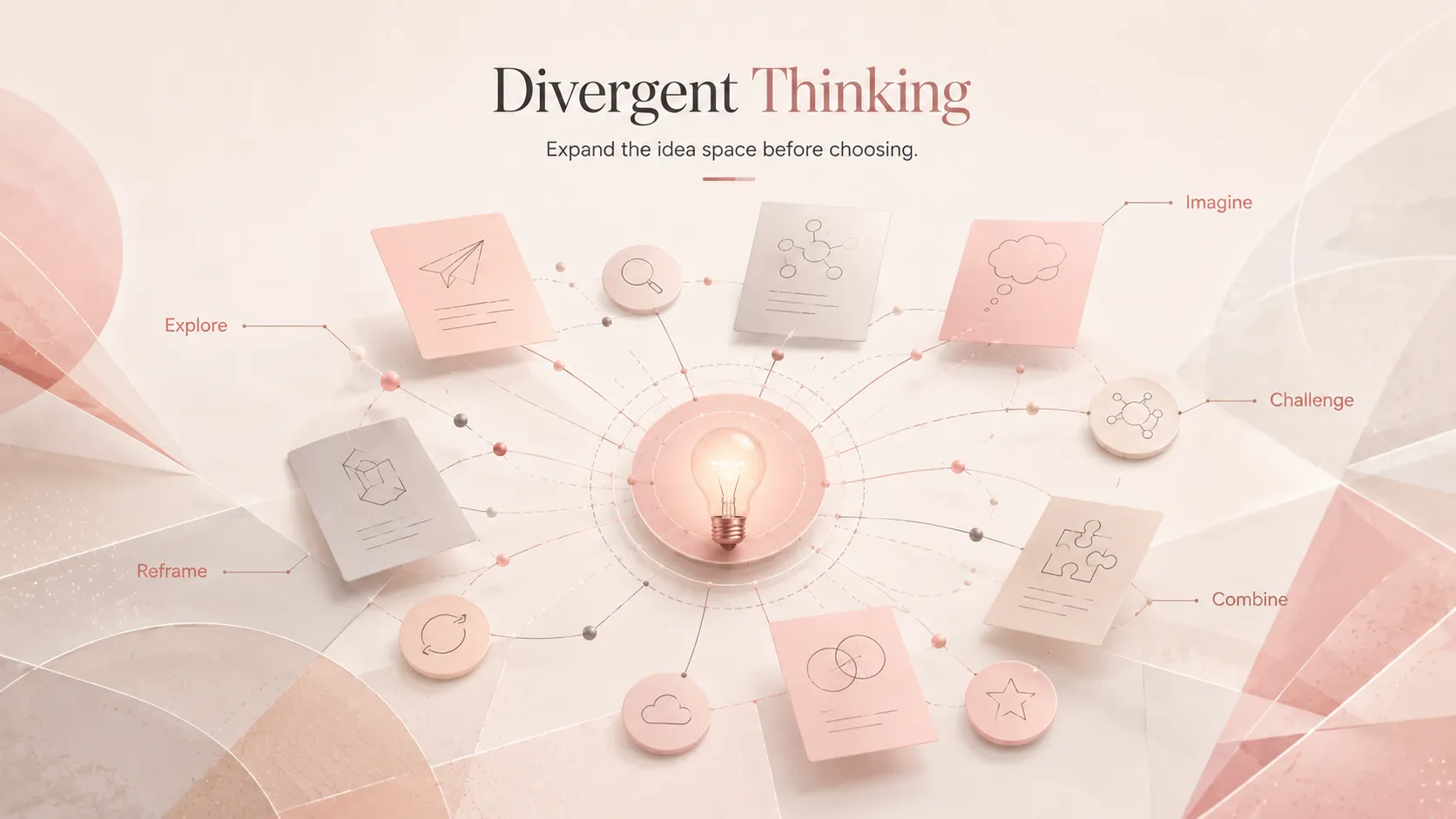
After the first sharing round, return to individual work. Ask participants to generate variations, combinations, missing perspectives, or more extreme alternatives.
Research published in the Proceedings of the National Academy of Sciences found that intermittent interaction can preserve independent exploration while still allowing people to learn from one another. Review the study on intermittent collaboration.
A practical rhythm is:
1.Individual generation
2.Group sharing
3.Individual expansion
4.Group combination
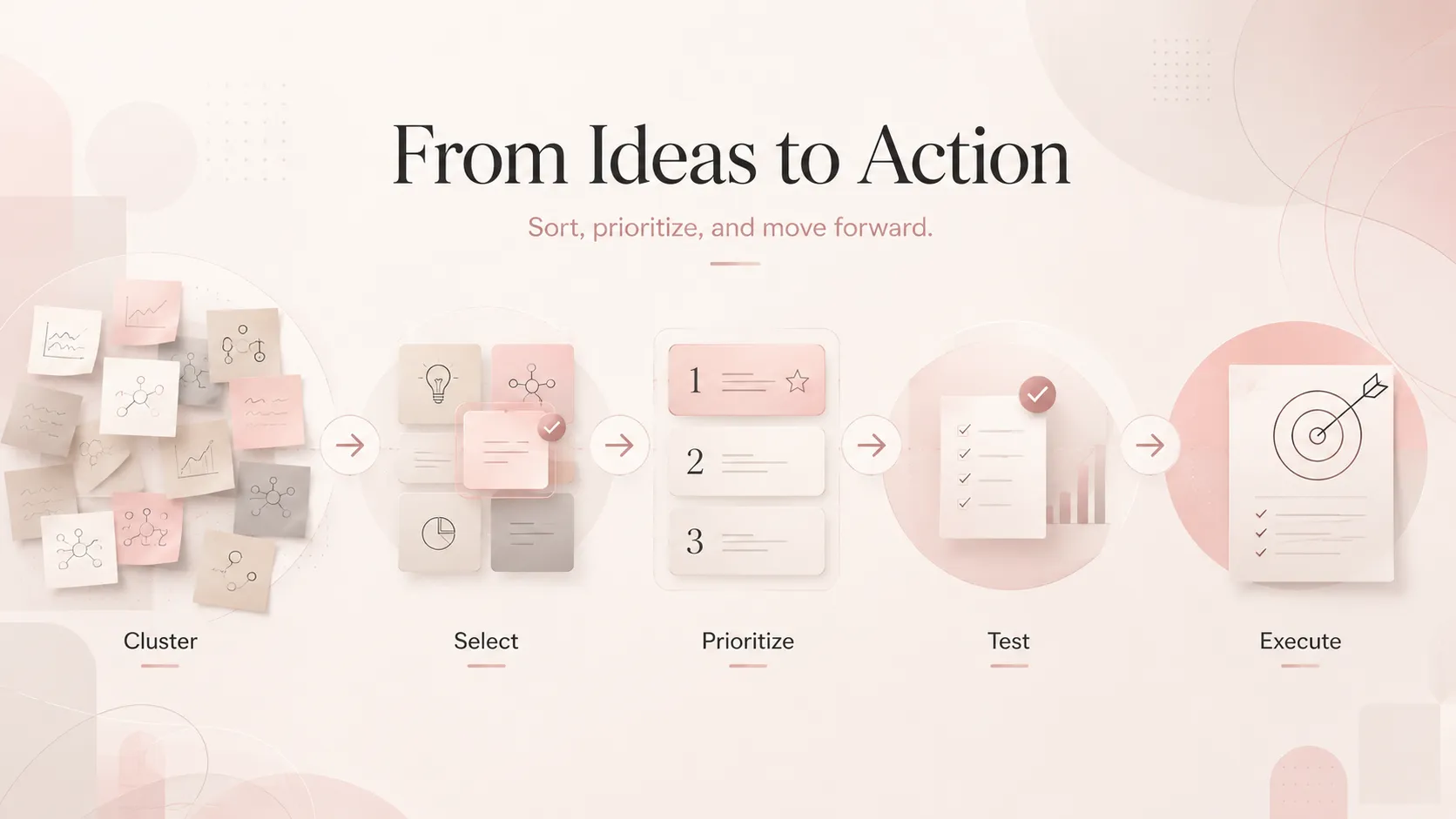
Step 5: Cluster Ideas Into Strategic Themes
Once enough ideas exist, group related notes together and identify the shared principle behind each cluster.
A product session might reveal themes such as reducing setup effort, explaining value earlier, increasing personalization, building trust, or adding guided assistance.
Naming clusters turns dozens of fragments into strategic directions. It also reveals whether the team explored genuinely different possibilities or produced twenty versions of the same thought wearing different hats.
Combine duplicates, clarify vague notes, and develop promising fragments into complete concepts.
Step 6: Evaluate With Shared Criteria
Voting is useful, but popularity should not be the only selection method.
Agree on criteria before ranking ideas. Depending on the project, these may include user value, strategic fit, originality, feasibility, cost, time to test, and potential business impact.
Then ask:
•Which assumption makes this idea risky?
•What is the smallest version we could test?
•Which users should see it first?
•What result would justify further investment?
The output should be a short list of testable concepts, not one prematurely polished answer.
Step 7: End With Owners and Next Actions
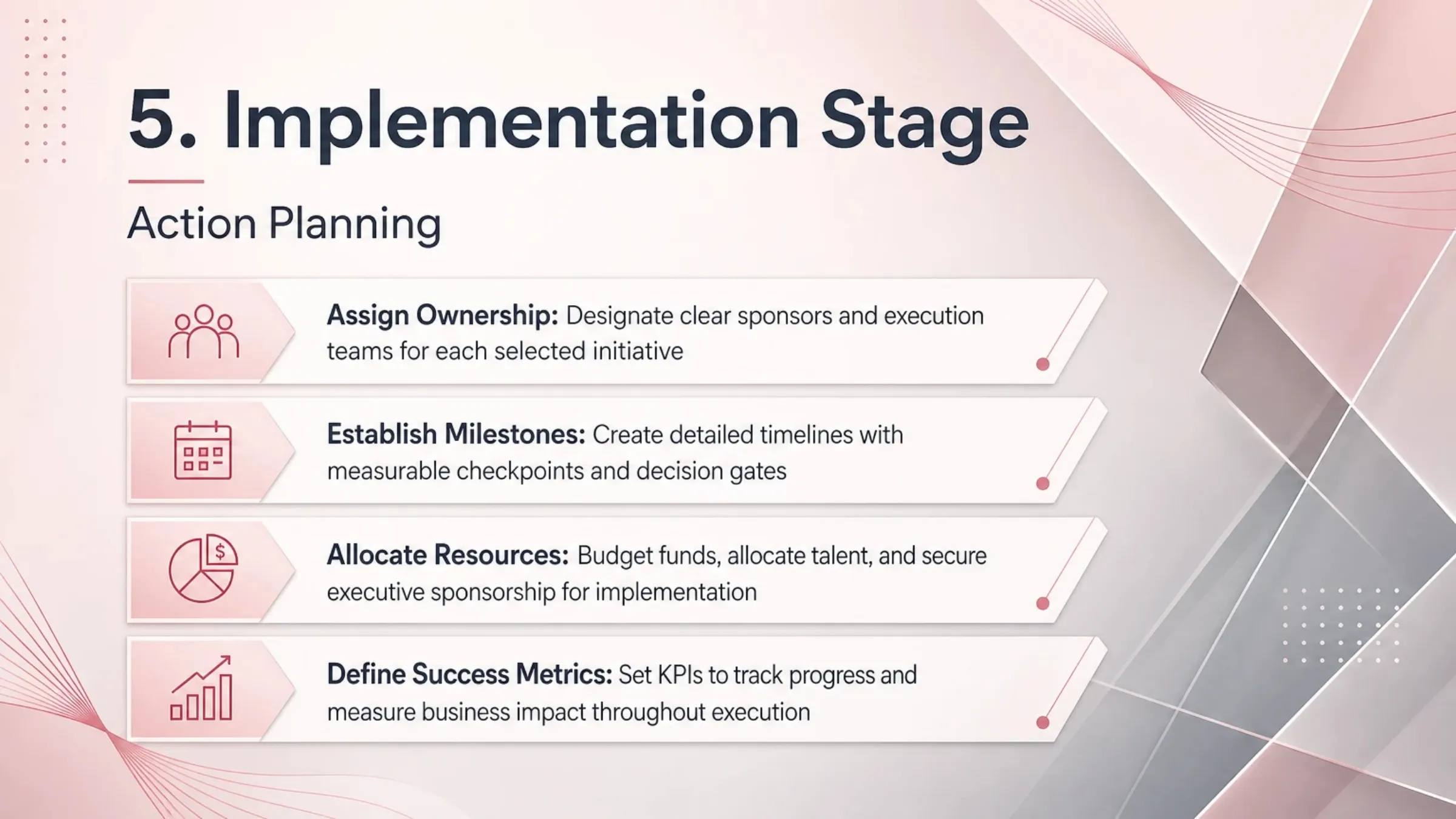
A brainstorming session is incomplete until ideas become assignments.
For every selected concept, record the owner, assumption being tested, next action, required resources, decision date, and success indicator.
Possible next steps include interviews, a storyboard, a low-fidelity prototype, a technical review, or a short concept presentation.
The session should end with movement. Otherwise, the whiteboard becomes a colorful archive of abandoned optimism.
How AI Can Support Brainstorming
AI can help teams generate alternative perspectives, combine ideas, rewrite weak prompts, identify overlooked audiences, and convert clusters into structured concepts.
It works best after participants have generated their own first ideas. Starting with AI may anchor the group around generic suggestions before domain knowledge enters the process.
A practical workflow is:
1.Generate initial ideas independently.
2.Ask AI for alternative angles.
3.Compare human and AI suggestions.
4.Combine the strongest directions.
5.Apply team judgment and business constraints.
6.Document decisions and next steps.
AI expands the search space. The team remains responsible for context, priorities, and consequences.
Turn Brainstorming Notes Into a Clear Visual Story
A workshop produces scattered materials: prompts, notes, clusters, criteria, decisions, and action items. A structured presentation helps participants understand how ideas developed and why particular concepts were selected.
Explore A Systematic Approach to Creative Brainstorming, created with Pi, to see how an ideation process can be organized into a visual framework for workshops, product planning, and creative reviews.
Ready to turn workshop notes, research, and rough concepts into a coherent deck? Create a presentation with Pi and transform scattered thinking into an editable visual narrative.
Frequently Asked Questions (FAQ)
Q: How long should a brainstorming session last?
A: Most focused sessions can run for 45 to 90 minutes. Complex challenges are often better handled through several shorter sessions.
Q: How many people should join a brainstorming session?
A: Five to eight participants is usually manageable. Larger groups can work in smaller teams and combine their ideas during convergence.
Q: Should ideas be evaluated during brainstorming?
A: Not during the initial generation stage. Evaluation should begin after the team has created a broad range of possibilities.
Q: What is the difference between brainstorming and brainwriting?
A: Brainstorming usually relies on spoken discussion. Brainwriting begins with participants writing independently, which can reduce production blocking and give quieter members equal space.
Q: Can AI replace a human brainstorming session?
A: AI can generate alternatives and reveal missing perspectives, but it lacks the team’s complete operational context and accountability. It is most useful as an ideation partner rather than the final decision-maker.