how to start a business
Starting a business is not just choosing a name, posting online, or opening a bank account. Those things matter, but they come after the harder work: testing the idea, understanding the customer, checking the market, making the numbers believable, and setting up the business properly.
A good start does not need to be dramatic. In fact, the best early version of a business is usually small, specific, and testable. You want to learn whether people actually need what you plan to sell, whether they will pay for it, and whether the business can survive outside your notes.
The U.S. Small Business Administration has an official guide to writing a business plan, which is useful once your idea starts becoming a real plan.
Start With A Business Idea You Can Test
A business idea should be more than something you like. It should connect a real customer, a real problem, and a real offer.
Ask simple questions first:
- What problem am I solving?
- Who has this problem often enough to care?
- What do they use now?
- Why would they switch?
- How much would they pay?
- Can I deliver this consistently?
At the beginning, avoid making the idea too broad. “Helping small businesses with marketing” is vague. “Helping local restaurants create weekly social media content” is easier to test.
The goal is not to prove your idea perfect. The goal is to find out what is true before you spend too much money.
Define The Customer And Problem
A business becomes clearer when the customer becomes specific. “Everyone” is not a customer. A strong customer profile tells you who you are building for, what they want, what frustrates them, and how they make buying decisions.
If you are starting a consumer business, think about lifestyle, budget, location, habits, and urgency. If you are starting a business-to-business company, think about job title, company size, industry, budget owner, and approval process.
The problem should also be specific. Customers rarely buy because a company exists. They buy because something is painful, slow, expensive, confusing, risky, or inconvenient.
Research The Market And Competitors
Market research does not have to mean a huge report. It means gathering enough information to understand demand, alternatives, pricing, and competition.
Look at:
- Direct competitors
- Indirect alternatives
- Customer reviews
- Search trends
- Industry reports
- Pricing pages
- Forums, communities, and social channels
- Local market conditions if the business is location-based
The SBA’s guide to market research and competitive analysis is a useful reference because it separates customer research from competitor research.
Do not only look for reasons your idea is good. Look for reasons it might fail. That is where the useful information often is.
Write A Simple Business Plan
A business plan does not need to be long at first. It needs to be useful.
Start with a simple version that includes:
- Business idea
- Target customer
- Product or service
- Market and competitors
- Pricing
- Sales channels
- Startup costs
- Basic financial assumptions
- Milestones
- Risks
You can make it more detailed later if you need funding, a loan, partners, or internal approval. SCORE’s business plan template is a helpful reference for a more complete plan structure.
Startup Steps At A Glance
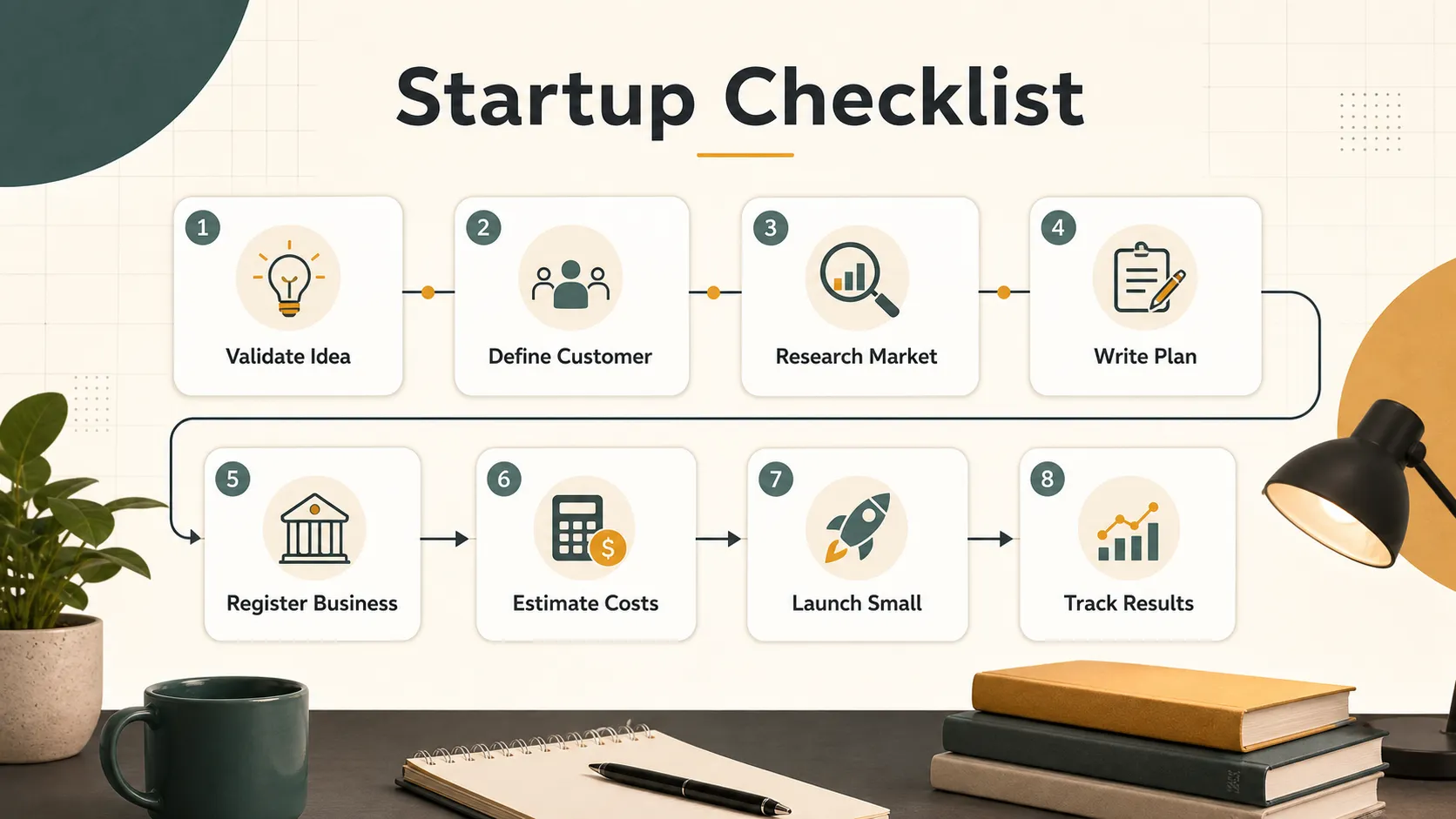
| Step | What to do | Why it matters |
|---|---|---|
| Validate the idea | Talk to customers | Avoid building blindly |
| Research the market | Study demand and competitors | Find your position |
| Write a plan | Organize the business | Clarify decisions |
| Choose structure | Compare legal options | Set tax and liability rules |
| Register the business | File required paperwork | Make it official |
| Estimate costs | List startup expenses | Know funding needs |
| Launch small | Test the offer | Learn before scaling |
| Track results | Review sales and feedback | Improve the business |
Choose A Business Structure
Your business structure affects taxes, paperwork, liability, and how the business can raise money. Common options include sole proprietorship, partnership, LLC, corporation, and S corporation.
The SBA’s guide to choosing a business structure explains how structure affects taxes, paperwork, fundraising, and personal liability. The IRS also has a page on business structures, which is useful from a tax perspective.
This is one of the steps where professional advice can be worth it. Requirements vary by location and business type, and the cheapest structure is not always the best long-term choice.
Register The Business
Once you choose a structure, you may need to register the business with state, local, or federal agencies. The exact process depends on your location, structure, and business name.
The SBA’s guide to registering your business explains how registration can vary by state, business structure, and whether you use a trade name or DBA.
You may also need an Employer Identification Number. The IRS lets eligible businesses apply for an EIN directly through its official site. Avoid third-party sites that charge unnecessary fees for something the IRS provides for free.
Check Licenses, Permits, Taxes, And Banking
Some businesses need licenses or permits before they can operate. This can depend on your state, city, industry, and business activity. Food, childcare, construction, healthcare, finance, transportation, and professional services often have extra requirements.
You should also think about taxes early. Sales tax, payroll tax, self-employment tax, and income tax can affect how you price and manage cash flow.
Set up a separate business bank account as soon as it makes sense. Mixing personal and business money makes bookkeeping harder and can create problems later, especially if you form an LLC or corporation.
Estimate Startup Costs And Funding Needs
Before launch, list what it will cost to start and operate for the first few months. Include equipment, software, inventory, supplies, insurance, registration fees, marketing, website costs, rent, contractors, and professional services.
The SBA’s guide to calculating startup costs is useful because it separates one-time startup expenses from ongoing costs.
Funding can come from savings, customer preorders, loans, grants, investors, friends and family, or revenue from a smaller first version. The right choice depends on risk, control, timeline, and how much money the business really needs.
Build The Offer And Launch Small
A small launch helps you learn faster. Instead of trying to build the full version immediately, create the simplest version people can understand, buy, and respond to.
That might be:
- A service package
- A landing page
- A small product batch
- A pilot program
- A local test
- A paid workshop
- A limited beta
Track what people ask, where they hesitate, what they pay for, and what they ignore. Early customer behavior is more useful than compliments.
Turn The Plan Into A Presentation
A written business plan helps you think through the details. A business presentation helps you explain the plan to other people.
You may need a presentation if you are pitching investors, applying for funding, presenting to partners, briefing a team, or explaining a launch plan. The deck should not copy the full document. It should turn the business into a clear story: problem, customer, solution, market, business model, plan, numbers, team, and next step.
Where Pi Fits Into Starting A Business
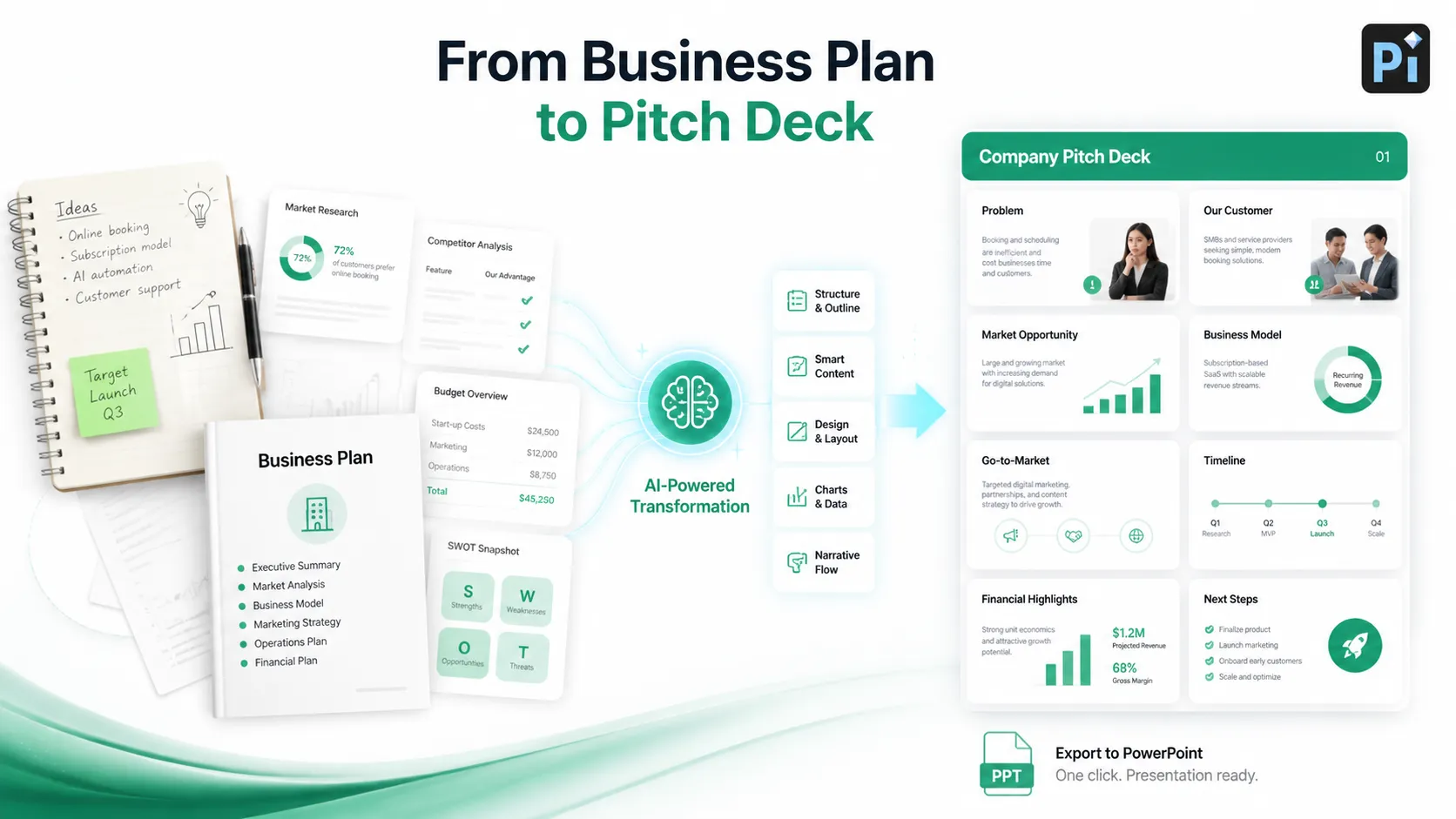
When your notes, research, website content, or business plan draft are ready, Pi can help turn that material into a polished business presentation.
Pi has editable templates and many presentation styles you can use directly. You can customize colors, themes, visual tone, and layout direction so the deck fits the business instead of looking like a generic template.
Pi also provides ready-made components for market analysis, business models, timelines, financial highlights, comparison blocks, executive summaries, and next-step slides. Automatic layout helps keep the deck clean as the content changes. The icon library makes sections easier to scan, while image effects and AI-generated visuals can support slides that need stronger visual direction.
Once the deck is ready, you can export it as a PPT file and continue editing or presenting it in PowerPoint or other compatible tools.
The Verdict
Starting a business is a sequence of practical decisions. Test the idea, define the customer, research the market, write a simple plan, choose a structure, register properly, understand costs, launch small, and adjust based on real feedback.
You do not need to make everything perfect before starting. You do need enough structure to avoid guessing blindly. And when the business plan needs to become a clear presentation, Pi can help turn rough planning material into a polished deck with editable templates, custom themes, components, icons, image effects, AI visuals, automatic layout, and PPT export.
Frequently Asked Questions (FAQ)
Q: What is the first step to start a business?
A: Start by testing the business idea. Define the customer, the problem, and the offer before spending heavily on branding, tools, or inventory.
Q: Do I need a business plan before starting?
A: You do not always need a long formal plan, but you should have a simple plan that covers the customer, offer, market, costs, revenue model, risks, and next steps.
Q: Do I need to register my business?
A: It depends on your location, business structure, and name. Check official state, local, SBA, and IRS resources before operating.
Q: Can Pi help make a startup pitch deck?
A: Yes. Pi can turn notes, research, websites, or business plan content into a polished presentation with editable templates, custom themes, components, automatic layout, icons, image effects, AI visuals, and PPT export.