how to write a cover letter
f you are learning how to write a cover letter, start with this idea: your resume lists the facts, but your cover letter explains the fit. It gives the hiring manager a short, human introduction to who you are, why the role interests you, and why your experience belongs in the conversation.
For beginners, the biggest mistake is trying to sound “professional” by becoming stiff. A good cover letter should be clear, warm, specific, and easy to skim. It should not repeat your whole resume. It should connect the dots.
Understand What A Cover Letter Is For
A cover letter is a short professional letter that usually goes with your resume. According to Yale Office of Career Strategy, it introduces you to an employer, explains your interest, and shows why you are qualified.
Think of it as answering three questions:
- Why this role?
- Why this company?
- Why are you a strong match?
If the application says a cover letter is required, send one. If it says optional, it is often still worth sending unless the posting clearly says not to. UW-Madison’s career center notes that a cover letter can show extra effort and give you space to explain qualifications that may not be obvious from your resume.
Research Before You Write
Do not start with “I am writing to apply for...” and hope the rest magically appears. Spend 15 minutes researching first.
Read the job description closely. Highlight the skills, responsibilities, and repeated phrases. Then check the company website, recent news, product pages, mission statement, or LinkedIn page. If you are still unclear about the role, use O*NET OnLine to understand common tasks and skills for that occupation.
Your goal is not to flatter the company. Your goal is to show that you understand what they need.
how to write a cover letter for one specific role
The best cover letters feel written for one job, not copied for every application. MIT Career Advising & Professional Development recommends tailoring the letter to a specific position and using examples that connect directly to the role.
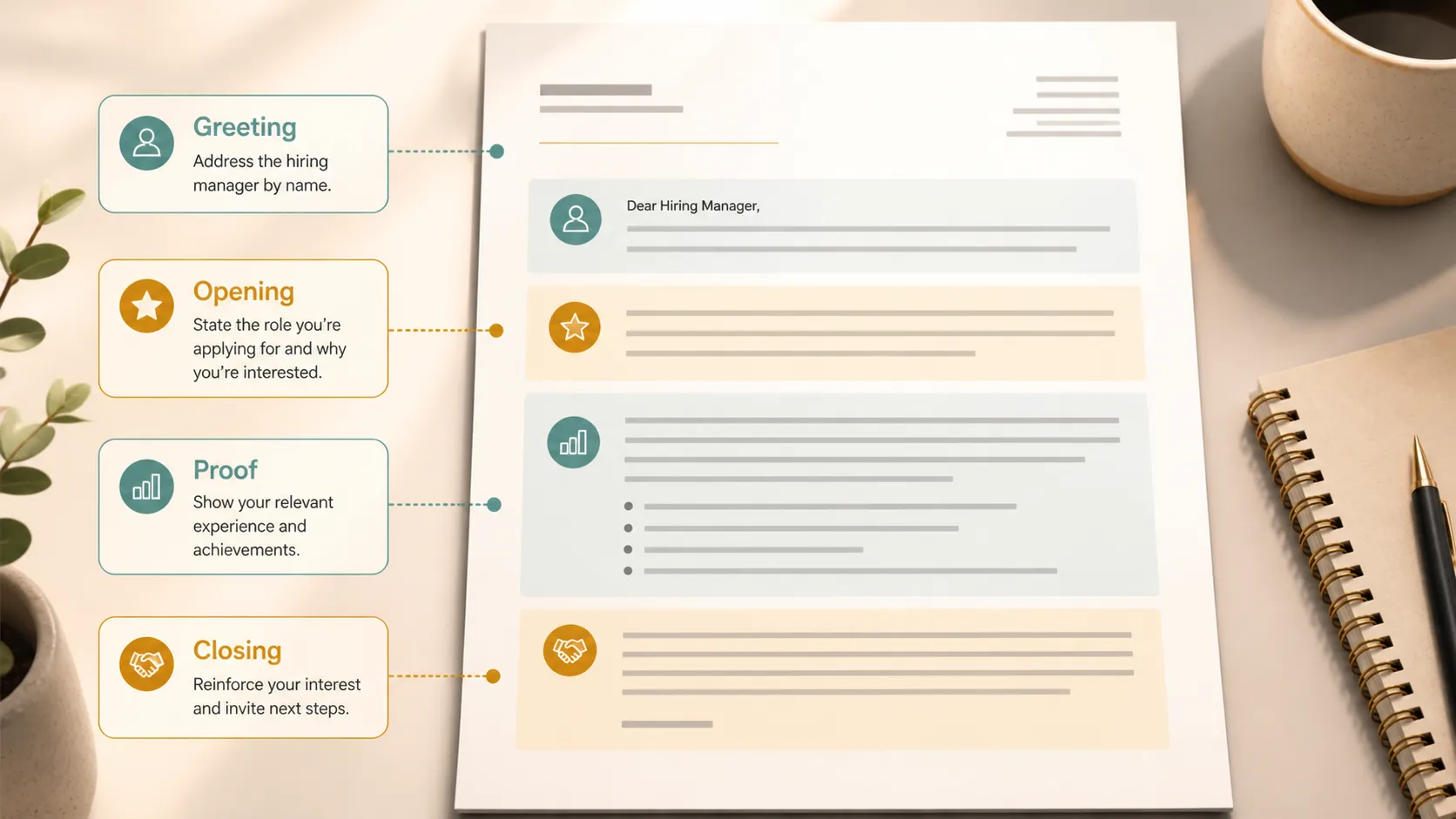
Use this simple structure:
| Section | how to write a cover letter focus | Beginner Tip |
|---|---|---|
| Greeting | Start professionally | Use “Dear Hiring Manager” if no name is available |
| Opening | Name the role and show specific interest | Avoid vague excitement |
| Body | Prove 1-2 key strengths with examples | Do not rewrite your resume |
| Company fit | Show why this employer makes sense | Mention something real and specific |
| Closing | Reconfirm interest and thank them | Keep it confident, not needy |
This structure keeps the letter easy to read and helps you avoid wandering through unrelated details.
Write A Strong Opening
The opening paragraph should quickly tell the reader what role you are applying for and why it makes sense.
Weak opening:
“I am writing to apply for the Marketing Assistant position. I believe I would be a good fit because I am hardworking and passionate.”
Stronger opening:
“I am excited to apply for the Marketing Assistant position at Brightwell Studio because the role combines campaign coordination, social content, and customer research, three areas I practiced while managing student organization promotions and analyzing engagement data for weekly events.”
The second version gives the employer something concrete. It mentions the role, the company, and relevant experience in one paragraph.
Prove Your Fit With One Or Two Stories
The body of your cover letter should not list every job you have had. Choose one or two examples that match the job description.
If the posting asks for project management, describe a time you organized a project, handled deadlines, coordinated people, or solved a messy problem. If it asks for customer service, show how you communicated with people, handled questions, or improved an experience.
The University of Washington Career & Internship Center describes cover letters as a way to connect your background with the position. That is the useful part: your resume gives facts, and the letter explains why those facts matter.
Use this pattern:
“I noticed you are looking for someone who can do X. In my previous role, project, or class, I did Y. The result was Z. That experience would help me contribute to this role by doing A.”
Even if you are entry-level, you still have material. Class projects, volunteer work, internships, part-time jobs, campus leadership, freelance work, and personal projects can all show transferable skills.
Show Why This Company
A cover letter should feel like it belongs to one employer. If you can swap the company name and send the same letter everywhere, it is too generic.
Mention something real: the company’s product, audience, values, recent work, industry position, or problem they are solving. Purdue’s Center for Career Opportunities emphasizes that employers do not want a generic letter sent to every company in the field.
Keep this part brief. One or two specific sentences are enough. You are not writing a fan letter. You are showing alignment.
Keep The Format Clean
A cover letter is usually one page. Use the same font and header style as your resume if possible. Keep paragraphs short. Leave white space. Save it as a PDF unless the application asks for another format.
MIT’s cover letter toolkit suggests keeping the letter brief, using a readable font, and proofreading carefully. That sounds basic, but mistakes in names, job titles, and company details can quietly damage an otherwise strong application.
Before sending, check:
- Did you name the correct company?
- Did you name the correct role?
- Is the letter under one page?
- Does each paragraph earn its place?
- Did you remove clichés like “I am a perfect fit”?
- Did you proofread it out loud?
Harvard Extension School frames resumes and cover letters as marketing documents. That does not mean exaggerating. It means making your value easy to see quickly.
Organize Your Application Story With Pi
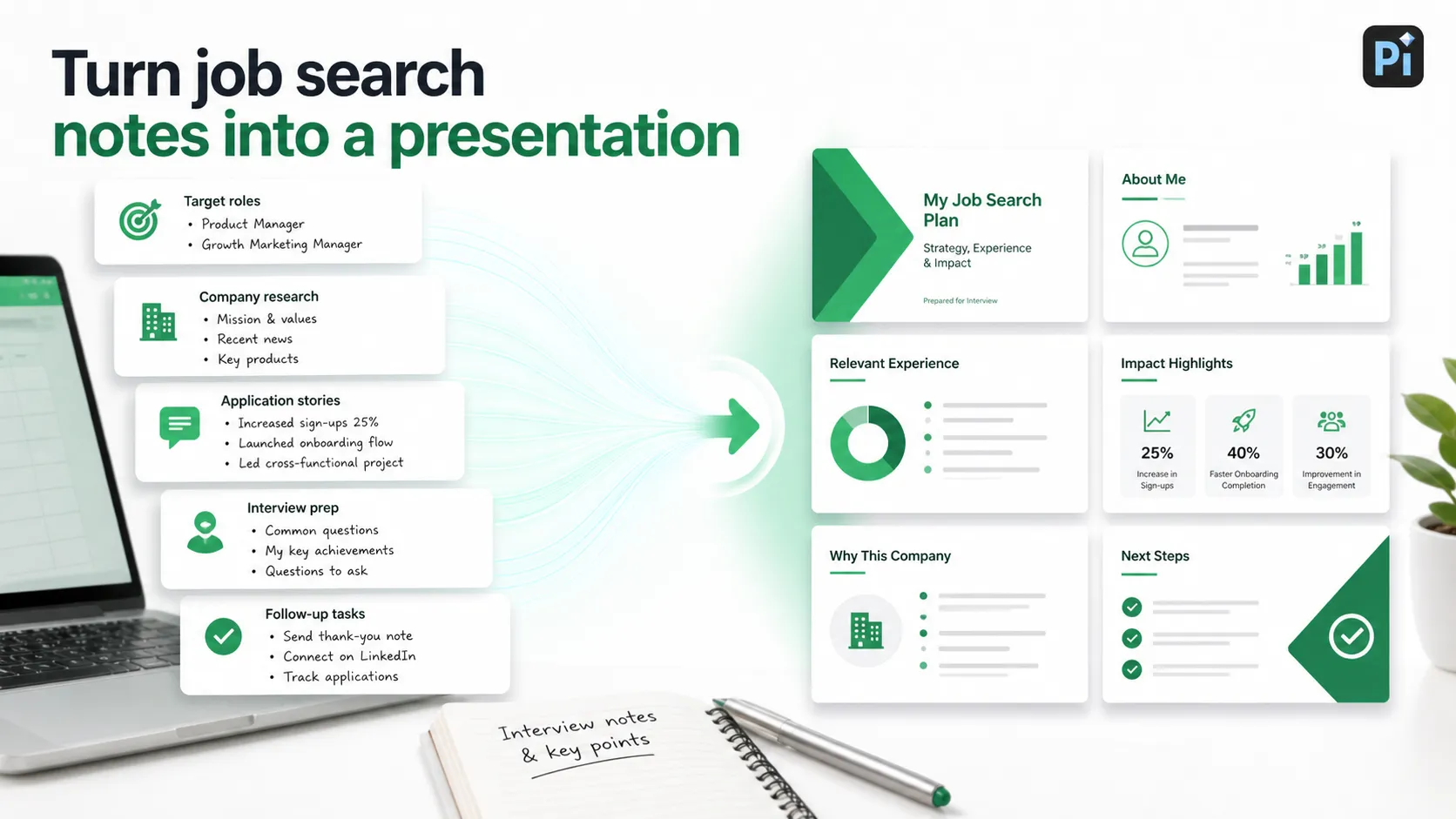
Pi can be useful before you write the final letter, especially if you are applying to several roles and your notes are scattered. Instead of treating each application as a blank page, you can build a simple job search presentation: target role, company research, required skills, proof points from your experience, resume highlights, interview stories, and follow-up reminders.
For example, if you are applying for a product marketing role, you might collect the job description, three company insights, two campaign examples from your background, and one short story about working with data. In Pi, that material can become a clean visual map with sections, icons, timelines, charts, and AI-generated images. This does not replace the cover letter. It helps you see your own story more clearly before you write.
Pi is also helpful if you work with a mentor, career coach, or university advisor. Instead of sending a messy document, you can present your application strategy slide by slide: what the role asks for, what evidence you have, where the letter is strong, and where it still feels thin. That makes feedback faster and more specific.
The Verdict
A strong cover letter is not about sounding fancy. It is about being specific. Show that you understand the role, prove your fit with one or two real examples, explain why the company interests you, and close with confidence.
Beginners often try to write the “perfect” letter. Aim for a useful one instead: clear, tailored, honest, and easy to read. That is what gives your resume a stronger chance of becoming an interview.
Frequently Asked Questions (FAQ)
Q: What is the easiest way to learn how to write a cover letter?
A: Start with one real job posting. Highlight the employer’s top needs, choose two matching examples from your experience, and write a short letter around those points.
Q: How long should a cover letter be?
A: Keep it to one page. Three or four short paragraphs are usually enough for most job applications.
Q: Should I write a cover letter if it is optional?
A: Usually, yes. If you can write a specific and useful letter, it can strengthen your application. Skip it only if the employer says not to include one.
Q: Can I use the same cover letter for every job?
A: You can reuse the structure, but you should tailor the content. Change the examples, company details, and role-specific skills for each application.