how to write a letter of presentation
A letter of presentation is a formal letter used to introduce a person, company, product, service, or proposal to someone else. It explains who you are, what you are presenting, why it matters to the reader, and what next step you want them to take.
The phrase can be confusing because it does not usually mean a slide presentation. In most professional contexts, it means a written introduction. A letter of presentation may be used for a job opportunity, business proposal, product introduction, client outreach, partnership request, or professional networking message.
If you want to know how to write a letter of presentation, start by deciding what you are presenting and who will read it. Then write a direct opening, introduce yourself or your company, explain the value for the reader, add one or two proof points, and close with a clear next step.
What is a letter of presentation?
A letter of presentation is a short professional message that presents a person, company, product, service, or idea to a specific reader. The reader may be evaluating your background, your company, your offer, or your reason for getting in touch.
There are two common types:
| Type | Main purpose | Best for | What to emphasize |
|---|---|---|---|
| Cover Letter / Self-Introduction Letter | Present yourself professionally | Jobs, client outreach, networking, partnerships | Background, skills, achievements, fit, motivation |
| Company/Product Presentation Letter | Present a business, product, or service | Sales outreach, product launch, service proposal, partnerships | Problem solved, value proposition, proof, next step |
Both types need a clear purpose, a respectful tone, specific value, and a direct call to action. For formal layout basics, the Purdue OWL business letter guide is a useful reference. For job-related letters, CareerOneStop cover letter resources can also help you understand what employers usually expect.
For a company or product presentation letter, make the value proposition clear: what problem you solve, who you help, and why the reader should take the next step.
Letter of presentation format
Most letters of presentation follow a simple structure. The goal is to make the message easy to understand and easy to respond to.
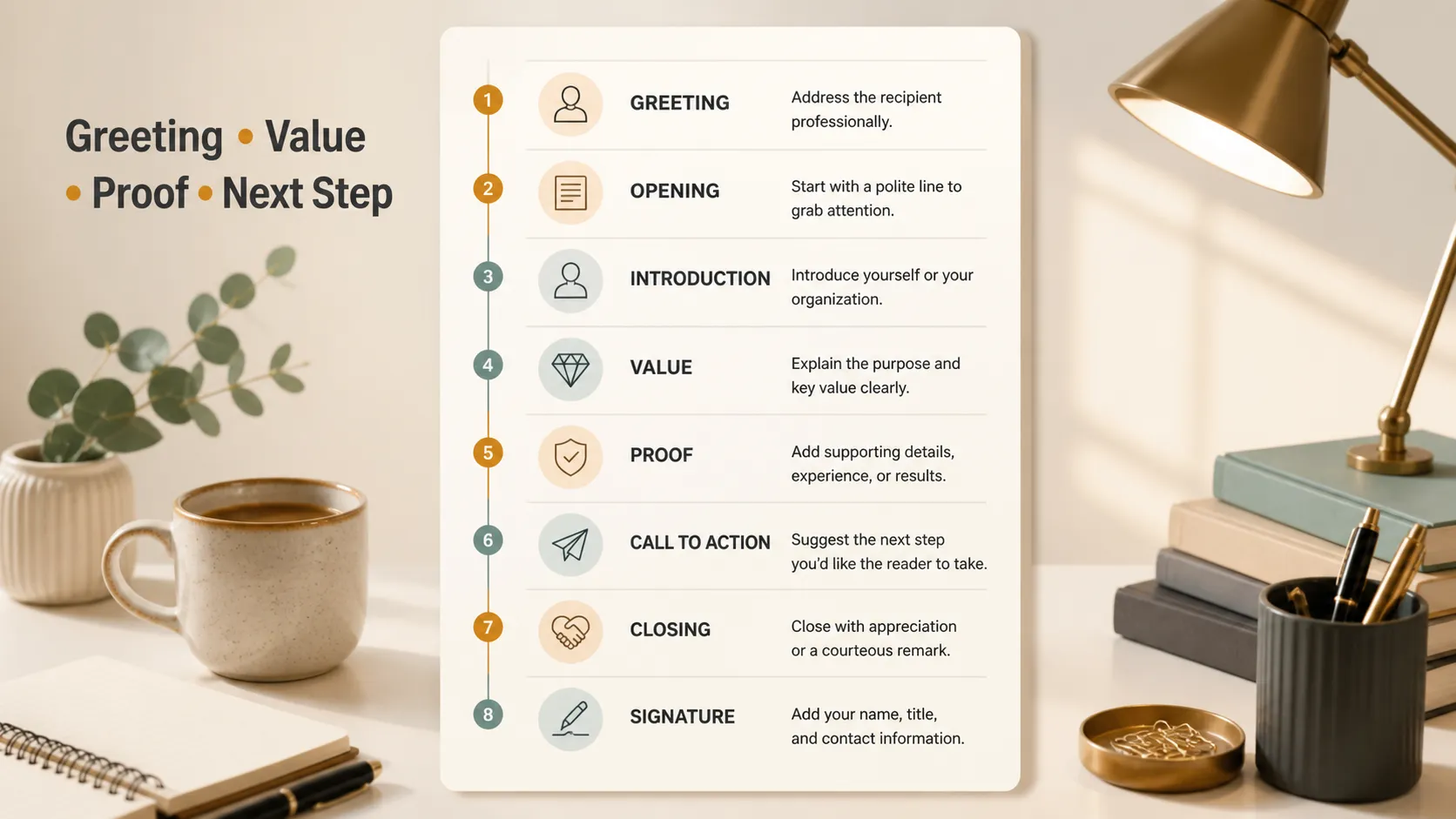
| Section | What to include |
|---|---|
| Contact details | Your name, role, company, email, phone, and date |
| Recipient details | Recipient name, title, company, and address if needed |
| Greeting | A professional greeting, ideally using the recipient's name |
| Opening line | A direct sentence explaining why you are writing |
| Introduction | A short introduction of yourself, your company, product, or proposal |
| Value and proof | Why it matters to the reader, plus one or two supporting details |
| Call to action | A request for a meeting, reply, demo, interview, or next step |
| Closing | A polite sign-off and signature |
This structure helps the reader understand your message quickly. It also prevents the letter from becoming a long biography, company brochure, or product description.
Letter of presentation template
Use this letter of presentation template as a starting point:
Dear [Recipient Name],
I am writing to introduce [yourself / your company / your product / your service] and explain how it may be relevant to [recipient's goal, team, or organization].
[Briefly explain who you are or what you offer. Keep this section focused on the reader's needs, not only on your own background.]
This may help [audience] achieve [result] by [method, product, service, or strength].
[Add one or two proof points, such as experience, results, clients, features, awards, or relevant examples.]
Would you be open to [a short call / meeting / demo / reply] next week?
Sincerely,
[Your Name]
[Your Role]
[Company Name]
[Email / Phone / Website]
How to write a letter of presentation
1. Define the reader and purpose
Before writing, decide exactly who the letter is for and what outcome you want. You may want to introduce yourself for a job, present a consulting service to a potential client, introduce a product, or contact a partner about a possible collaboration.
If the purpose is clear, the letter will be easier to write and easier to answer.
2. Write a direct opening
The opening should explain why you are writing. Avoid vague lines like "I am writing to tell you about myself." Be specific from the first sentence.
For a self-introduction letter, you might write:
I am writing to introduce myself as a digital marketing specialist with five years of experience helping B2B teams improve lead generation and campaign performance.
For a company or product letter, you might write:
I am writing to introduce ClearPath Analytics, a reporting platform designed to help small finance teams turn monthly data into client-ready dashboards faster.
The reader should understand the topic and relevance quickly.
3. Present clear value
After the opening, explain what you bring to the reader. This is not the place for a full biography, product manual, or company brochure. Choose details that connect directly to the recipient's needs.
A useful formula is:
I help [audience] achieve [result] by [method or strength].
For example:
I help SaaS teams improve trial-to-paid conversion through lifecycle email strategy.
For a company or product letter, focus on the problem you solve and the benefit you provide.
4. Add brief proof
A presentation letter should feel credible, but it should not become a resume, brochure, or product catalog. Add only the proof that strengthens your message.
Useful proof may include years of experience, measurable results, relevant clients, certifications, awards, product features, or one short example of past work. Two strong details are better than six vague claims.
5. End with a clear next step
Every letter of presentation should end with a clear call to action. You might ask for a short meeting, interview, phone call, demo, permission to send more information, or referral to the right contact.
Good closing lines include:
- Would you be open to a 20-minute call next week?
- I would be glad to send a short overview if this is relevant to your team.
- Thank you for considering my introduction. I would welcome the chance to discuss the role further.
Letter of presentation vs cover letter vs letter of introduction
A letter of presentation, cover letter, and letter of introduction can overlap, but they are not always the same.
A cover letter is usually sent with a resume or application. It presents your background for a specific job or opportunity. A letter of introduction is often used to introduce one person, company, or contact to another. A letter of presentation is broader. It can introduce a person, company, product, service, proposal, or business idea.
In simple terms, a cover letter can be a type of letter of presentation, but not every letter of presentation is a cover letter.
How to write a letter of presentation with Pi
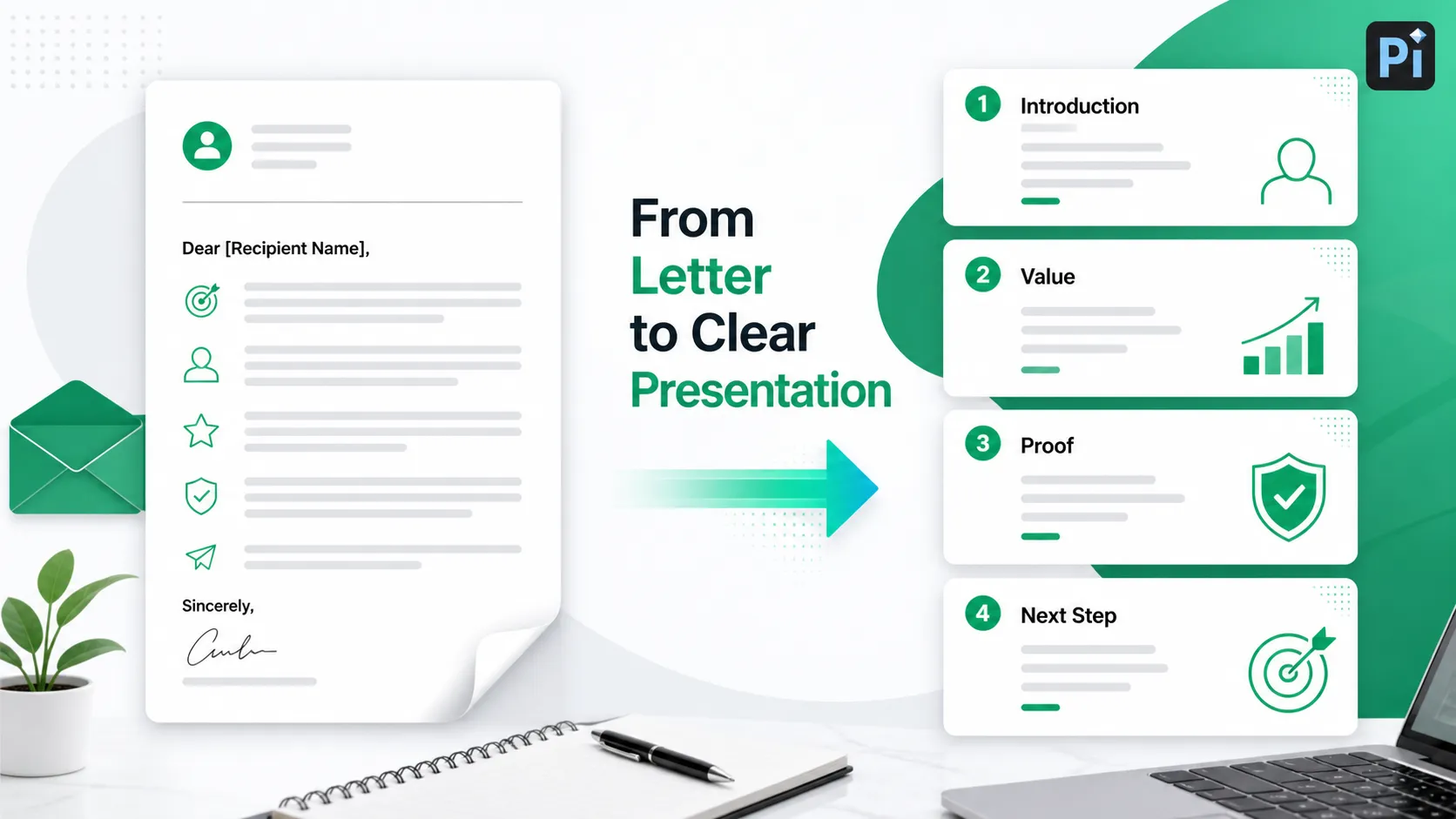
If you already have the facts but are not sure how to organize them, Pi can help you shape the first draft. This is useful when your information is scattered across a resume, company profile, product page, proposal notes, PDF, Word document, or webpage.
The best way to use Pi is to give it real context: who the reader is, what you are presenting, what tone you want, and what outcome you need.
Example prompt for a self-introduction letter:
Write a concise letter of presentation for a marketing specialist introducing herself to a potential employer. Highlight B2B campaigns, lead generation, and content strategy. End by asking for a short conversation.Example prompt for a business presentation letter:
Write a letter of presentation introducing our project management software to a consulting firm. Focus on saving time, improving client visibility, and reducing manual status updates. End with a request for a short demo.After Pi gives you a draft, revise it carefully. Add the recipient's name, real achievements, accurate product details, and a more personal opening. You can also reuse the core message later for a short pitch, email introduction, or meeting presentation.
Common mistakes to avoid
- Do not make the letter too long. A strong letter of presentation is usually one page or less.
- Do not focus only on yourself. Even in a self-introduction letter, the reader wants to know why your background matters to them.
- Do not use vague claims such as "excellent service" or "strong skills" without proof.
- Do not sound too aggressive. A presentation letter should open a conversation, not pressure the reader.
- Do not forget to proofread names, titles, company details, dates, and contact information.
The Verdict
A good letter of presentation is clear, focused, and useful to the reader. Identify whether you are presenting yourself or presenting a company, product, service, or proposal. Then write a direct opening, explain the value, add brief proof, and end with a simple next step.
Pi can help you move from rough notes to an organized draft, but the strongest letters still need human judgment. Personalize the message, check every detail, and make sure the final version sounds like a real professional reaching out with a clear reason.
Frequently Asked Questions (FAQ)
Q:Is a letter of presentation the same as a cover letter?
A:Sometimes. In a job or self-introduction context, a letter of presentation can function like a cover letter. In business contexts, it may introduce a company, product, service, or proposal instead.
Q: How long should a letter of presentation be?
A:Most letters of presentation should be one page or less. Aim for three to five short paragraphs that explain who you are, what you offer, why it matters, and what should happen next.
Q:What tone should I use?
A:Use a professional, respectful, and clear tone. It can be warm, but it should not be casual. Avoid exaggeration, pressure, or language that sounds copied from a template.
Q: Can I use the same letter for different recipients?
A:You can reuse the structure, but you should personalize the details. Change the greeting, opening, value points, and call to action so the letter fits each recipient.