how to write a thesis statement
Learning how to write a thesis statement can feel difficult when you have a broad topic but no clear point to make. The good news is that a strong thesis is not something you either “have” or do not have. It is usually built through a simple process: narrow the subject, decide what you want to say about it, and make that idea specific enough to support in an essay.
A thesis statement gives your reader a clear sense of where the paper is going. It also gives you a practical guide for choosing evidence, organizing paragraphs, and avoiding unrelated ideas.
What Is A Thesis Statement?
A thesis statement is the main claim, answer, or controlling idea of an essay. It tells readers what the paper will argue, analyze, or explain.
The Harvard College Writing Center ↗ describes a thesis as the central claim or main insight of an essay. The UW-Madison Writing Center ↗ also explains that a thesis makes a promise about the scope, purpose, and direction of a paper.
In most academic writing, a thesis statement appears near the end of the introduction. It is often one or two sentences long, although the right length depends on the assignment and subject.
A thesis is not simply a topic. “Social media and teenagers” is a topic. “Schools should teach media literacy because it helps teenagers evaluate online information, recognize harmful content, and communicate responsibly” is a thesis statement.
For an essay thesis or research paper thesis, the goal is to make a point that the rest of the paper can develop and support.
Why A Strong Thesis Statement Matters
A strong thesis statement does more than introduce a subject. It gives the essay direction.
When your thesis is clear, readers know what to expect. They can see the purpose of your evidence and understand how each body paragraph connects to your main point. For writers, a focused thesis makes research easier because it helps answer a useful question: “Does this source or example support my argument?”
Without a thesis, essays often become a list of facts or loosely related observations. With one, the writing has a central idea. The University of Toronto writing advice ↗ puts special emphasis on making a definite, limited assertion that can be explained and supported.
How To Write A Thesis Statement Step By Step
If you want to know how to write a thesis statement, begin with the assignment instead of the sentence. A thesis is easier to write when you know what kind of thinking the paper requires.
1. Understand the assignment. Look closely at the prompt. Are you being asked to argue a position, analyze a text, compare ideas, or explain a topic? Your answer should match that purpose.
2. Narrow your topic. Broad subjects are hard to cover well. Instead of writing about “education,” focus on a smaller issue, such as the effect of later school start times on high school students.
3. Turn the topic into a question. Indiana University’s guide on how to write a thesis statement ↗ recommends thinking of the thesis as the answer to the question your paper explores.
4. Make a claim or central point. An argumentative thesis takes a position. An analytical thesis offers an interpretation. An expository thesis explains the main idea or structure of a topic.
5. Add useful specificity. Give readers a reason, result, or organizing idea. This turns a general statement into one that can guide an entire essay.
6. Revise as you research. Your first thesis is a working draft, not a permanent contract. Refine it when evidence leads you toward a more precise and supportable claim.
What Makes A Thesis Statement Strong?
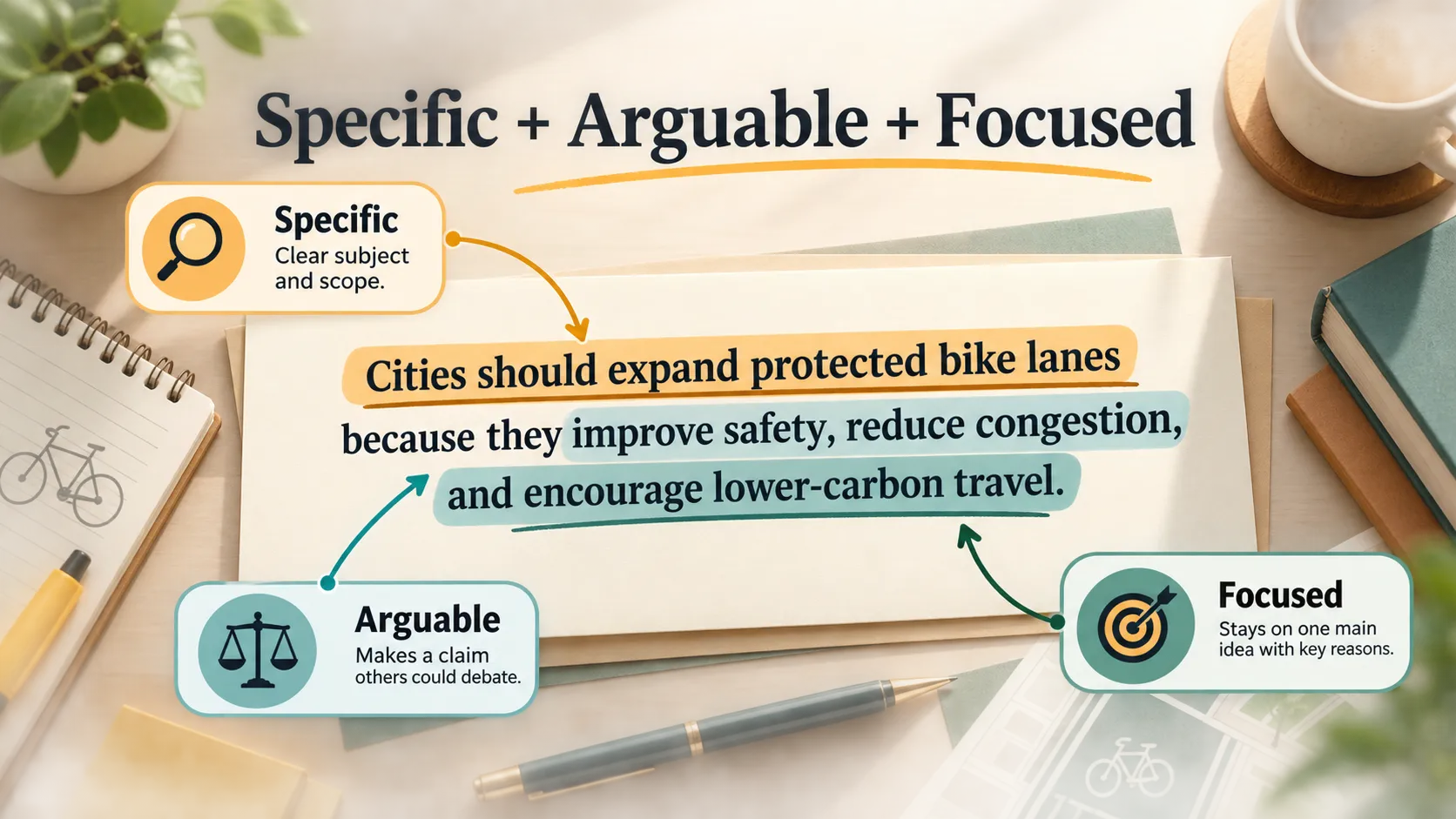
A strong thesis statement is usually specific, purposeful, and focused.
Specific means it names a clear subject and says something meaningful about it. Purposeful means it makes an arguable claim or provides a clear explanation, rather than stating an obvious fact. Focused means it stays within a manageable scope.
The George Mason University Writing Center ↗ explains that a thesis should go beyond fact or observation and become an idea that needs support. That is the key difference between a weak topic sentence and a real thesis statement.
The exact requirements vary by essay type. An argumentative thesis statement should take a defensible position. An analytical thesis should explain an interpretation of a text, event, or idea. An expository thesis should clearly present the central point readers will learn about.
A three-point structure can help beginners, but it is not a rule for every assignment. Some essays need a more nuanced claim, especially when the topic is complex.
Thesis Statement Formula And Examples
Use this thesis statement formula as a starting point, then adjust it for your assignment. The best thesis statement examples sound natural rather than mechanically following a template.
| Essay Type | How To Write A Thesis Statement | Thesis Statement Example |
|---|---|---|
| Argumentative | Topic + position + key reasons | Cities should expand protected bike lanes because they improve commuter safety, reduce traffic congestion, and encourage lower-carbon travel. |
| Analytical | Subject + interpretation + supporting insight | In *The Giver*, Lois Lowry uses controlled language and restricted memory to show how a community can sacrifice freedom for the appearance of safety. |
| Expository | Topic + central explanation + main areas | Effective time management for college students depends on planning weekly priorities, breaking large tasks into smaller steps, and protecting regular study time. |
When learning how to write a thesis statement, do not copy formulas word for word. Use them to identify what is missing from your own sentence: a position, a clear insight, or a manageable scope.

Weak Vs. Strong Thesis Statement Examples
A weak thesis is often too broad, too obvious, or too vague to guide the paper.
Weak: “Technology has changed education.” Strong: “Online learning platforms have changed higher education by making course materials more flexible, while also increasing the need for students to manage their time independently.”
Weak: “School uniforms are controversial.” Strong: “Public middle schools should allow flexible uniform policies because students benefit from lower clothing costs without losing reasonable dress standards.”
Weak: “This essay will discuss climate change.” Strong: “Local governments can reduce urban heat risks by expanding tree cover, improving cooling-center access, and prioritizing heat-resilient housing.”
The stronger versions make a clear point and suggest the evidence the writer will need.
Common Thesis Statement Mistakes To Avoid
Avoid announcing your topic instead of making a point. Phrases such as “This paper will discuss” usually weaken academic writing.
Also avoid statements that are too broad, such as “Pollution is bad,” or statements that are only facts, such as “Many students use smartphones.” A thesis should go beyond information that nobody would dispute.
Do not leave your thesis as a question. If the prompt asks, “Should schools start later?” your thesis should answer that question. Finally, avoid claims that your essay cannot support. A qualified, evidence-based statement is more convincing than an absolute claim.
The Purdue OWL ↗ is a useful broader resource for academic writing, especially when you want help with essay structure, research, citation, and revision.
The Verdict
A good thesis statement is a focused promise to your reader: this is the point I will make, and this is how the essay will develop it. Draft one early, compare it with the assignment prompt, and revise it as your research becomes clearer.
Ready to present your argument? Turn your thesis outline into slides with Pi. ↗
Frequently Asked Questions
What is a thesis statement?
A thesis statement is the main claim, answer, or controlling idea of an essay. It tells readers what the paper will argue, analyze, or explain.
Where does a thesis statement go?
A thesis statement usually appears near the end of the introduction. This placement prepares readers for the body paragraphs that follow.
How long should a thesis statement be?
Most thesis statements are one or two sentences. A strong thesis statement should be long enough to state a clear, specific point but short enough to remain focused.
What is the easiest way to learn how to write a thesis statement?
Turn your topic into a question, answer that question in one sentence, then revise the sentence until it is specific, focused, and supportable.