How to Write an Elevator Pitch: Step-by-Step Guide & Examples
Whether you are preparing for a job interview, meeting a potential client, introducing a startup, or networking at an event, you may only have a few moments to make your message clear. That is where a strong elevator pitch helps.
Learning how to write an elevator pitch is not about memorizing a sales speech. It is about preparing a concise, audience-centered introduction that makes people want to know more. The best pitches explain your value quickly, sound natural in conversation, and end with a practical next step.
What Is an Elevator Pitch?
An elevator pitch is a brief, persuasive introduction that explains who you are, what you do, the problem or opportunity you address, and why it matters. It is usually delivered in roughly 30 seconds, though the right length depends on the situation and listener.
A good elevator pitch is not a rigid script. Think of it as a flexible message framework you can adapt for interviews, sales calls, investor conversations, conferences, and everyday professional networking.
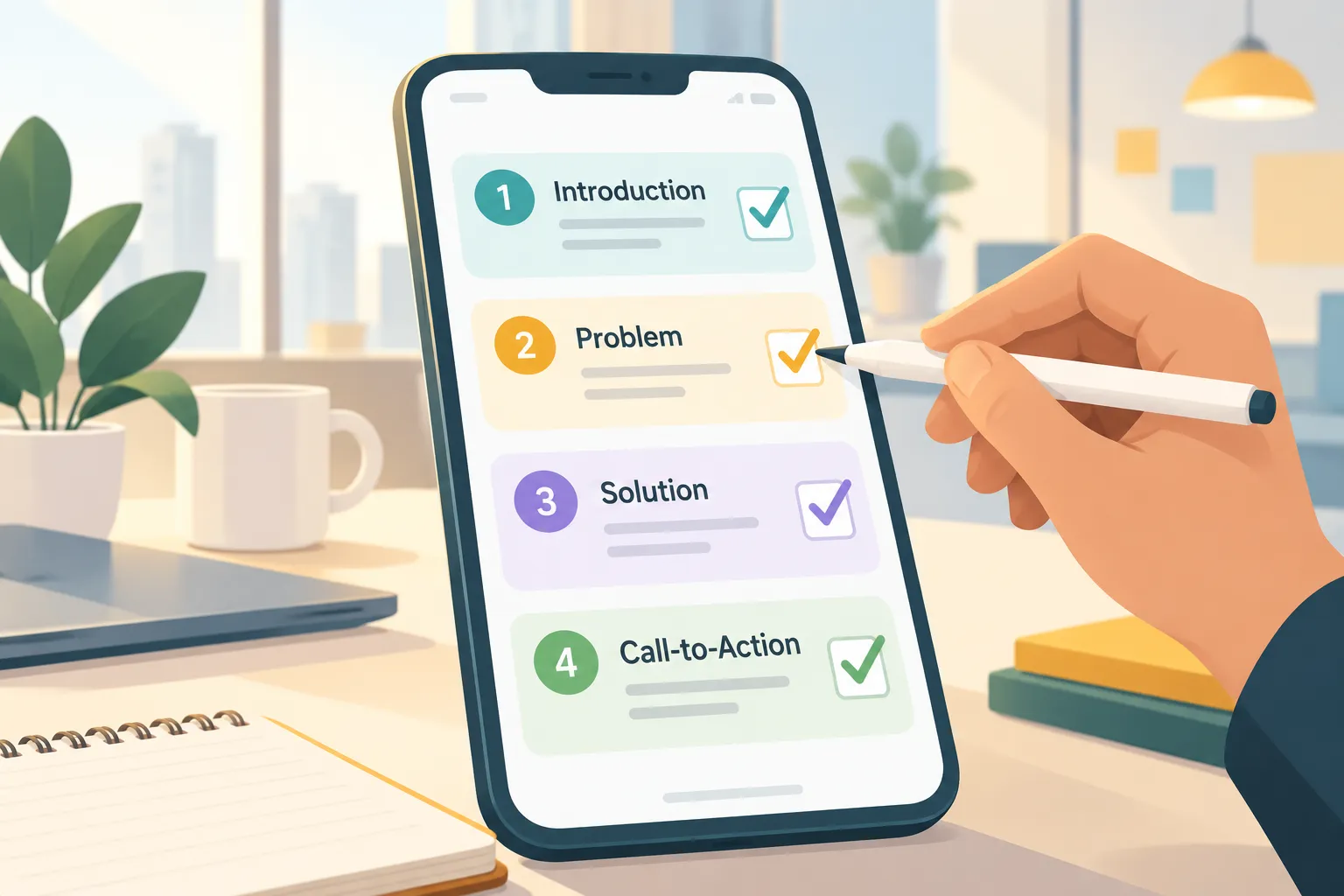
Elevator Pitch Quick Summary: The 4-Step Formula
Use this simple elevator pitch outline to organize your message before refining the wording:
1. Start with who you help or what you do. Make your role, company, or focus immediately relevant.
2. Name a problem, need, or opportunity. Show that you understand the listener’s context.
3. Explain your unique value. Describe the outcome you create, supported by a credible differentiator or result.
4. End with a next step. Invite a conversation, ask a question, or suggest a relevant follow-up.
This structure works because it moves beyond a generic biography. Instead of listing your title, education, product features, or career history, it gives the listener a clear reason to engage.
Step 1: Start With Who You Help or What You Do
The first sentence answers the question behind most introductions: “Why should I pay attention?”
When deciding how to start an elevator pitch, avoid leading with a vague label such as “I work in marketing” or “I am an entrepreneur.” Those statements may be accurate, but they do not explain your relevance.
Try to connect your work to a specific audience or outcome.
Instead of saying, “I am a financial advisor,” say, “I help first-time business owners make confident decisions about cash flow and long-term growth.”
Instead of saying, “I am looking for a new role,” say, “I am a customer success specialist focused on helping SaaS teams improve onboarding and reduce early customer churn.”
Specificity creates clarity. You do not need to share every detail; you only need to give the listener a useful starting point.
Step 2: Name the Problem, Need, or Opportunity
Next, make the pitch audience-centered. Identify the challenge your work solves, the goal it supports, or the opportunity it unlocks.
For an entrepreneur, this could be a costly operational problem. For a job seeker, it may be a business need connected to the role. For a sales professional, it should reflect a priority the prospect recognizes.
A useful question to ask is: What matters to this audience right now?
For example, a project manager might say, “Many growing teams struggle to keep cross-functional launches on schedule when priorities change quickly.” This statement establishes context before introducing a solution.
Keep this portion short. You are not trying to prove every point in 30 seconds. You are showing that your work connects to a real need.
Step 3: Explain Your Unique Value Clearly
This is the core of your pitch: how you help and what makes your approach credible.
Strong value statements focus on outcomes rather than empty claims. Phrases such as “we are innovative,” “I am passionate,” or “our solution is best-in-class” do not give the listener enough information to evaluate your value.
Instead, describe a concrete result, method, or proof point.
For example: “We combine automated reporting with hands-on financial guidance, so founders can see their cash position without waiting until month-end.”
Or: “In my last role, I redesigned the onboarding sequence and helped reduce time-to-value for new customers by 20%.”
You do not need to overload your pitch with statistics. One relevant proof point can be helpful, but clarity matters more than cramming in credentials, features, and achievements.
Step 4: End With a Relevant Next Step
A clear ending prevents your pitch from feeling abrupt or overly promotional. The best next step depends on the conversation.
In a networking setting, ask an open question: “What customer-retention priorities is your team focused on this year?”
In a job interview, connect your experience to the role: “I would be glad to share how I would approach improving the onboarding journey for this position.”
In a sales conversation, offer a low-pressure follow-up: “Would it be useful to compare this with how your team currently handles reporting?”
Your goal is not to force a decision. It is to create a natural opening for a more detailed conversation.

How to Keep an Elevator Pitch to 30 Seconds
A 30 second elevator pitch is usually around 60 to 75 spoken words, depending on your pace. That may sound short, but it is enough time to communicate a focused idea.
Start by writing a longer draft, then edit aggressively. Remove background details that do not help the listener understand your value. Replace jargon with familiar language, and choose short sentences that are easy to say aloud.
A concise pitch should usually include:
- One clear description of who you help or what you do
- One relevant problem, goal, or opportunity
- One value statement or proof point
- One conversational next step
Practice with a timer, but do not rush. Speaking too quickly can make even a well-written pitch hard to follow. Aim for a calm pace, leaving enough room for the listener to react or ask a question.
Need help condensing your core message into a pitch deck?
Try Pi AI Presentation Maker for Free
Elevator Pitch Templates You Can Customize
A flexible elevator pitch template gives you a starting structure without making every introduction sound the same.
Job seeker template
> “I am a [professional role or specialty] with experience in [relevant area]. I help [team, customer, or employer type] achieve [business outcome] by [key skill or approach]. Recently, I [relevant result or achievement]. I am interested in opportunities where I can help with [role-related priority].”
Entrepreneur template
> “I am the founder of [company], which helps [target audience] solve [specific problem]. Unlike [common alternative or old approach], we [clear differentiator]. Our goal is to help customers achieve [measurable or meaningful outcome]. I would love to hear how you currently approach this challenge.”
Sales representative template
> “I work with [customer type] that need to improve [priority or process]. Many teams struggle with [specific pain point], which can lead to [business consequence]. We help them [desired result] through [solution category or approach]. Would you be open to discussing whether this is relevant for your team?”
General networking template
> “I work in [field] and focus on [specialty]. I am especially interested in helping [audience] with [need or opportunity]. At the moment, I am exploring [goal, project, or topic]. What kind of work are you focused on?”
Customize the words to fit your voice. A template should make preparation easier, not make you sound like you are reading from a script.
Elevator Pitch Examples: Before and After
The difference between a weak and effective pitch is often not more information. It is better focus.
Job seeker example
Before: “Hi, I am Jordan. I have a degree in communications, and I have worked in several marketing jobs. I am a hard worker, I learn quickly, and I am looking for a company where I can grow.”
After: “I am a content marketer with experience turning complex B2B topics into campaigns that generate qualified interest. In my most recent role, I helped improve organic demo conversions by creating clearer product-education content. I am now looking for a growth-focused team where content can support both brand and pipeline.”
The revised version gives the listener a clearer role, business contribution, and career direction.
Entrepreneur example
Before: “We have an innovative platform for small businesses with many features that can help them manage everything better.”
After: “We help independent retailers reduce stockouts by giving them a simple view of inventory across in-store and online sales. Instead of relying on disconnected spreadsheets, owners can see what needs attention before lost sales add up.”
The improved version replaces broad claims with a defined audience, problem, and outcome.
Sales example
Before: “Our software has dashboards, automations, integrations, and advanced analytics for businesses of all sizes.”
After: “We help revenue operations teams spend less time consolidating performance data from separate systems. Our platform brings pipeline, activity, and forecast information into one reporting workflow, so leaders can spot risk earlier.”
The second version leads with the buyer’s problem rather than a feature list.
How to Deliver an Elevator Pitch Naturally
Even the strongest elevator pitch examples can feel awkward if delivered too formally. Practice enough to remember your core points, but avoid trying to recite every word perfectly.
Start by adapting the opening to the situation. At a networking event, a simple “What brings you here?” may come before your introduction. In an interview, you may begin with a direct response to “Tell me about yourself.” In sales, lead with a question or observation relevant to the prospect’s business.
Listen for cues from the other person. If they seem interested in one part of your message, pause and explore it. If they ask a question before you reach your planned ending, answer it. A pitch should support a conversation, not interrupt one.
Record yourself once or twice and listen for jargon, overly long sentences, or words you would not normally use. Then practice with a colleague who can tell you what they understood after hearing it once. If they cannot repeat your main value clearly, simplify the message.

Turn Your Elevator Pitch Into a Stronger Presentation With Pi
An elevator pitch opens the conversation. When the opportunity moves into a meeting, interview presentation, sales discussion, or investor review, you need a clearer way to expand the message without losing its focus.
Pi is an AI presentation maker designed for professional business communication. It can help turn a validated elevator pitch outline into a structured pitch deck, sales deck, executive presentation, or proposal with stronger narrative flow and polished visuals.
1. Business Logic Comes Before Slide Styling
A strong deck should build on the same logic as your pitch: audience, problem, value, evidence, and next step. Pi helps organize those ideas into a business-ready presentation structure instead of treating slides as isolated design tasks.
2. Multi-Agent AI Supports Complex Presentation Work
High-stakes presentations often require more than a single prompt. Pi’s Multi-Agent AI approach helps develop content, structure, and visual direction together, making it easier to move from a short message to a coherent story for decision-makers.
3. Premium Visual Quality Supports Credibility
Professional visuals cannot replace clear thinking, but they can make your message easier to absorb. Pi helps teams produce business-grade slides that support the value proposition you have already defined in your elevator pitch.
| Communication Need | Elevator Pitch | Pi Presentation Workflow |
|---|---|---|
| Primary goal | Create interest quickly | Explain and support the full case |
| Typical length | About 30 seconds | A focused meeting-ready deck |
| Content depth | Core message only | Evidence, context, and recommendations |
| Best use | Introductions and first conversations | Sales meetings, interviews, pitches, and reviews |
| Visual role | Minimal or none | Structured, premium business visuals |
Ready to transform your 30-second pitch into a high-converting presentation?
Frequently Asked Questions (FAQ)
How long should an elevator pitch be?
Most elevator pitches take about 30 seconds, or roughly 60 to 75 spoken words. However, the best length depends on the setting. Prepare a short version for quick introductions and a slightly longer version for interviews or planned business conversations.
How do you start an elevator pitch?
Start with a relevant description of who you help, what you do, or the outcome you create. Avoid opening with your full biography. A focused first sentence gives the listener immediate context and makes the rest of the pitch easier to follow.
Should an elevator pitch be memorized?
You should know the key ideas well, but you do not need to memorize every word. Over-memorization can make your delivery sound stiff. Practice the structure, core proof point, and next-step question so you can adapt naturally to different listeners.
What should I include in an elevator pitch for a job interview?
Include your professional focus, relevant experience, a specific strength or achievement, and a connection to the role you want. Keep the message focused on the employer’s needs rather than simply listing your work history.