Kimi K3 Open Day: 2.8 Trillion Parameters, Now Open Weight
On July 27, 2026, Moonshot AI held Kimi K3 Open Day and announced three connected releases: the Kimi K3 model weights, the official technical announcement, and three infrastructure technologies: MoonEP, FlashKDA, and AgentEnv. The event positioned Kimi K3 not only as a new large-scale model, but also as a release covering model access, architecture, and deployment infrastructure.
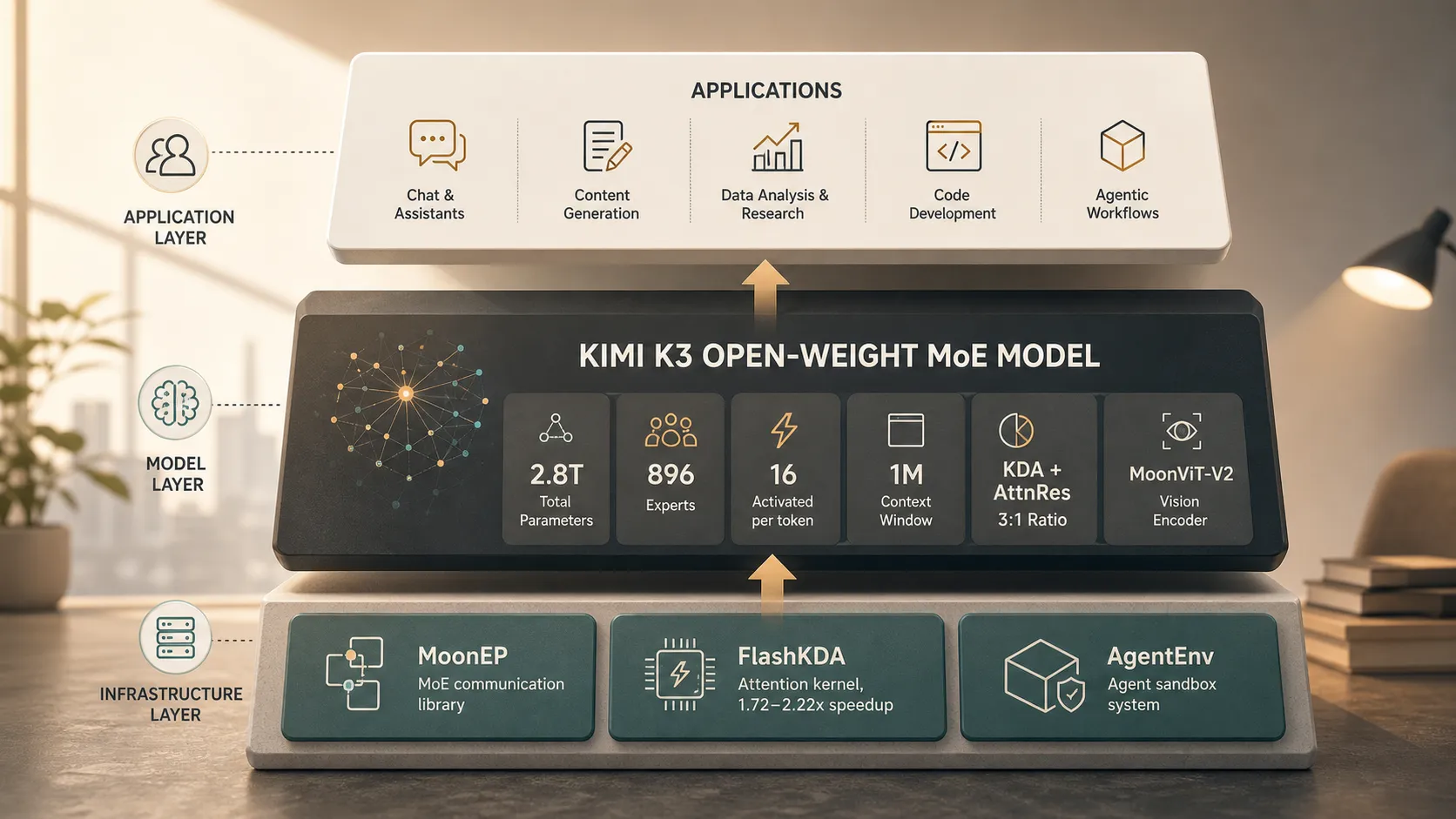
The headline specification is clear: Kimi K3 is a 2.8 trillion-parameter open-weight model built on a Mixture of Experts (MoE)architecture. Moonshot AI disclosed major technical details, including 896 experts, 16 experts activated per token, a 1M-token context window, KDA + AttnRes at a 3:1 ratio, MoonViT-V2, and a reported 2.5x scaling efficiency improvement.
The term open-weight matters. Open-weight means the trained model weights are made available under defined terms. It does not automatically mean the model is fully open-source, which usually implies broader access to source code, training data, tooling, and reproduction pipelines. Still, open-weight access can change how developers and organizations deploy, inspect, and build around a major AI model.
Moonshot AI summarized the value of this approach by saying that “open-weight models... lower the barrier to accessing intelligence, drive innovation, and give users greater control over data, privacy, and ownership.”
The Open Day Event: Three Core Releases
Kimi K3 Open Day centered on three release categories.
First, Moonshot AI released the Kimi K3 model weights. This is the core open-weight announcement. For builders, access to weights can enable more flexible deployment than a hosted-only API, especially when teams need control over infrastructure, latency, privacy, or data residency.
Second, Moonshot AI published the Kimi K3 technical report. This matters because large-model announcements cannot be evaluated by parameter count alone. Architecture, routing strategy, long-context design, multimodal capability, and efficiency claims determine whether a model is useful in practice.
Third, Moonshot AI released MoonEP, FlashKDA, and AgentEnv. These infrastructure technologies target expert communication, attention performance, and agent execution. Their inclusion shows that Kimi K3 Open Day was not just a model release; it was also an infrastructure release for using very large open-weight models more effectively.
The Model: Key Specs
Kimi K3 is a 2.8 trillion-parameter MoE model. In a Mixture of Experts architecture, only part of the model is activated for each token. A router selects a subset of experts, allowing the system to combine very large total capacity with lower active compute than a dense model of similar size.
According to Moonshot AI, Kimi K3 has 896 experts, with 16 experts activated per token. This design is central to the model’s efficiency profile. It lets the model hold massive overall capacity while using selective activation during inference.
| Specification | Kimi K3 Official Detail |
|---|---|
| Total Parameters | 2.8 trillion |
| Architecture | Mixture of Experts (MoE) |
| Expert Allocation | 896 experts / 16 activated per token |
| Context Window | 1M tokens |
| Attention Design | KDA + AttnRes at a 3:1 ratio |
| Vision Architecture | MoonViT-V2 |
| Scaling Efficiency | 2.5x improvement |
The 1M-token context window is one of the most practical specifications. Long context can support full-document analysis, large codebase review, multi-file reasoning, legal or financial document workflows, and longer agent tasks without forcing every input into small fragments.
Kimi K3 also uses KDA + AttnRes at a 3:1 ratio, a hybrid attention design tied to its long-context strategy. The model includes MoonViT-V2 as its vision architecture, indicating native multimodal capability rather than a purely text-only system. Moonshot AI also reported a 2.5x scaling efficiency improvement, suggesting that Kimi K3 was designed not only for scale, but also for more practical training and inference economics.
The Infra Release: MoonEP, FlashKDA, and AgentEnv.
Open-weight models still need strong systems around them. Large MoE models depend on efficient communication, fast attention kernels, and safe execution environments. Moonshot AI’s infrastructure release addresses these needs directly.
MoonEP: MoE Expert Communication
MoonEP is a communication library for MoE expert parallelism. In MoE systems, tokens are routed to different experts, and those experts may be distributed across multiple devices. This creates communication challenges that can limit throughput and increase latency.
For Kimi K3, with 896 experts and 16 activated per token, expert routing is a major systems problem. MoonEP is designed to improve distributed expert communication and reduce bottlenecks in large-scale MoE deployment.
FlashKDA: Faster Long-Context Attention
FlashKDA is an attention kernel optimized for KDA. Its role is especially important for long-context workloads, where prefill computation can become expensive. Moonshot AI reported that FlashKDA delivers a 1.72x to 2.22x speedup in prefill performance on Nvidia H20 GPUs compared with flash-linear-attention baselines.
This matters because a 1M-token context window is only useful if it can be served efficiently. Faster attention kernels can make long-document analysis, code review, research workflows, and multi-step reasoning more practical in production.
AgentEnv: Sandbox for AI Agents
AgentEnv is an agent sandbox system co-developed with KVCache.ai. It provides an isolated sandbox environment for agents that need to execute steps, test actions, fork state, restore prior states, or run parallel branches.
Agent workflows often involve more than text generation. They may use files, tools, code execution, and multi-step decisions. A sandbox helps separate agent behavior from external systems while supporting experimentation. AgentEnv’s snapshot, restore, and fork features are useful when agents need to explore multiple paths before producing a final result.
Why Open-Weight Matters
Open-weight access changes the relationship between model providers and builders. A closed hosted API can be powerful, but infrastructure, hosting, data flow, and operational limits remain controlled by the provider. An open-weight model gives qualified teams more room to deploy, adapt, optimize, and integrate the model into their own systems.
For enterprises, the biggest advantage is deployment and data control. Sensitive documents, internal code, legal records, customer information, and financial materials may require private infrastructure. Open-weight access can support local or private-cloud deployment where data governance, privacy, and ownership are central requirements.
For developers, open-weight access enables deeper technical integration. Teams can optimize inference stacks, test adaptation methods, and build workflows around the model’s strengths. Kimi K3’s MoE scale, 1M-token context, MoonViT-V2 vision capability, and infrastructure releases create a foundation for specialized applications.
The distinction from open-source remains essential. Open-weight does not automatically provide the training data, source pipeline, or full reproduction recipe. However, it can still lower practical barriers for teams that need model access, private deployment, or more control over performance and privacy.
The Verdict: A Model and Infrastructure Release
Kimi K3 Open Day is best understood as a coordinated release across three layers: model access, technical disclosure, and deployment infrastructure. The 2.8 trillion-parameter MoE model is the center of the announcement, but the technical report and infrastructure tools are critical to understanding its broader significance.
The official specifications are substantial: 2.8T total parameters, 896 experts with 16 activated per token, a 1M-token context window, KDA + AttnRes at a 3:1 ratio, MoonViT-V2, and a reported 2.5x scaling efficiency improvement. MoonEP, FlashKDA, and AgentEnv show that Moonshot AI is also addressing the systems needed to operate large open-weight models effectively.
Kimi K3 is not described as fully open-source; it is open-weight. Even so, by releasing weights, technical details, and supporting infrastructure, Moonshot AI made Kimi K3 a significant event in large-scale open-weight AI development.
Frequently Asked Questions (FAQ)
Q: What is Kimi K3?
A: Kimi K3 is a 2.8 trillion-parameter open-weight Mixture of Experts AI model from Moonshot AI, announced at Kimi K3 Open Day on July 27, 2026.
Q: What does open-weight mean?
A: Open-weight means trained model weights are accessible under defined licensing terms. It differs from open-source, which usually implies broader access to source code, data, and reproduction pipelines.
Q: What Infra technologies were released with Kimi K3?
A: Moonshot AI released MoonEP, FlashKDA, and AgentEnv. MoonEP supports MoE communication, FlashKDA accelerates KDA attention, and AgentEnv provides a sandbox system for AI agents.
Q: What are the most important Kimi K3 specs?
A: Kimi K3 has 2.8T total parameters, 896 experts with 16 activated per token, a 1M-token context window, KDA + AttnRes at a 3:1 ratio, MoonViT-V2, and a 2.5x scaling efficiency improvement.