Management Consulting Report Template: Structuring Complex Business Logic
A strong management consulting report format is not simply a collection of attractive slides. It is a structured argument that helps decision-makers understand what is happening, why it matters, what options exist, and what action should come next.
That is why a useful management consulting report template must do more than provide a clean layout. Whether you are preparing a business strategy report slide, a transformation roadmap, a market entry recommendation, or an executive advisory deck, the real challenge is turning complex analysis into a clear decision narrative.
What a Management Consulting Report Format Must Do
A management consulting report format should help the audience make a decision. It should not feel like a research archive, a status update, or a decorative slide deck.
A strong format usually does five things:
- Defines the business question early.
- Explains why the issue matters now.
- Shows the evidence behind the problem.
- Compares realistic strategic options.
- Recommends a clear next step.
This is what separates a professional management consulting presentation from a general business update. The report should make the logic easy to follow, even when the analysis behind it is complex.
Harvard Business Review’s guide to effective presentations is useful here because executive communication depends on clarity, sequence, and audience focus.
Management Consulting Report Format: Core Sections
Use this structure as the foundation for a consulting-style report. It gives the deck enough discipline without turning it into a rigid template.
| Management consulting report format section | Purpose | Common slide output |
|---|---|---|
| Executive summary | State the answer and decision needed | Recommendation overview |
| Business context | Explain why the issue matters now | Market or performance snapshot |
| Key question | Define the decision frame | Problem statement slide |
| Diagnostic analysis | Identify causes, gaps, or drivers | Issue tree, chart, or framework |
| Strategic options | Compare possible paths | Option evaluation matrix |
| Recommendation | Commit to the preferred direction | Recommendation slide |
| Implementation roadmap | Translate strategy into action | Timeline or workstream plan |
| Risks and mitigations | Prepare leaders for uncertainty | Risk map or mitigation plan |
| Next steps | Clarify ownership and momentum | Action plan slide |
This structure works because it moves from context to diagnosis, from diagnosis to choice, and from choice to action. The audience should not have to guess where the report is going.
How to Structure Complex Business Logic
The strongest consulting reports usually start with the answer, then support it with grouped evidence. This is often associated with pyramid-style communication: recommendation first, supporting reasons second, detail after that.
A practical slide flow can look like this:
- Start with the business question.
- Give the executive answer.
- Explain the current situation.
- Show the root causes or key findings.
- Compare strategic options.
- Recommend one path.
- Explain the implementation plan.
- Close with risks, owners, and next steps.
Action titles are especially important. Instead of writing “Market Analysis,” write “Enterprise demand is growing fastest in regulated industries.” Instead of “Cost Review,” write “Three cost pools account for most margin pressure.”
These headlines make the reasoning visible. They help the audience understand the conclusion before they inspect every chart.
What Makes Consulting Slides Executive-Ready
Executive-ready slides are not just clean. They are easy to scan, specific, and decision-oriented.
Good consulting slides usually have:
- one main message per slide;
- a clear action title;
- supporting evidence below the headline;
- charts or tables that prove the point;
- limited secondary detail;
- a visible recommendation or implication.
Nielsen Norman Group’s explanation of visual hierarchy is useful for consulting slides because the audience should know where to look first. For data-heavy slides, the U.S. Census Bureau’s guide to data visualization is also a helpful reference for presenting information clearly.
If the report will be shared as a deck, accessibility matters too. Microsoft’s guide to accessible PowerPoint presentations and W3C’s accessible presentation guidance can help teams make slides easier for more audiences to use.
Where Static Consulting Templates Break Down
Static templates are helpful when the structure is already known. They can save time, standardize formatting, and give teams a professional starting point.
They start to break down when the business situation is unclear. A template can provide boxes for “insights” and “recommendations,” but it cannot automatically decide which evidence belongs in the main storyline, which findings should move to the appendix, or how to make the recommendation credible.
Common problems include:
- too many slides with no clear storyline;
- data shown without interpretation;
- recommendations buried too late;
- options that are not meaningfully different;
- visual polish without decision clarity;
- slide titles that describe topics instead of insights.
A deck can resemble McKinsey style slides in visual tone without achieving the same level of analytical discipline. The goal is not to copy any proprietary style. The goal is to build a clear, evidence-based business argument.
How Pi Helps Build Consulting Reports
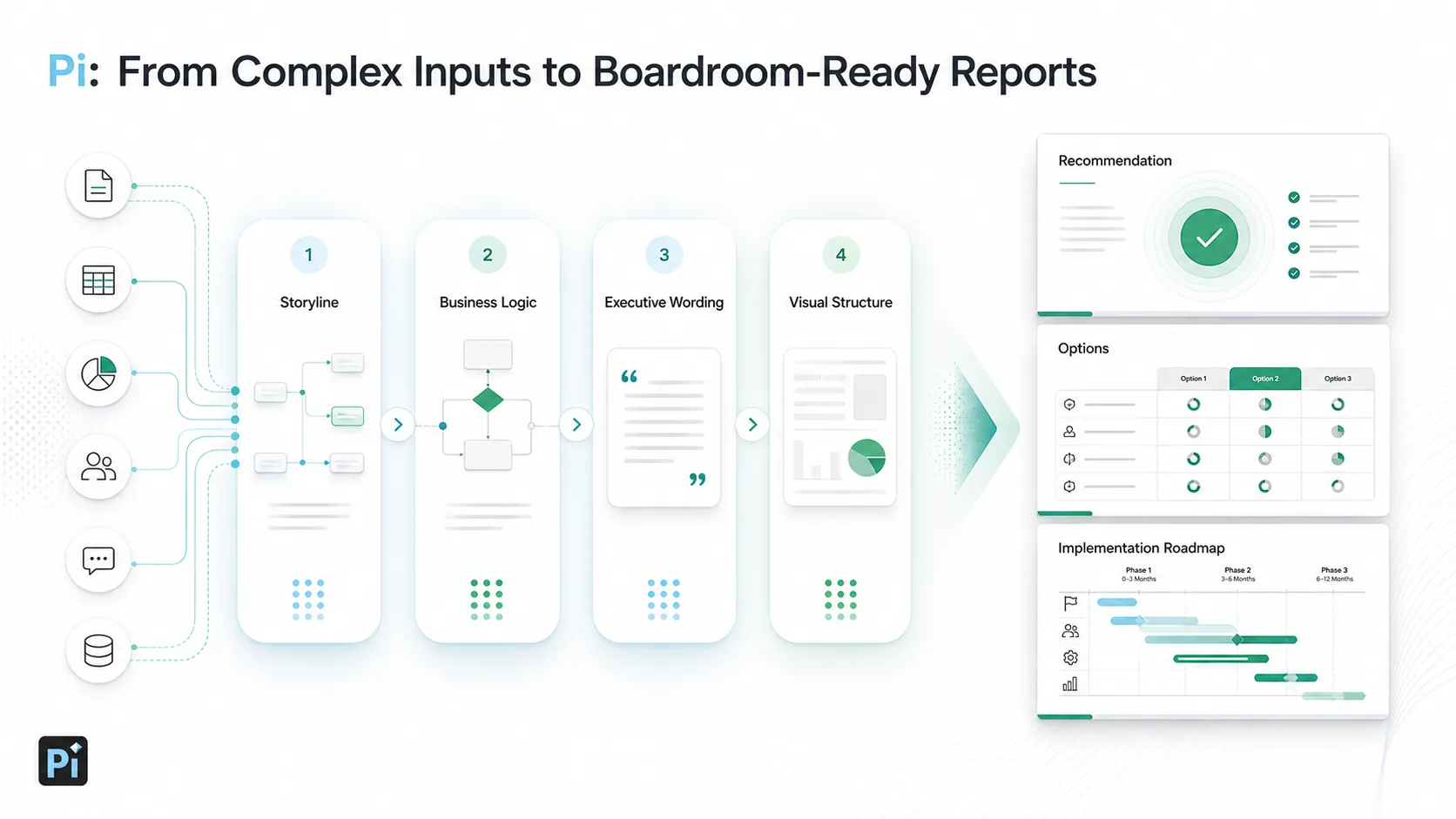
Pi presentation maker can help turn complex inputs into a structured management consulting presentation. This is useful when a team has notes, research, spreadsheets, interview findings, or rough strategy ideas, but not yet a clear executive narrative.
Pi helps with the layer between raw analysis and final slides. It can support storyline structure, slide sequencing, executive wording, and visual organization. For consulting reports, that matters because the deck needs to feel like a recommendation, not a pile of materials.
Pi also supports AI consulting template workflows where different parts of the presentation need different kinds of thinking. A concept such as a multi-agent system is useful background for understanding how specialized AI processes can work together, but the business value is simple: the final deck should be more structured, more polished, and easier to present.
Pi does not replace expert judgment, validated data, or client-specific analysis. Its value is helping professionals move from complex material to a business-ready consulting report format faster.
When to Use This Consulting Report Template
This management consulting report template is useful for:
- strategy reviews;
- market research decks;
- transformation plans;
- operating model recommendations;
- executive presentations;
- client advisory reports;
- internal decision papers;
- board-level updates.
It is also useful when a team wants consulting-style slides that are concise, structured, insight-led, and decision-oriented. The focus should be clarity of thinking, not imitation.
A Better Way to Build Consulting Reports
The best consulting report template is not just a slide format. It is a thinking structure. It helps teams clarify the problem, organize evidence, compare options, and recommend action with confidence.
Static templates can provide a useful foundation. But when the material is complex, the real value comes from a workflow that helps shape the logic behind the slides.
A strong management consulting report format should make the business argument easier to understand. Once that logic is clear, Pi can help turn it into a polished, professional deck ready for serious business conversations.

Frequently Asked Questions (FAQ)
What should a management consulting report template include?
It should include an executive summary, business context, key question, diagnostic analysis, strategic options, recommendation, implementation roadmap, risks, and next steps. The structure should support decision-making, not just organize information.
How are McKinsey style slides different from normal business slides?
McKinsey style slides are often associated with clear action titles, structured logic, strong evidence hierarchy, and concise executive communication. The goal is not to copy proprietary materials, but to make business reasoning easier to follow.
Can AI help create a consulting presentation?
Yes. AI can help structure the storyline, refine slide content, improve hierarchy, and accelerate PPT creation. However, expert judgment, validated data, and client-specific insight remain essential.
How does Pi support AI consulting templates?
Pi supports consulting-style presentations through Multi-Agent AI, business-ready structure, and premium visual quality. It helps professionals turn complex inputs into a clearer, more executive-ready management consulting presentation.