The Odyssey Pitch: Crafting Epic Business Narratives
A great pitch does not make the audience admire how much information you have. It helps them understand why the information matters, why the moment is urgent, and why the next decision is reasonable.
That is the value of an Odyssey-style pitch. The goal is not to turn your business presentation into a movie plot. The goal is to structure the journey so the audience does less work. Something has changed. A real obstacle has appeared. Your company offers a credible path forward. Evidence proves the path can work. Then a decision becomes the natural next step.
As anticipation builds around epic storytelling moments in culture, including Christopher Nolan’s 2026 film *The Odyssey*, founders and executives can borrow one useful principle: high-stakes stories need direction. In business, that direction is the difference between a polished slide deck and a pitch deck narrative that earns attention, trust, and action.
Why Executive Audiences Need a Clearer Journey
Investors, buyers, and leadership teams rarely experience a deck as isolated slides. They experience it as a sequence of questions:
- What changed in the market?
- Why does this matter now?
- What problem is becoming urgent?
- Why is this solution credible?
- What proof reduces risk?
- What action should we take?
If a deck answers these questions in the wrong order, even strong information can feel disconnected. A market-size slide may be impressive but fail to explain why this company is positioned to win. A product demo may look advanced without proving that customers need it. A traction slide may show momentum while leaving the audience unsure whether that momentum can scale.
This is why a storytelling presentation template is only useful when it supports business logic. Storytelling is not decoration. It is the architecture that helps people follow an argument under time pressure.
The Odyssey Structure for a Modern Pitch Deck
An epic journey works because each stage makes the next stage necessary. The same principle applies to high-stakes business presentations.
A strong pitch deck narrative often follows this sequence:
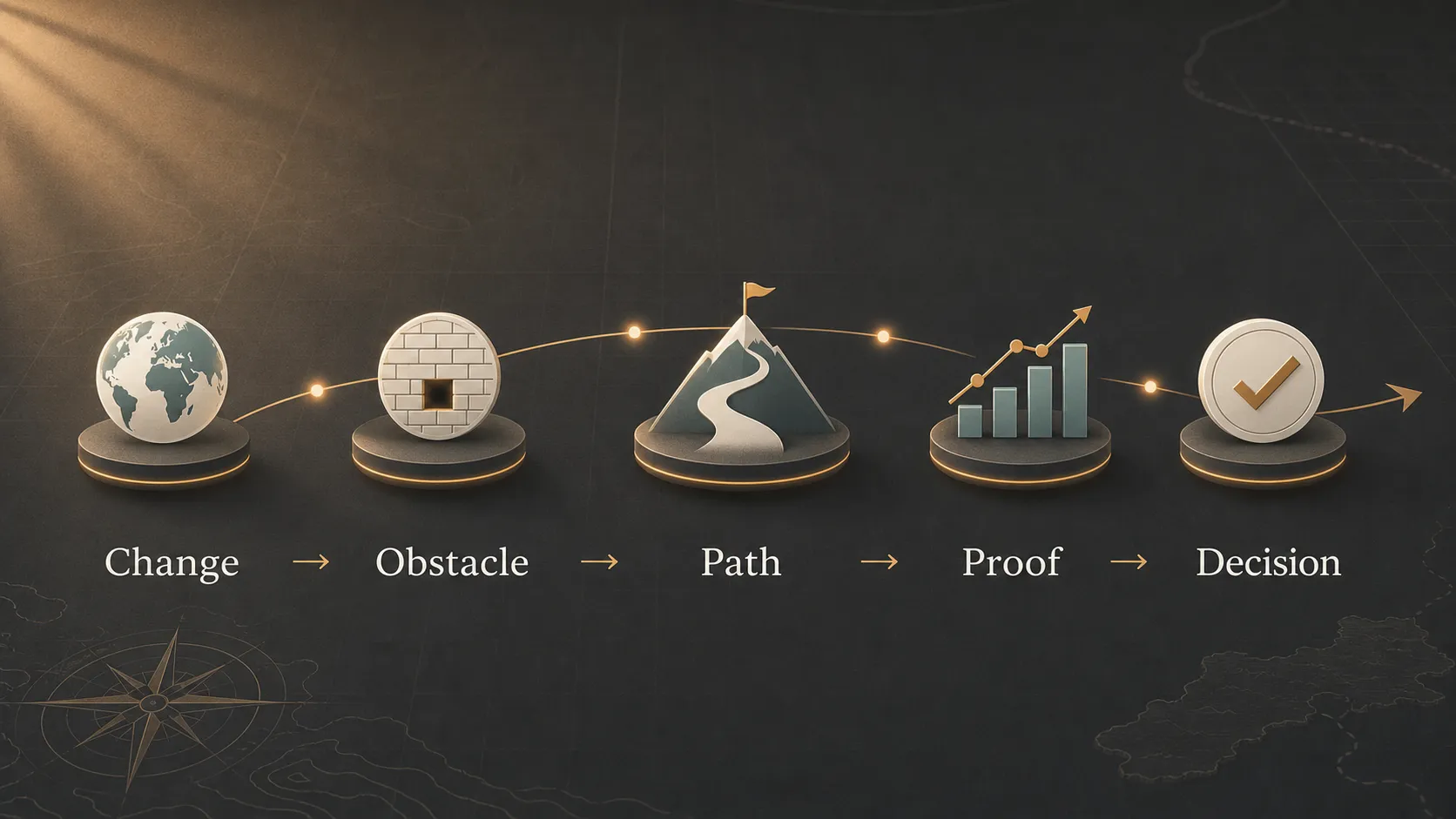
Change → Obstacle → Path → Proof → Decision
The order matters because the audience must understand the world before they can value the solution. If you introduce the product too early, the pitch can feel like a feature tour. If you introduce financial projections before the problem is clear, the numbers may feel unsupported. If you end without a specific decision, the deck may be remembered as interesting but not actionable.
The Odyssey approach does not require theatrical language. It requires narrative dependency. Each section should create a reason for the next section to exist.
Five Questions That Create an Epic Business Narrative
1. What Changed?
Begin with the shift that makes the conversation timely. This could be a technology transition, a customer behavior change, a regulatory pressure, a cost problem, or a new market opening.
The goal is to answer a simple executive question: why now?
A good opening does not overload the audience with background. It identifies the change that makes the old way less effective and the new opportunity more relevant.
2. What Became Difficult?
Every compelling business journey has friction. Make that friction specific.
Instead of saying companies are “inefficient,” explain where the inefficiency appears: slow reporting cycles, high manual workload, fragmented tools, delayed sales follow-up, poor forecasting, weak conversion, or rising operating costs.
Specific obstacles create urgency. They also make the audience more willing to evaluate a new path.
3. What Is the New Path?
Only after the obstacle is clear should the product or service become central.
This is where many decks lose focus. They present features as if features automatically create belief. In a stronger narrative, each feature is connected to a business consequence.
Do not simply say your platform automates analysis. Explain how faster analysis changes decision-making. Do not only describe AI capabilities. Explain what becomes possible for the customer, investor, or organization because those capabilities exist.
4. What Makes the Path Credible?
Proof should answer the doubts created earlier in the story.
If the main risk is adoption, show usage, retention, or customer behavior. If the main risk is demand, show pipeline, revenue growth, or validated pain. If the main risk is execution, show team experience, delivery milestones, or operational discipline.
The strongest evidence is not always the largest number. It is the proof that directly reduces the audience’s biggest uncertainty.
5. What Decision Comes Next?
A business presentation should end with a clear next step.
For investors, that may be a funding conversation. For enterprise buyers, it may be a pilot. For executives, it may be approval for a new initiative. For partners, it may be a joint plan.
A strong ending does not need to sound dramatic. It needs to make the requested decision feel connected to the logic already presented.
Traditional Deck Structures Are Useful but Not Enough
Most founders know the standard pitch deck sections: problem, solution, market, business model, traction, competition, team, and financials.
Those sections are helpful, but they are not a complete presentation strategy. Two companies can use the same slide categories and create very different outcomes. One deck feels inevitable. The other feels like a set of disconnected updates.
The difference is the connective tissue between sections.
| Presentation Need | Traditional Deck Structure | Odyssey-Style Pitch with Pi |
|---|---|---|
| Opening context | Introduces market facts | Defines the urgent shift |
| Problem slide | Describes pain points | Shows the obstacle created by change |
| Solution section | Lists product capabilities | Connects features to a new path |
| Proof section | Adds traction and metrics | Uses evidence to reduce key risk |
| Final ask | States the requested action | Makes the decision feel logical |
The winning factor is not whether the deck includes familiar sections. It is whether those sections create momentum toward a decision. That is especially important for executive audience engagement, where attention is limited and every slide must earn its place.
How Pi Presentation Intelligence Supports the Narrative
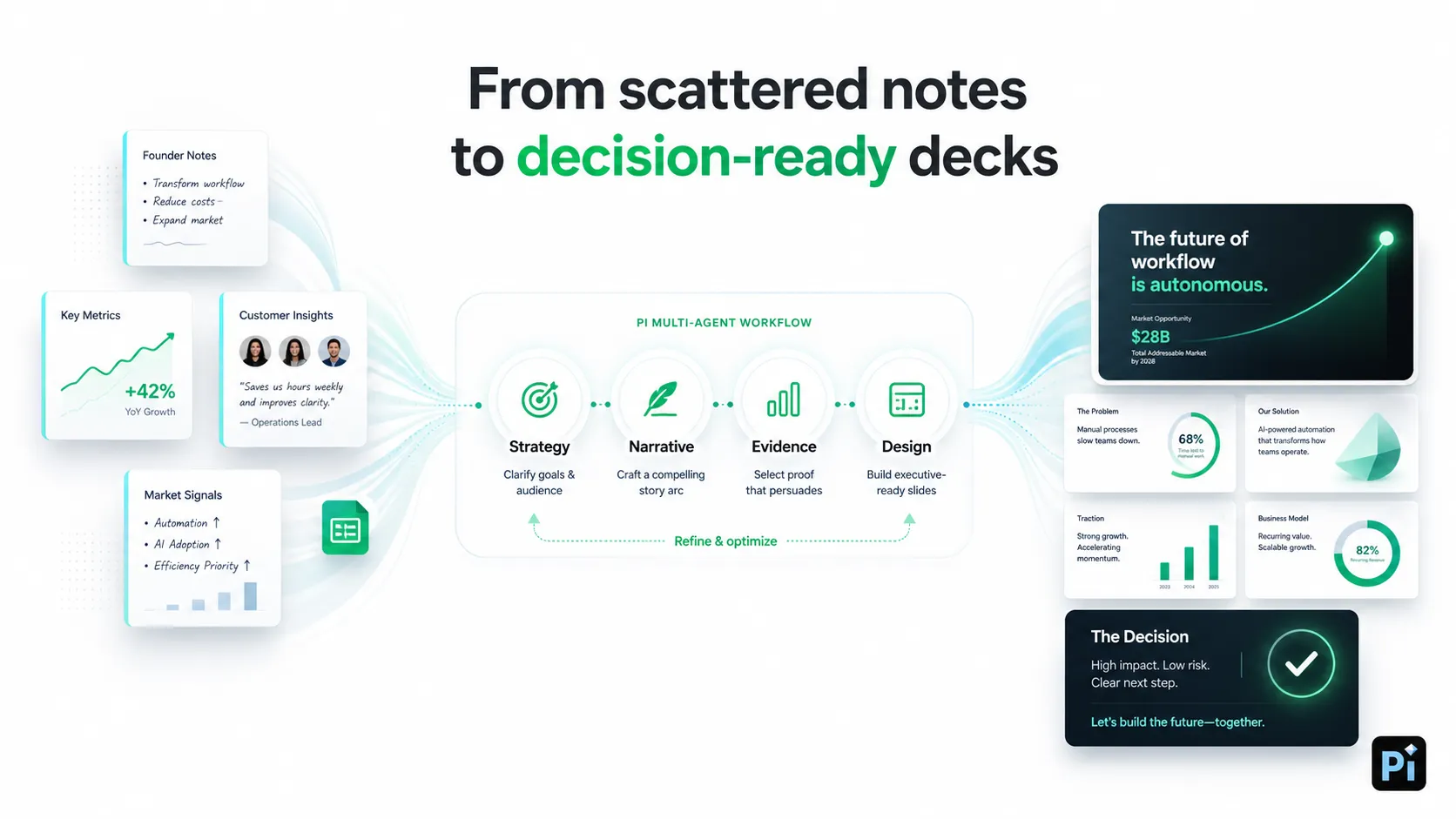
As 2026 presentation trends move toward AI-assisted creation, teams will generate slides faster than ever. But speed is not the main challenge in executive communication.
The harder challenge is deciding what the audience should understand first, what they need to believe next, and what evidence will make the final decision credible.
This is where Pi presentation intelligence becomes useful. Pi, short for Presentation Intelligence, is an AI presentation maker designed for professional business presentations such as pitch decks, sales decks, consulting reports, product launch decks, and executive briefings.
1. Business Logic Comes Before Slide Styling
Many AI slide tools begin with a prompt and quickly produce pages. That can be useful for early drafting, but high-stakes decks need deeper reasoning.
Pi helps teams organize the business case before turning it into slides. The workflow can begin with audience intent, strategic context, core message, supporting evidence, and the desired decision. This helps prevent the common problem of creating a visually attractive deck that lacks a clear argument.
2. Multi-Agent AI Helps Separate Strategic Tasks
A strong deck requires several kinds of thinking: narrative design, business analysis, executive framing, visual hierarchy, and slide-level clarity.
Pi’s Multi-Agent AI approach is built to support this broader workflow. Instead of treating presentation creation as one writing task, it can help structure the story, refine the logic, and shape the output into a business-ready presentation.
For founders, that may mean turning scattered notes into an investor-ready pitch deck narrative. For sales teams, it may mean transforming customer discovery into a tailored executive deck. For consultants, it may mean organizing findings into a structured recommendation.
3. Premium Visual Quality Reinforces Credibility
Visual design does not replace strategy, but it affects trust. Executive audiences often judge clarity, discipline, and maturity through the quality of the deck.
Pi helps translate business logic into polished slides with premium aesthetics. The goal is not to over-design the presentation. It is to make the argument easier to scan, easier to remember, and easier to discuss.
The Verdict: Make the Journey Easier to Follow
The Odyssey pitch is not about adding drama to a business deck. It is about creating a journey that makes strategic sense.
When a presentation clearly moves from change to obstacle, from obstacle to path, from path to proof, and from proof to decision, the audience can focus on judgment instead of reconstruction.
That is the practical value of a stronger storytelling presentation template. It does not merely make the deck feel more engaging. It helps the audience understand why your company, your timing, and your ask belong together.
Pi presentation intelligence supports that workflow by helping professional teams turn complex business material into structured, polished, decision-ready presentations. For founders preparing an investor pitch, leaders building an executive proposal, or teams shaping a high-stakes sales deck, the goal is the same: connect the right dots before the audience has to do it themselves.
Frequently Asked Questions (FAQ)
What is a pitch deck narrative?
A pitch deck narrative is the logical sequence that connects market context, customer pain, solution, evidence, and the decision the presentation is designed to influence.
How is an Odyssey-style pitch different from a normal storytelling presentation template?
It uses the idea of a journey as a business reasoning framework, focusing on change, obstacle, path, proof, and decision instead of simply adding dramatic storytelling.
Why is executive audience engagement important in a pitch deck?
Executive audiences have limited time, so a deck must make the argument easy to follow, connect claims to evidence, and guide the audience toward a clear next step.
How does Pi presentation intelligence help with pitch decks?
Pi helps organize business logic, narrative structure, supporting evidence, and premium slide design so teams can create clearer, more professional, decision-ready presentations.