Personal AI Is Becoming the Next Big Tech Race
Personal AI is emerging as one of the defining AI trends of 2026. Instead of answering isolated prompts, it aims to understand user preferences, remember relevant context, and provide ongoing support across everyday tasks.
Meta's latest Personal AI strategy highlights this broader industry direction. Major technology companies are moving beyond traditional chatbots toward AI assistants that can organize information, coordinate tasks, and deliver more personalized experiences. For consumers, this could simplify shopping, learning, travel, and communication. For businesses, it opens new opportunities to improve productivity, collaboration, and decision-making while raising important questions about privacy, transparency, and user trust.
What Is Personal AI?
Personal AI is an AI assistant designed to adapt to an individual over time. Rather than treating every conversation as independent, it uses context, preferences, and ongoing interactions to deliver more relevant assistance.
Unlike traditional chatbots that mainly answer questions, Personal AI can support planning, scheduling, writing, research, and decision-making across multiple tasks. However, today's Personal AI is not fully autonomous. It still relies on human guidance and approval, making it an assistant rather than a replacement for human judgment.
How Personal AI Differs From Traditional Chatbots
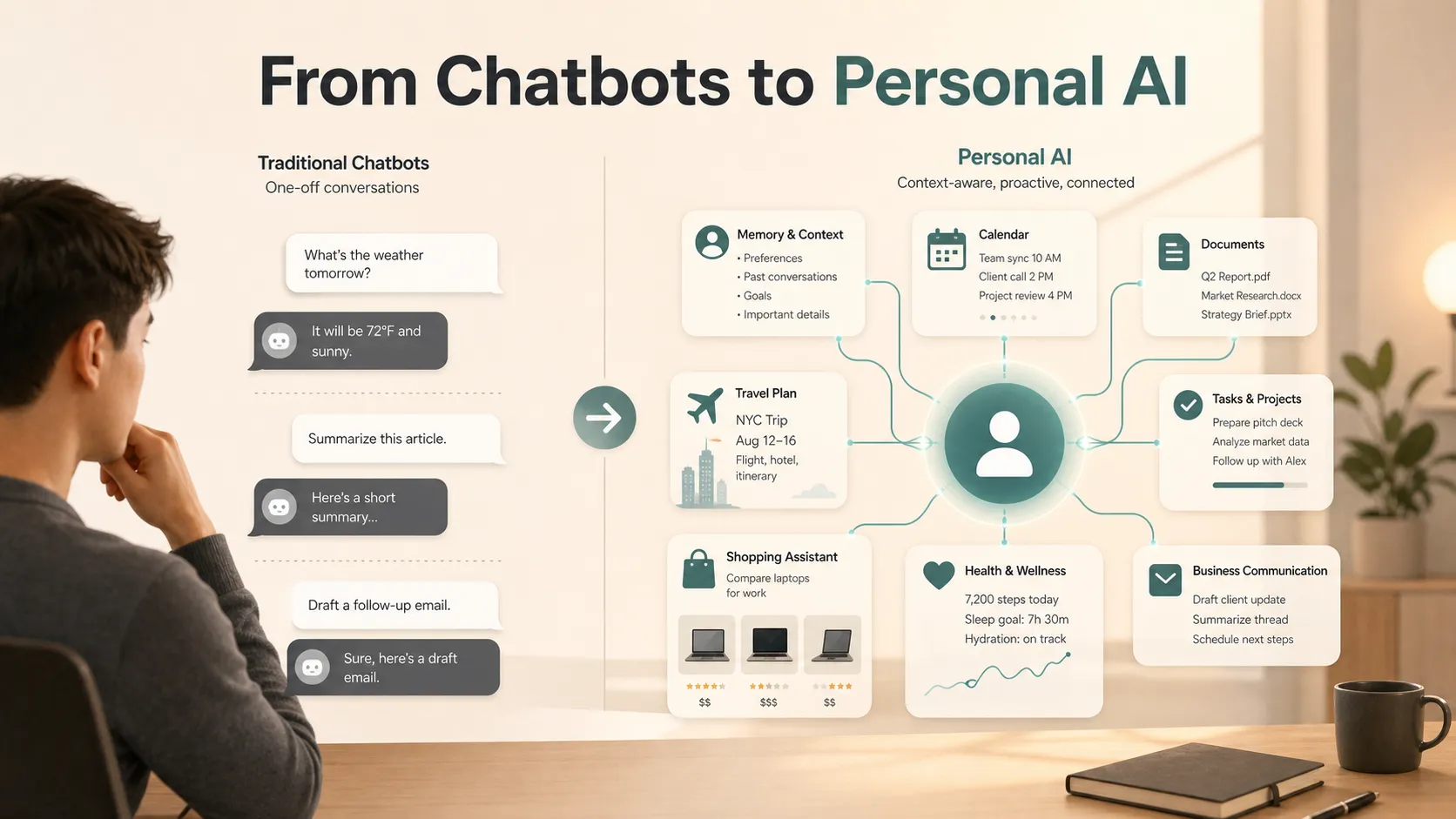
Traditional chatbots respond to prompts and often lose context after a conversation ends. Personal AI focuses on long-term assistance by combining user preferences, contextual memory, and AI-powered task support.
| Capability | Traditional AI Assistants | Personal AI |
|---|---|---|
| Interaction | Prompt and response | Continuous assistance |
| Memory | Session-based | User-controlled context |
| Personalization | Generic responses | Preference-aware support |
| Task support | Single-step tasks | Multi-step workflows |
| Context | Current conversation | Past context + current goals |
| User role | Ask and review | Direct, approve, and supervise |
The difference matters because everyday activities—planning trips, comparing products, preparing presentations, or managing projects—often require multiple decisions instead of a single answer. Personal AI helps organize information, but people remain responsible for the final decision.
Why Big Tech Is Investing in Personal AI
Companies including Meta, Google, Microsoft, and OpenAI see Personal AI as the next evolution of digital experiences. Advances in large language models, multimodal AI, and AI agents are making assistants more capable of understanding intent, coordinating tasks, and supporting users across apps and devices.
For technology companies, Personal AI is becoming more than a feature. It has the potential to reshape how people search, communicate, shop, learn, and work. For businesses, it also creates new opportunities to automate repetitive tasks and improve productivity without replacing human expertise.
How Personal AI Could Change Everyday Life
The biggest advantage of Personal AI is reducing everyday complexity. Instead of switching between multiple apps, users can rely on AI to organize information and recommend next steps.
For example, a Personal AI assistant could compare products based on budget and preferences, create travel itineraries, summarize research, manage schedules, draft emails, or prepare meeting notes. The goal is not simply to generate content, but to help users make better and faster decisions.
Benefits and Challenges
Personal AI offers clear advantages. It can save time, reduce repetitive work, organize information, and provide recommendations based on a user's goals and preferences. Whether planning a trip, comparing products, or managing projects, AI can simplify complex decisions.
However, greater personalization also creates new challenges. Users need confidence that their data is handled responsibly and that AI recommendations are transparent and reliable. Privacy, security, inaccurate outputs, and excessive reliance on AI remain important concerns.
As Personal AI becomes more capable, trust will become just as important as intelligence. Responsible AI design requires clear user consent, transparent data practices, and meaningful human oversight.
Personal AI Beyond Consumer Apps
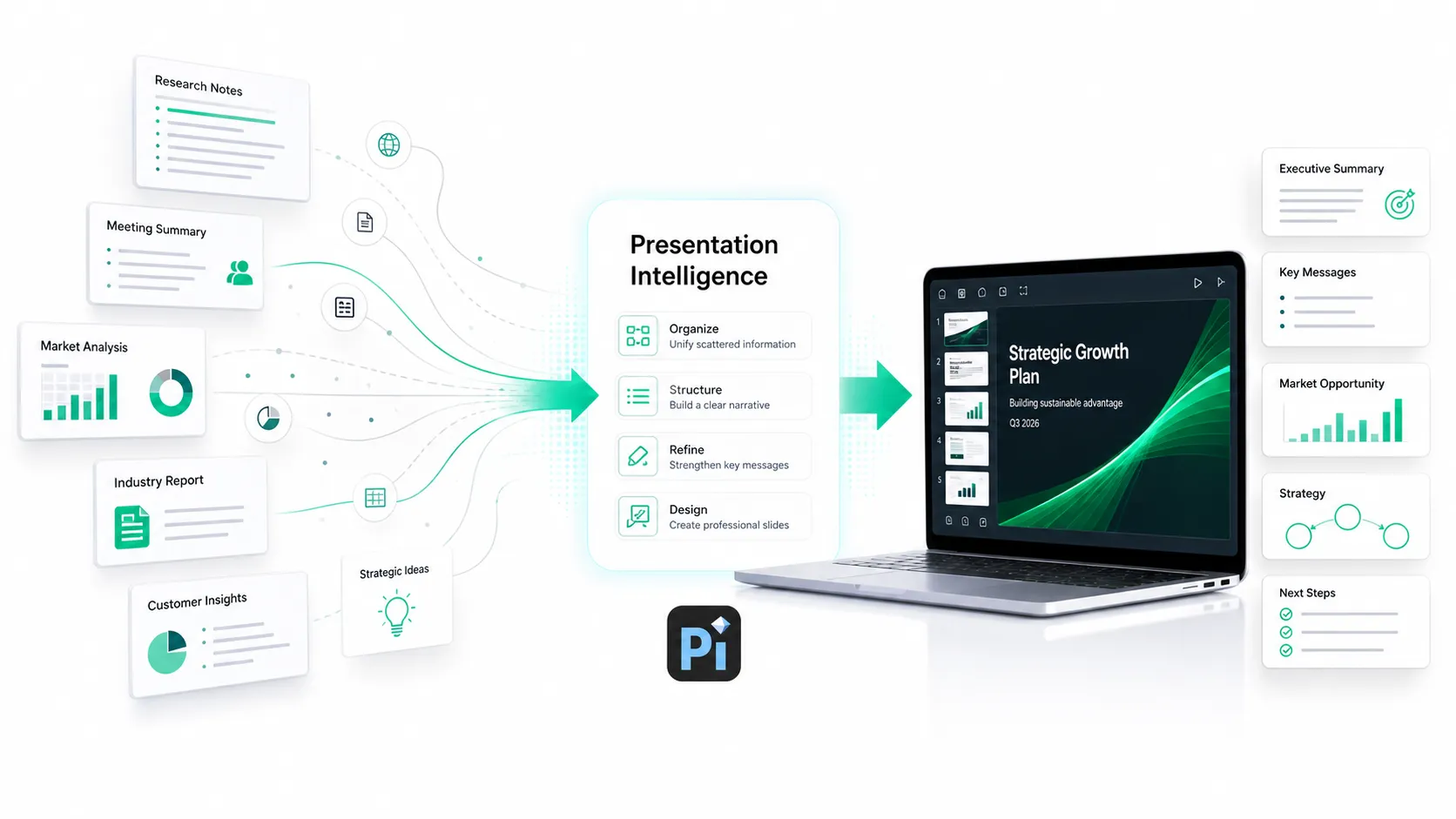
Personal AI is not limited to consumer experiences. The same technologies are increasingly transforming knowledge work by helping professionals organize information, analyze content, summarize meetings, and communicate ideas more effectively.
As organizations adopt AI across daily workflows, the focus is shifting from simply generating content to improving how knowledge is structured and shared. Professionals still spend significant time turning research, documents, spreadsheets, and meeting notes into reports, proposals, and presentations. Personal AI can reduce that preparation work while allowing people to review, refine, and make the final decisions.
This is where Pi (Presentation Intelligence) demonstrates the broader value of AI-powered productivity. Rather than acting as a general-purpose personal assistant, Pi is designed specifically for business communication. It helps teams transform scattered research, meeting notes, strategic plans, and data insights into structured, presentation-ready content, making complex information easier to understand and present.
Beyond creating slides, Pi supports a more efficient workflow by helping users organize ideas, identify key messages, and build a clear narrative before presentation design begins. This reflects a broader shift in AI adoption: the greatest value often comes not from replacing human expertise, but from reducing repetitive preparation and enabling people to focus on critical thinking, collaboration, and decision-making.
The Future of Personal AI
Personal AI is expected to become more integrated into everyday digital experiences. Instead of switching between separate apps for search, messaging, scheduling, and productivity, users may increasingly rely on AI assistants that connect these tasks within a single experience.
Future improvements will likely focus on stronger personalization, multimodal interaction, better memory management, and deeper integration across devices and services. At the same time, responsible AI practices—including transparency, privacy, and human control—will remain essential for long-term adoption.
The Verdict
Personal AI represents the next stage of AI development. Rather than replacing people, it is designed to help users organize information, complete everyday tasks, and make better decisions.
Meta's latest strategy reflects a broader industry movement, but the trend extends well beyond a single company. As Personal AI becomes part of everyday life and work, organizations that combine intelligent AI with transparency, privacy, and human oversight will be best positioned for long-term success.
Frequently Asked Questions (FAQ)
Q: What is Personal AI?
A:Personal AI is an AI assistant that learns user preferences and context over time to provide more personalized and proactive support across different tasks.
Q: How is Personal AI different from traditional chatbots?
A:Traditional chatbots mainly respond to individual prompts, while Personal AI focuses on long-term context, personalization, and ongoing task assistance.
Q: Why are technology companies investing in Personal AI?
A:Companies such as Meta, Google, Microsoft, and OpenAI see Personal AI as the next generation of digital experiences, combining AI assistants, productivity tools, and personalized services.
Q: Is Personal AI safe?
A:Personal AI can be useful when supported by strong privacy protections, transparency, and human oversight. Users should understand how their information is stored and always review AI-generated recommendations before making important decisions.