SaaS Competitor Analysis Pitch Deck: How to Benchmark Like a Pro
For SaaS founders, strategy teams, and marketers, the competitor analysis slide is often one of the most scrutinized parts of a pitch deck. Investors and executives are not only checking whether you know the other companies in the market. They are testing whether you understand customer pain, category dynamics, defensibility, pricing pressure, and your real path to win.
A strong SaaS competitor analysis PPT does more than display logos. It turns market research into a clear business argument: where the market is crowded, where customers remain underserved, and why your company is positioned to capture a valuable opportunity.
Why SaaS Competitor Analysis Slides Matter in a Pitch Deck
In a tech startup pitch deck, competitor analysis is rarely just a research section. It is a credibility test. If the slide feels shallow, biased, or incomplete, the audience may question the rest of the business case. If it feels structured and honest, it can strengthen the entire presentation.
Good competitor research for pitch deck slides should answer practical investor questions:
- Is the market large enough to support multiple winners?
- Does the company understand direct and indirect alternatives?
- Are customers switching because of real pain?
- Is the team realistic about pricing and sales cycles?
- Is there a clear reason this company can win?
The U.S. Small Business Administration’s guide to market research and competitive analysis is useful because competitor research should connect market demand, customer behavior, and competitive advantage.
The Mistake Most SaaS Benchmarking Slides Make
Many SaaS benchmarking slides fail because they are designed to make the company look good rather than to explain the market clearly. The result is often a slide that looks confident but does not feel credible.
Common issues include:
- Logo grids that show many competitors but explain very little
- Feature tables where the company conveniently wins every row
- Positioning maps with vague axes such as “easy” and “powerful”
- Claims about superiority without evidence from customers, pricing, traction, or product depth
- Overly detailed matrices that are impossible to read in a live pitch
A professional benchmarking slide template should not pretend competitors are weak. Strong competitors can validate the market. The real goal is to show how your company competes differently, which customer segment you serve best, and why that focus matters now.
What SaaS Competitor Analysis Should Prove
A SaaS competitor analysis should prove four things. First, it should show market awareness. You know the main players, adjacent alternatives, legacy solutions, and manual workarounds customers use today.
Second, it should show differentiated positioning. The deck should make it easy to understand whether you compete on workflow depth, speed, automation, integrations, vertical specialization, pricing, service model, or enterprise readiness.
Third, it should show customer insight. The best competitor slides are built around buyer needs, not internal feature preferences. They explain why a segment is underserved and what trade-offs customers are currently forced to accept.
Fourth, it should show a credible path to win. That path may come from a wedge product, a focused ICP, a better GTM motion, stronger data advantage, or superior workflow fit. The slide should connect competitive research to business strategy.
Harvard Business School’s overview of strategy and competition is useful here because good strategy is not about being generally better. It is about creating a distinct position and making clear trade-offs.
SaaS Competitor Benchmarking Framework
Before building slides, define the dimensions that actually matter in your category. For SaaS, competitor research for pitch deck work usually needs more than a basic feature checklist.
| Benchmarking area | What to compare | Why it matters |
|---|---|---|
| Market category | Direct competitors, adjacent tools, legacy solutions, manual workarounds | Shows market awareness |
| Customer segment | SMB, mid-market, enterprise, vertical-specific, developer-led buyers | Clarifies who each company serves |
| Product capability | Workflow depth, automation, integrations, platform scope | Makes product differences specific |
| Pricing model | Seat-based, usage-based, freemium, enterprise contracts | Explains adoption and margin pressure |
| GTM motion | PLG, founder-led sales, channel sales, enterprise sales | Shows how competitors reach customers |
| Traction signals | Customers, funding, reviews, hiring, partnerships | Supports credibility |
| Strategic gap | Underserved need, weak workflow, pricing gap, service gap | Connects research to opportunity |
This framework avoids two extremes: too little detail to be useful, or too much detail to be persuasive.
What to Include in a SaaS Competitor Analysis Pitch Deck
A complete SaaS competitor analysis pitch deck may need more than one slide, especially for investor or board-level presentations. The section should move from market shape to strategic insight.
A useful sequence is:
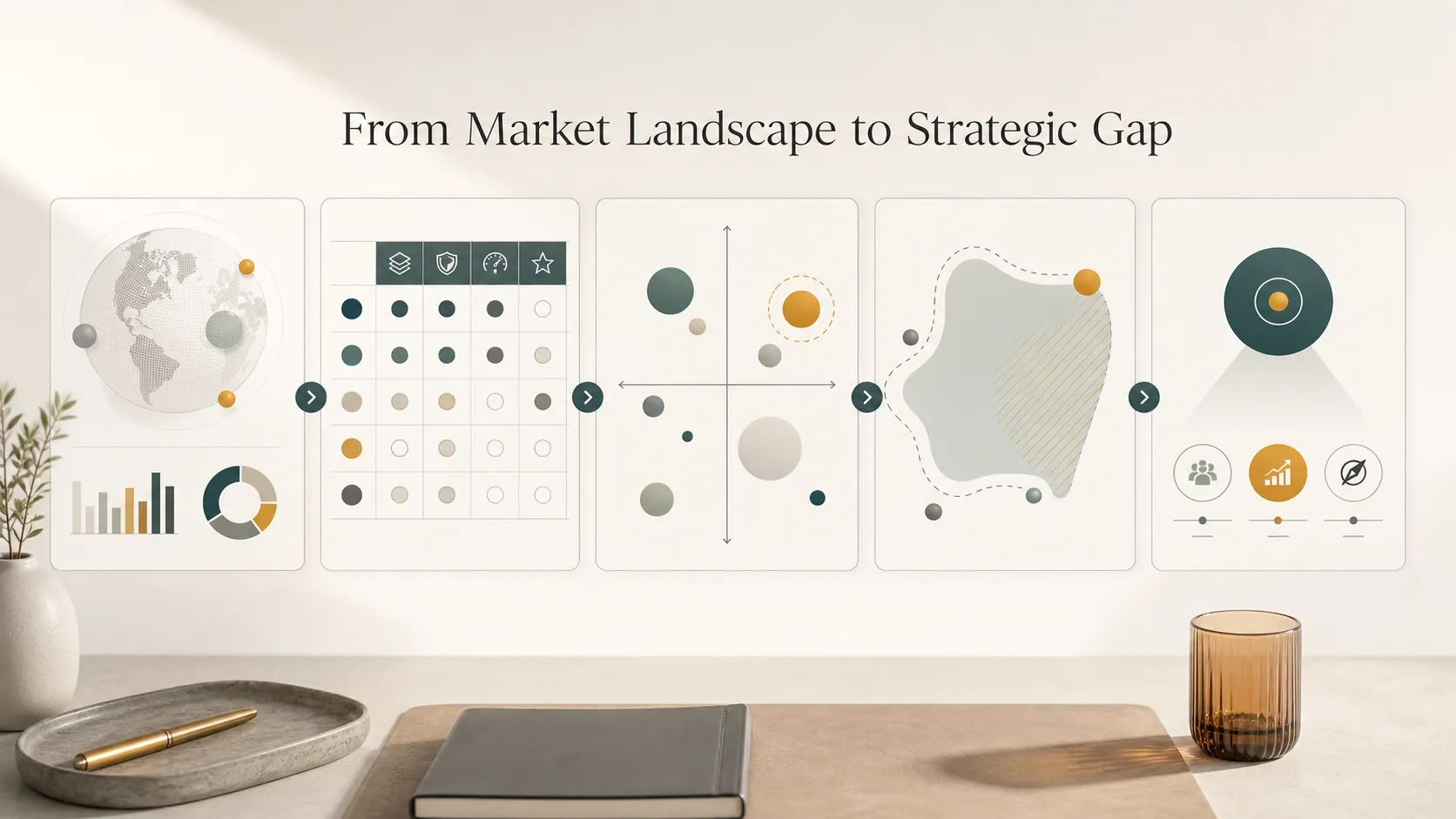
- Market landscape: classify competitors and alternatives.
- Competitor matrix: compare the dimensions that matter.
- Positioning map: show where your company sits.
- Feature and pricing benchmark: explain product and commercial trade-offs.
- Opportunity gap: show the underserved customer need.
- Strategic takeaway: summarize why your path is credible.
Do not begin with a dense feature table. Start by framing the market, then narrow into the competitors that matter most, then explain the strategic gap. This makes the section feel like a business narrative rather than a collection of research notes.
Y Combinator’s guide to pitching your company is useful for startup teams because it emphasizes clarity, market understanding, and a concise explanation of what makes the company compelling.
How to Make Competitor Slides More Credible
Investor audiences are used to seeing competitor slides. They can usually tell when the comparison is too convenient.
To make the slide more credible:
- include direct and indirect alternatives;
- compare dimensions buyers actually care about;
- avoid claiming you win every category;
- show where competitors are strong;
- explain the customer trade-off;
- connect the gap to your product and GTM strategy.
The best competitor slides do not say “everyone else is bad.” They say, “Here is the market structure, here is the underserved segment, and here is why our focus creates an advantage.”
Visual clarity matters too. Competitor matrices, market maps, and pricing benchmarks can become crowded quickly. Nielsen Norman Group’s guide to visual hierarchy is helpful because the slide should make the main takeaway easy to see first.
For broader accessibility, W3C’s accessible presentation guidance can help teams make dense slides easier for different audiences to read and follow.
How Pi Helps Turn Competitor Research Into Pitch Deck Slides
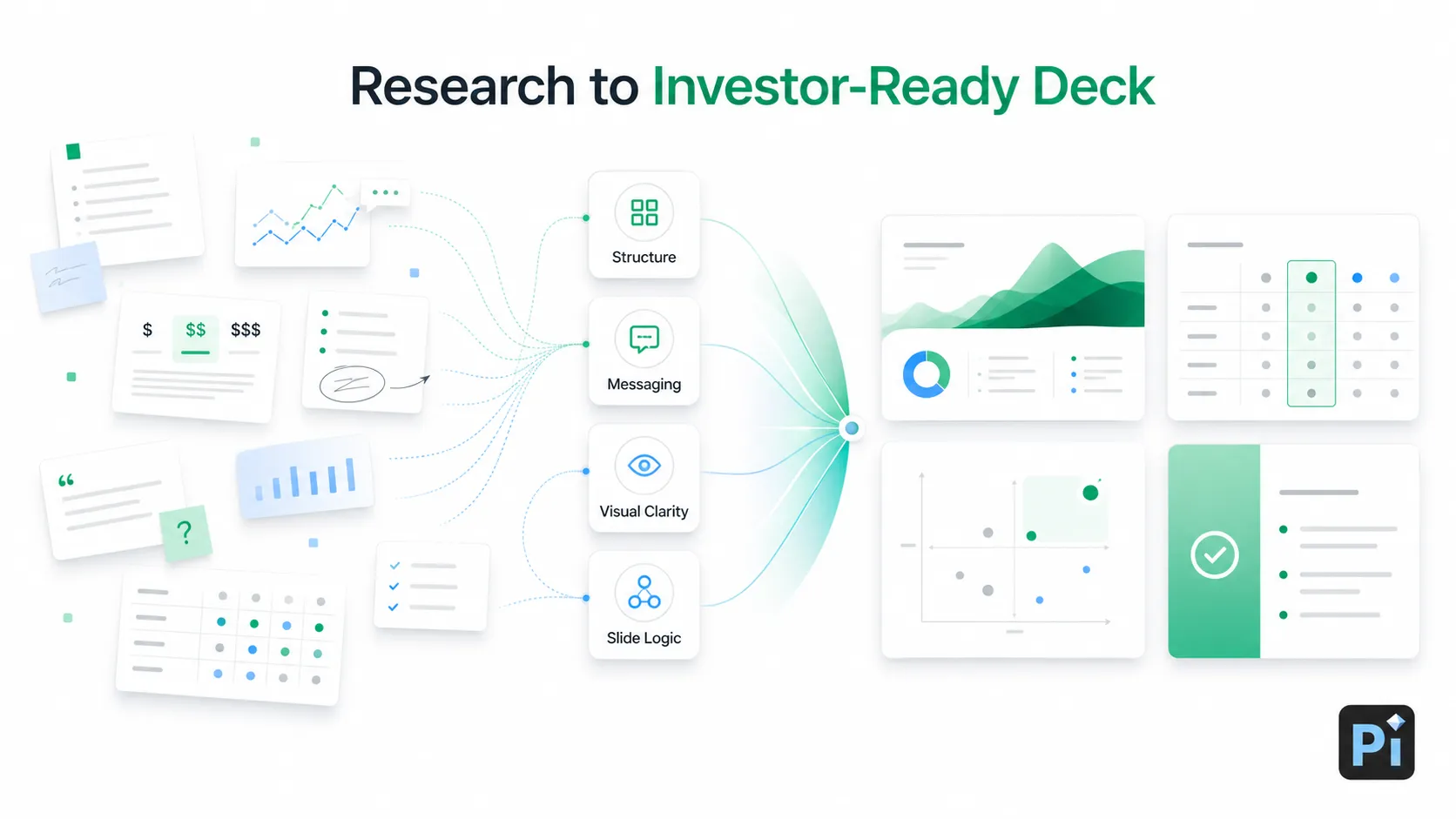
Pi presentation maker is useful when competitor research is scattered across notes, spreadsheets, sales calls, pricing pages, review sites, and founder discussions. The hard part is often not finding competitors. The hard part is turning that research into a pitch deck section investors can understand quickly.
For a SaaS competitor analysis pitch deck, Pi can help organize the section around the story the slides need to tell:
- What alternatives do customers use today?
- Which competitors matter most?
- What dimensions should be compared?
- Where are competitors strong?
- Where is the customer pain still unresolved?
- Why does your product have a credible wedge?
This is different from generating a generic competitor matrix. A useful benchmarking slide should explain the market shape, not just list company names. Pi can help turn messy research into a slide sequence that moves from landscape to comparison to opportunity gap.
Pi can also help keep the competitor section readable. Dense SaaS matrices often become too crowded for a live pitch. Pi helps shape clearer slide titles, tighter comparison language, and more presentation-ready layouts so the audience can see the strategic takeaway faster.
You still need to verify competitor data yourself, especially pricing, customer claims, product capabilities, funding signals, and positioning. But once the research is ready, Pi can help turn it into a sharper, more investor-ready pitch deck section.
Final Verdict: Benchmark the Market, Then Tell the Strategic Story
 A strong SaaS competitor analysis pitch deck is not about proving that every competitor is weak. It is about showing that your team understands the market with discipline and can identify a specific, valuable opportunity.
The best decks benchmark competitors through the lens of customer pain, product capability, pricing, GTM motion, positioning, and strategic gaps. They make the market easier to understand and the company’s strategy easier to believe.
If you already have competitor notes, customer insights, pricing research, or positioning hypotheses, Pi can help turn that raw material into a more structured, professional, and investor-ready AI business presentation.
Frequently Asked Questions (FAQ)
What should be included in a SaaS competitor analysis PPT ?
Include a market landscape, competitor matrix, positioning map, feature and pricing benchmark, opportunity gap, and strategic takeaway. The section should explain not only who the competitors are, but how your company is positioned to win.
How do you create a benchmarking slide template?
Start by choosing comparison dimensions that matter to buyers, such as customer segment, product capability, pricing model, GTM motion, traction signals, and positioning. Then organize those dimensions into a clear matrix or map with one main takeaway.
What is the best way to show competitors in a tech startup pitch deck?
The best approach is to combine a market landscape with a focused positioning insight. Avoid claiming your company wins every category. Instead, show where competitors are strong, where customers remain underserved, and where your strategy creates an advantage.
Can AI help create a business presentation for competitor analysis?
Yes. AI can help structure research, organize slide flow, clarify messaging, and improve visual hierarchy. However, competitor data should still be verified by the team before it is used in an investor or executive presentation.