Understanding Model Context Protocol (MCP): A Practical Guide
Model Context Protocol (MCP) is becoming an important standard for AI integration. It enables AI applications to securely connect with external tools, business data, documents, and workflows instead of relying only on language models. As AI agents become more capable, organizations need a consistent way to provide reliable context while maintaining security and governance.
Introduced by Anthropic as an open standard, MCP defines a common interface for AI applications to discover and use tools, resources, and prompts. Rather than replacing APIs, it standardizes how AI systems interact with existing software and business services, making AI integrations easier to scale across different environments.
What Is Model Context Protocol (MCP)?
Model Context Protocol (MCP) is an open protocol that allows AI applications to communicate with external systems through a consistent interface. Instead of building a separate integration for every database, SaaS platform, or internal application, developers can expose capabilities in a standardized way that multiple AI clients understand.
A simple way to think about MCP is as a communication layer between AI applications and business software. APIs continue to provide access to data and functions, while MCP helps AI systems discover what resources are available, understand how they should be used, and interact with them more consistently.
As enterprise AI continues to expand, this standardized approach reduces repetitive engineering work and improves interoperability between AI models and external tools.
How Model Context Protocol (MCP) Works
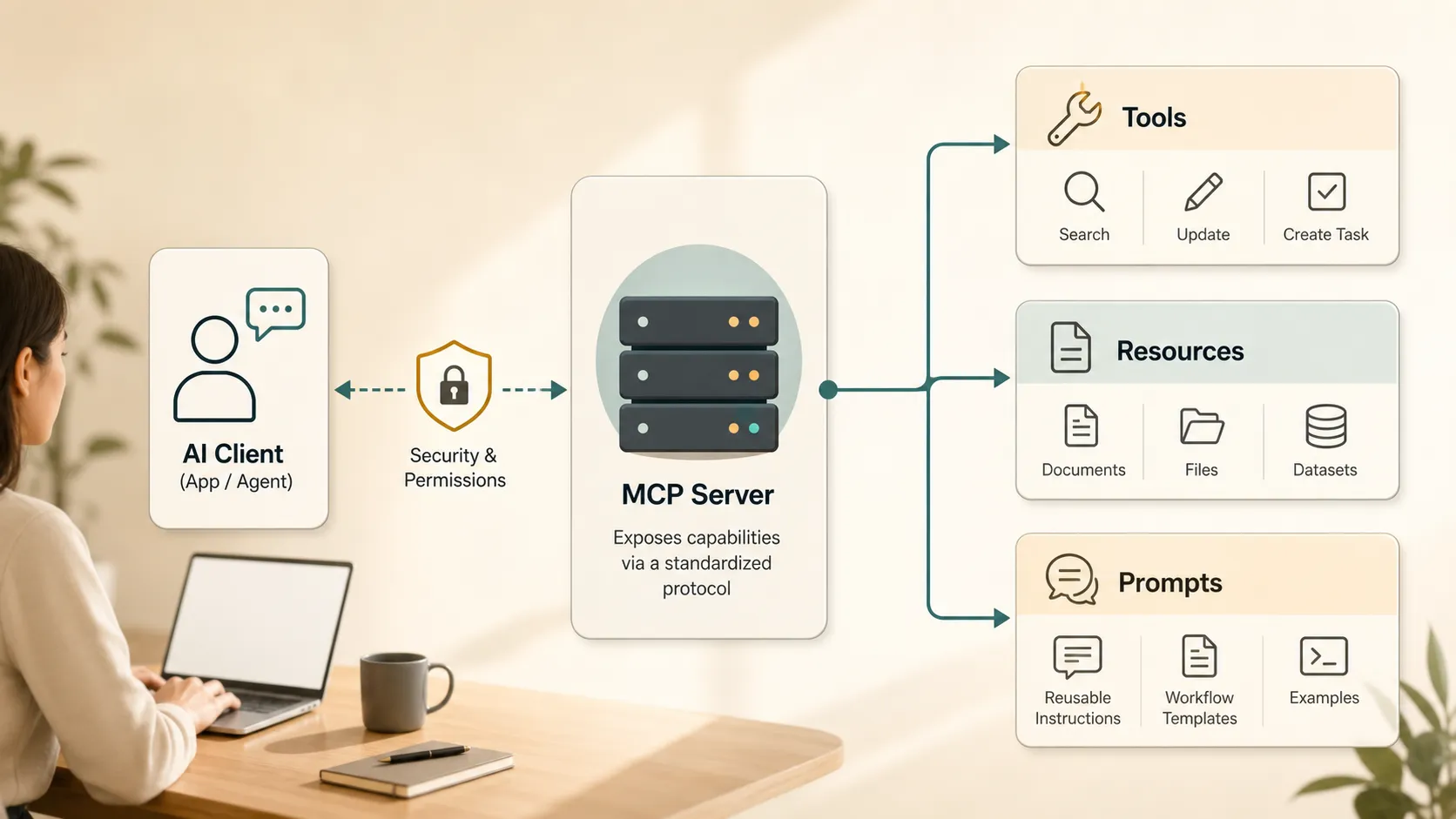
MCP uses a client-server architecture.
The AI application acts as the MCP client, while external systems expose capabilities through MCP servers. These servers may connect to databases, cloud storage, documentation platforms, CRM systems, code repositories, or other enterprise applications.
MCP servers typically expose three categories of capabilities:
- Tools perform actions such as searching, updating records, or creating tasks.
- Resources provide structured access to documents, files, and datasets.
- Prompts supply reusable instructions that guide AI workflows.
When an AI application requires additional information, it first discovers which tools and resources are available before requesting the appropriate context. User permissions, authentication, and organizational policies still control what information can be accessed. MCP standardizes communication rather than replacing security controls.
MCP vs Traditional API Integrations
Although MCP is often compared with APIs, they serve different purposes.
Traditional APIs expose software functionality for developers. MCP provides AI applications with a standardized way to discover and use those capabilities across different systems.
The following table compares traditional API integrations with MCP.
| Capability | Traditional APIs | MCP |
|---|---|---|
| Primary purpose | Expose software functions and data | Standardize AI access to tools and context |
| Typical users | Developers and applications | AI applications and AI agents |
| Discovery | Documentation and custom integration | Structured discovery of tools and resources |
| Integration | Usually platform-specific | Reusable protocol across systems |
| Relationship | Core software interface | Works alongside existing APIs |
Rather than competing with APIs, MCP complements them by making AI integrations more consistent and reusable.
Practical MCP Use Cases
MCP is most valuable when AI applications need to work across multiple business systems instead of handling isolated prompts.
- AI agents can retrieve trusted information, use approved tools, and complete multi-step tasks.
- Enterprise software can connect with CRM platforms, customer support systems, analytics tools, and project management applications.
- Knowledge management systems can access internal documentation, policies, research notes, and technical references through approved sources.
- Workflow automation can trigger actions across business applications while following user permissions and governance policies.
MCP can also improve AI-powered presentation workflows. For example, platforms such as Pi can retrieve approved business context from connected knowledge sources to generate more accurate executive presentations, sales decks, and business reports while reducing manual copy-and-paste work.
Security and Adoption Challenges
Like any enterprise integration, MCP requires strong security and governance. Organizations must ensure AI applications only access information users are authorized to view, especially when working with customer data, financial records, or proprietary documents.
Reliable permission management, audit logs, and monitoring remain essential. While MCP standardizes communication between AI applications and external systems, it does not replace existing security controls or compliance requirements.
Adoption is growing quickly, but support is still evolving across the AI ecosystem. Businesses should evaluate MCP based on their existing infrastructure, security policies, and integration requirements.
The Future of MCP
As AI becomes part of everyday business operations, interoperability will become increasingly important. Organizations want AI applications that can work across multiple systems without requiring separate custom integrations for every workflow.
MCP supports this direction by providing a reusable integration layer that helps AI applications discover tools, access trusted context, and coordinate tasks more efficiently. Although the ecosystem is still developing, the protocol represents an important step toward more connected and scalable AI workflows.
The Verdict
Model Context Protocol is an open standard that helps AI applications connect with tools, business data, and external services through a consistent interface. Rather than replacing APIs, it standardizes how AI systems discover and use existing capabilities across different software environments.
For organizations adopting AI agents, workflow automation, LLM integrations, and enterprise AI platforms, MCP offers a more scalable approach to integration. It can reduce repetitive connector work, improve interoperability, and support more reliable access to business context.
The main point is practical: AI applications become more useful when they can work with the systems where business knowledge and actions already live. MCP is one important step toward that future. Whether the use case is customer support, software development, knowledge management, analytics, or AI-powered presentation workflows, standardized protocols can help AI tools become more connected, governed, and useful across the organization.
Frequently Asked Questions (FAQ)
Q: What is MCP?
A: MCP, or Model Context Protocol, is an open standard that enables AI applications to securely connect with external tools, data sources, and business systems through a consistent interface.
Q: Who created MCP?
A: MCP was introduced by Anthropic as an open standard to improve interoperability between AI applications and external software systems.
Q: How does MCP work?
A: MCP uses a client-server architecture. AI applications act as clients, while MCP servers expose tools, resources, and prompts that AI systems can securely discover and use.
Q: Is MCP replacing APIs?
A: No. MCP does not replace APIs. APIs continue to expose software functions and data, while MCP standardizes how AI applications discover and use those capabilities.