what is artificial intelligence
Artificial intelligence, usually shortened to AI, is technology that allows machines to do tasks that normally require human intelligence. That can include recognizing images, understanding language, making predictions, recommending actions, detecting patterns, generating content, or helping people make decisions.
A simple way to think about AI is this: traditional software follows rules written by humans, while AI systems often learn patterns from data. A normal program might say, “If the customer clicks this button, show that page.” An AI system might study many past examples and learn which product someone may buy next, which medical scan may need review, or which transaction looks suspicious.
AI is not magic. It is built from data, models, computing power, and human choices. When it works well, it can make complex tasks faster and easier to handle. When it is used badly, it can be biased, wrong, opaque, or overtrusted.
A Clear Definition Of Artificial Intelligence
The NIST glossary defines artificial intelligence as a machine-based system that can make predictions, recommendations, or decisions for human-defined objectives. That definition is useful because it avoids science fiction. AI is not necessarily a robot with a personality. In most real-world cases, it is software that turns inputs into useful outputs.
The OECD AI Principles describe AI systems as systems that generate outputs such as predictions, content, recommendations, or decisions. OECD also emphasizes trustworthy AI that respects human rights and democratic values.
So, in plain English: AI is a computer system that uses data and models to produce outputs that look intelligent or useful in a specific context.
How Artificial Intelligence Works
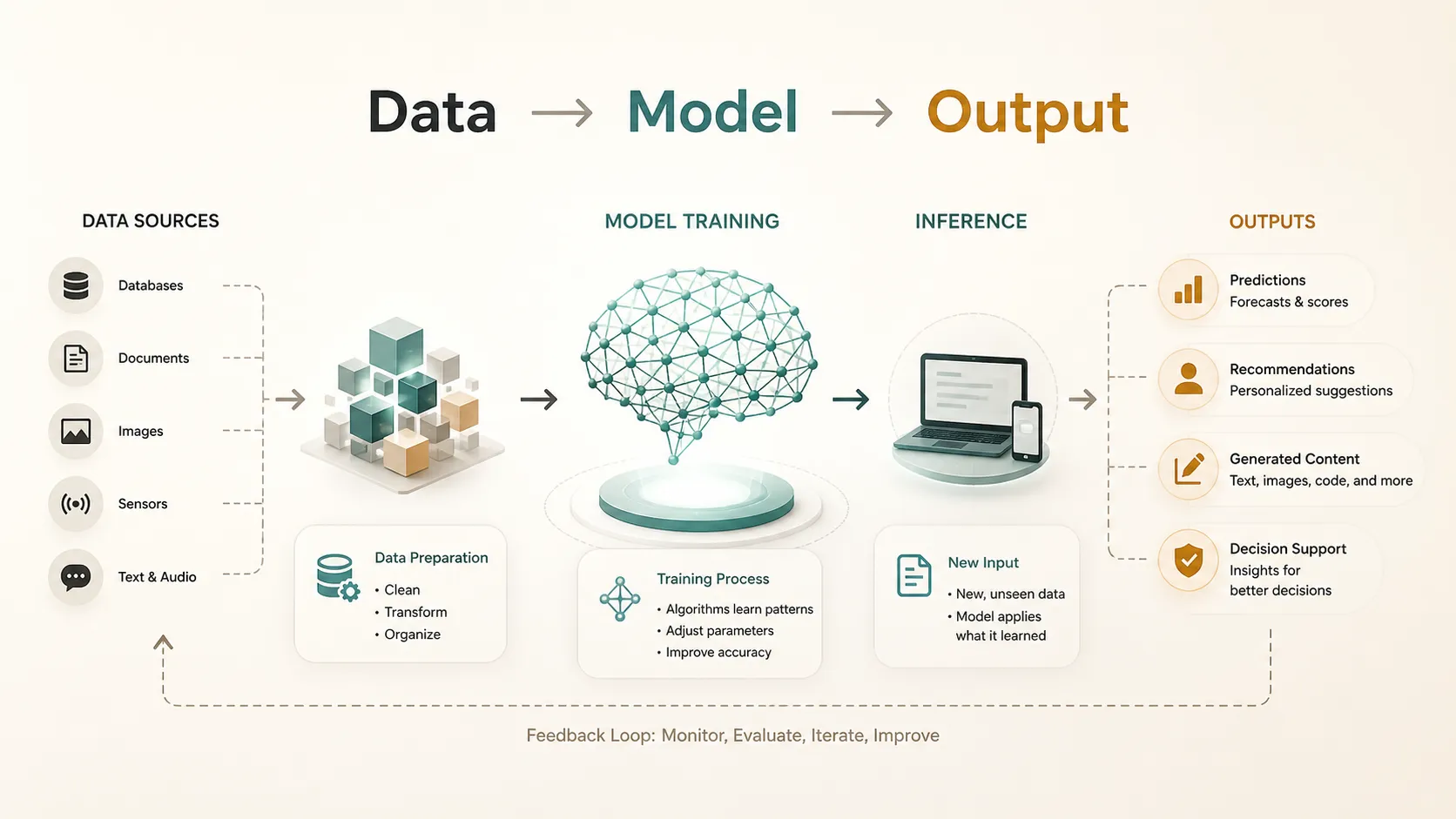
Most AI systems follow a basic pattern:
- Collect data.
- Train a model on that data.
- Use the model to recognize patterns.
- Apply the model to new inputs.
- Produce an output, such as a prediction, recommendation, ranking, classification, or generated response.
For example, an email spam filter can learn from many examples of spam and non-spam messages. Over time, it learns patterns: suspicious links, certain phrases, unusual sender behavior, or formatting tricks. When a new email arrives, the model estimates whether it is likely to be spam.
IBM’s guide to artificial intelligence explains AI as technology that enables computers and machines to simulate learning, comprehension, problem solving, decision making, and creativity. That sounds broad because AI is a field, not one single product.
AI, Machine Learning, Deep Learning, And Generative AI
People often use these terms as if they mean the same thing, but they are not identical.
| Term | Simple meaning | Example |
|---|---|---|
| Artificial intelligence | The broad field of machines performing tasks associated with intelligence | A system that recommends, predicts, classifies, or generates |
| Machine learning | A type of AI where systems learn patterns from data | Fraud detection, recommendation systems, risk scoring |
| Deep learning | A machine learning method using layered neural networks | Image recognition, speech recognition, large language models |
| Generative AI | AI that creates new content | Chatbots, image generation, code generation, video generation |
Machine learning is one of the most important ways to build AI. Deep learning is a powerful type of machine learning. Generative AI is a newer, highly visible category that can produce text, images, audio, video, code, presentations, and other content.
Real Examples Of AI In Everyday Life
AI is already part of ordinary life, even when people do not call it AI.
Recommendation systems are one easy example. When a shopping site recommends products, a music app suggests songs, or a video platform decides what to show next, AI may be ranking options based on user behavior and patterns from many other users.
Fraud detection is another practical example. Banks and payment networks use AI systems to flag unusual activity, such as a purchase that does not match a customer’s normal location, timing, amount, or spending pattern.
Healthcare is also using AI in regulated settings. The FDA maintains a public list of AI-enabled medical devices authorized for marketing in the United States. Many of these tools support medical imaging, cardiology, radiology, and clinical decision support. This does not mean AI replaces doctors. It means AI can help detect patterns or support review under regulatory oversight.
Science gives one of the strongest examples. Google DeepMind’s AlphaFold showed how AI can help predict protein structures, a problem that matters for biology, medicine, and drug discovery. The Stanford AI Index tracks how quickly AI is moving from labs into products, workplaces, and policy debates.
Generative AI And Tools Like Pi
Generative AI is the part of AI many people now experience most directly. Instead of only classifying data or making predictions, generative AI can create something new: text, images, code, slides, videos, diagrams, summaries, or design drafts.
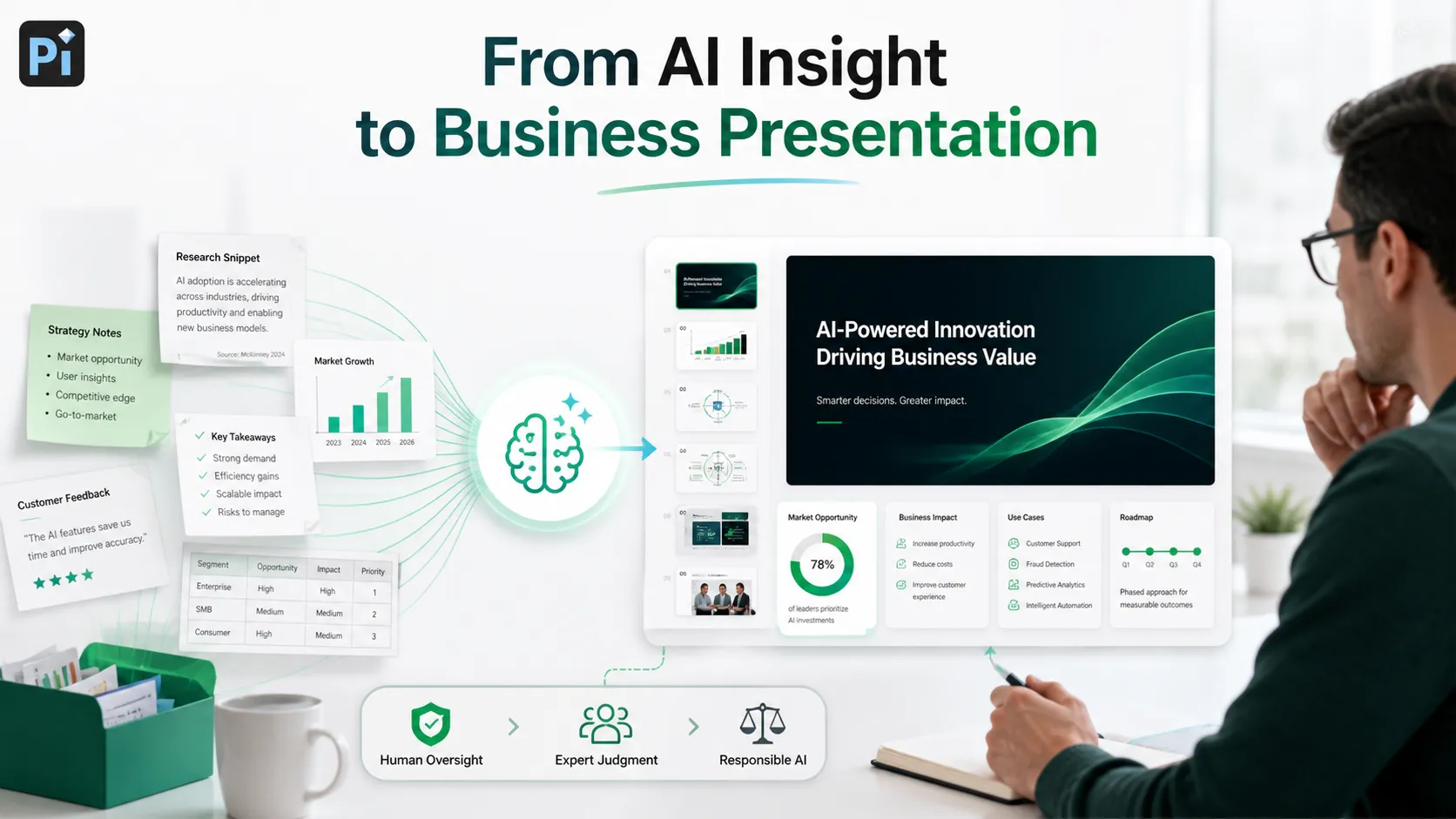
This is where Pi fits naturally as a real example of AI in everyday work. A presentation used to start with a blank slide and a lot of manual formatting. With Pi, a user can start from notes, a document, an outline, or a rough idea, then turn that material into a structured presentation. That is AI being used not as a mysterious machine, but as a practical assistant for organizing and expressing information.
Pi also shows how AI can combine several capabilities in one workflow. It can generate presentation themes, customize styles and colors, use ready-made components, apply automatic layout, provide an icon library, and call AI image generation when a slide needs supporting visuals. Since Pi can also generate video or visual assets, it can help explain ideas that are hard to communicate with static text alone.
The useful part is not simply “AI makes slides.” It is that AI can reduce the friction between thinking and communicating. A founder can turn investor notes into a pitch deck. A teacher can turn a lesson outline into a class presentation. A team can turn a report into a more visual executive update. The human still decides the message, but AI helps shape the material into something clearer.
What AI Is Good At And Bad At
AI is strong when a task involves patterns, scale, or repetition. It can scan large datasets faster than a person, compare many signals at once, and make predictions based on examples.
Useful AI tasks include summarizing long documents, classifying images or text, detecting anomalies, recommending products, forecasting demand, translating languages, generating draft text or visuals, supporting customer service, and helping experts review complex information.
But AI has limits. It can produce answers that sound confident but are wrong. Generative AI systems can hallucinate facts, invent sources, misunderstand context, or overgeneralize from patterns in training data. AI can also reflect bias in data, and privacy can become a risk when sensitive information is handled poorly.
Responsible AI
Responsible AI means building and using AI with guardrails. It does not mean avoiding AI. It means asking better questions before trusting it.
The NIST AI Risk Management Framework is useful because it gives organizations a way to think about trustworthy AI: validity, reliability, safety, security, transparency, explainability, privacy, and fairness.
A responsible AI process should ask: what problem is the AI solving, what data was used, who could be harmed if the system is wrong, how accuracy is measured, whether users can understand the output, and whether there is human oversight.
The OECD’s work on trustworthy AI and NIST’s AI RMF point in the same direction: AI should be useful, but also accountable. The more important the decision, the more careful the oversight should be.
The Verdict
Artificial intelligence is a broad field of technology that helps machines make predictions, recommendations, decisions, or generated content based on data and models. It powers recommendation systems, fraud detection, medical software, navigation, customer support, scientific research, and generative tools.
The simplest way to understand AI is not as a human-like mind, but as a pattern-based system. It can be powerful, fast, and useful, but it is not automatically correct or fair. Good AI needs good data, thoughtful design, testing, transparency, and human judgment.
Tools like Pi show the practical side of AI: helping people turn messy information into clearer communication with slides, images, layouts, icons, and video-style visuals. That is the real promise of AI at its best: not replacing judgment, but helping people work with information more effectively.
Frequently Asked Questions (FAQ)
Q: What is artificial intelligence in simple words?
A: Artificial intelligence is technology that lets computers perform tasks that usually require human intelligence, such as recognizing patterns, making predictions, recommending actions, understanding language, or generating content.
Q: What is the difference between AI and machine learning?
A: AI is the broad field. Machine learning is one way to build AI, where a system learns patterns from data instead of following only fixed rules written by humans.
Q: What are real examples of artificial intelligence?
A: Real examples include recommendation systems, fraud detection, medical image analysis, navigation apps, customer service chatbots, translation tools, AlphaFold, and AI presentation tools such as Pi.
Q: Is artificial intelligence always reliable?
A: No. AI can be useful, but it can also be wrong, biased, insecure, or hard to explain. Important AI systems need testing, human oversight, privacy protection, and responsible governance.