what is grad school
If you are asking what is grad school, the simple answer is: grad school is education after a bachelor’s degree. It is where students study a subject more deeply, train for a specialized profession, conduct research, or earn an advanced credential such as a master’s degree, doctoral degree, or professional degree.
Grad school can be exciting, useful, expensive, intense, and sometimes unnecessary, depending on your goals. The key is understanding what it is actually for before you apply.

what is grad school in simple terms
Graduate school, often shortened to grad school, is an advanced program of study after undergraduate college. UC Berkeley describes graduate school as advanced study focused on an academic discipline or a specific profession, and notes that it may be research-focused, professional, or a mix of both through its guide on preparing for graduate school ↗.
In undergraduate college, you usually build broad knowledge and complete a major. In grad school, the work becomes more specialized. You may study public health, computer science, education, business, engineering, psychology, law, medicine, social work, data science, or another focused field.
Some people go to grad school to qualify for a career. Others go because they want to conduct research, teach at the college level, change fields, earn a higher salary, or build expertise.
Grad School Vs College
College and grad school are both higher education, but they feel different.
Undergraduate college often includes general education classes, electives, campus activities, and exploration. Grad school is usually narrower and more demanding. Professors may expect you to read more independently, write more deeply, join discussions, complete research, work in labs, or apply theory to real professional problems.
Here is a simple comparison:
| Area | College | Grad School |
|---|---|---|
| Main keyword focus | what is grad school compared with college? | Advanced study after a bachelor’s degree |
| Degree level | Bachelor’s degree | Master’s, doctoral, or professional degree |
| Course style | Broader requirements and exploration | Specialized seminars, research, clinical work, or projects |
| Student role | Learner building foundations | Emerging specialist, researcher, or professional |
| Time | Often 4 years in the U.S. | Often 1-2 years for many master’s programs; longer for doctoral programs |
| Goal | Broad education and entry-level preparation | Advanced expertise, credentialing, research, or career advancement |
Harvard Griffin GSAS, for example, describes itself as offering PhD and select master’s degrees ↗, which shows the typical graduate-school focus: advanced academic study and research.
Common Types Of Graduate Degrees
The most common graduate degrees are master’s degrees, doctoral degrees, and professional degrees.
A master’s degree usually takes one to two years full time, though some programs are shorter or longer. Examples include MA, MS, MBA, MPH, MEd, MFA, and MPA degrees. Master’s programs may be academic, professional, or both.
A doctoral degree is usually longer and more research-heavy. A PhD often prepares students for research, university teaching, or advanced expert roles. Doctoral programs can take several years and may require coursework, exams, original research, and a dissertation.
Professional degrees prepare students for licensed or highly specialized professions. Examples include JD for law, MD for medicine, PharmD for pharmacy, DVM for veterinary medicine, and some advanced clinical degrees.
The BLS Occupational Outlook Handbook is useful because it shows which careers typically require a master’s, doctoral, or professional degree.
What Do You Do In Grad School?
Grad school is not just “more classes.” Depending on the program, you may:
- Take advanced courses
- Write research papers
- Complete lab work
- Join a research group
- Teach undergraduate students
- Complete internships or clinical hours
- Build a portfolio
- Pass qualifying exams
- Write a thesis or dissertation
- Complete a capstone project
A master’s in data science may involve coding, statistics, and applied projects. A counseling program may include supervised clinical practice. A PhD in history may involve archives, research methods, teaching, and a dissertation. An MBA may focus on strategy, finance, leadership, and case studies.
How Do You Apply To Grad School?
Graduate applications vary by field and school, but most include transcripts, a statement of purpose, letters of recommendation, a resume or CV, and sometimes test scores, writing samples, portfolios, or interviews.
UC Berkeley’s graduate application process ↗ recommends exploring programs, tracking deadlines, and preparing materials early. Its admissions requirements ↗ also show a common baseline: applicants typically need a bachelor’s degree or equivalent, a satisfactory academic record, and enough preparation for the chosen field.
Cornell’s graduate catalog similarly notes that applicants generally need a baccalaureate degree or equivalent, preparation for graduate work, and evidence of promise in advanced study or research through its Graduate School information ↗.
The best applications explain fit. Why this field? Why this program? Why these faculty, courses, labs, clinics, or career outcomes? A generic application usually feels weaker than a specific one.
How Much Does Grad School Cost?
Costs vary widely. A public university, private university, online program, professional school, funded PhD, and part-time master’s program can all have very different costs.
Tuition is only one part of the decision. You also need to consider fees, books, housing, health insurance, transportation, lost income, and loan interest. Funding may include scholarships, fellowships, assistantships, employer tuition support, grants, or loans.
For U.S. students, Federal Student Aid is the main place to research federal aid. USA.gov also summarizes common types of student financial aid ↗, including loans, grants, scholarships, and work-study. Graduate and professional students should pay close attention to current loan rules; Federal Student Aid materials note that graduate and professional aid rules can differ from undergraduate aid, including eligibility and borrowing limits.
Because rules and costs change, always confirm details with the program and the school’s financial aid office.
Is Grad School Worth It?
Sometimes yes. Sometimes no.
The BLS “Education pays, 2024” chart shows that, on average, higher educational attainment is linked with higher median weekly earnings and lower unemployment rates. But averages do not decide your individual outcome.
A graduate degree may be worth it if it is required for the career you want, strongly preferred in your field, funded well, or likely to open doors you could not reach otherwise. It may be less useful if you are applying only because you feel unsure, want to delay job searching, or have not compared the cost with realistic career outcomes.
The NCES Digest of Education Statistics and NCES data on annual earnings by educational attainment can help you understand broad education trends, but you should also research your specific field, location, and program.
How To Decide If Grad School Is Right For You
Before applying, ask yourself:
- Does my target career require a graduate degree?
- Would work experience help me more right now?
- Can I explain why this program fits my goals?
- What is the total cost after funding?
- What do graduates from this program usually do?
- Am I ready for the workload?
- Do I want research, professional training, or both?
If possible, talk to current students, alumni, faculty, and professionals in the field. Program websites are useful, but real conversations can reveal workload, culture, funding, job placement, and whether the degree delivers what it promises.
The Verdict
Grad school is advanced education after a bachelor’s degree. It can mean a master’s program, doctoral program, or professional degree, and it can lead to deeper expertise, research opportunities, career advancement, or required credentials.
But grad school is not automatically the right next step. The smartest choice depends on your career goal, financial situation, program quality, funding, timeline, and personal readiness. Treat it like a major investment, not just another school application.
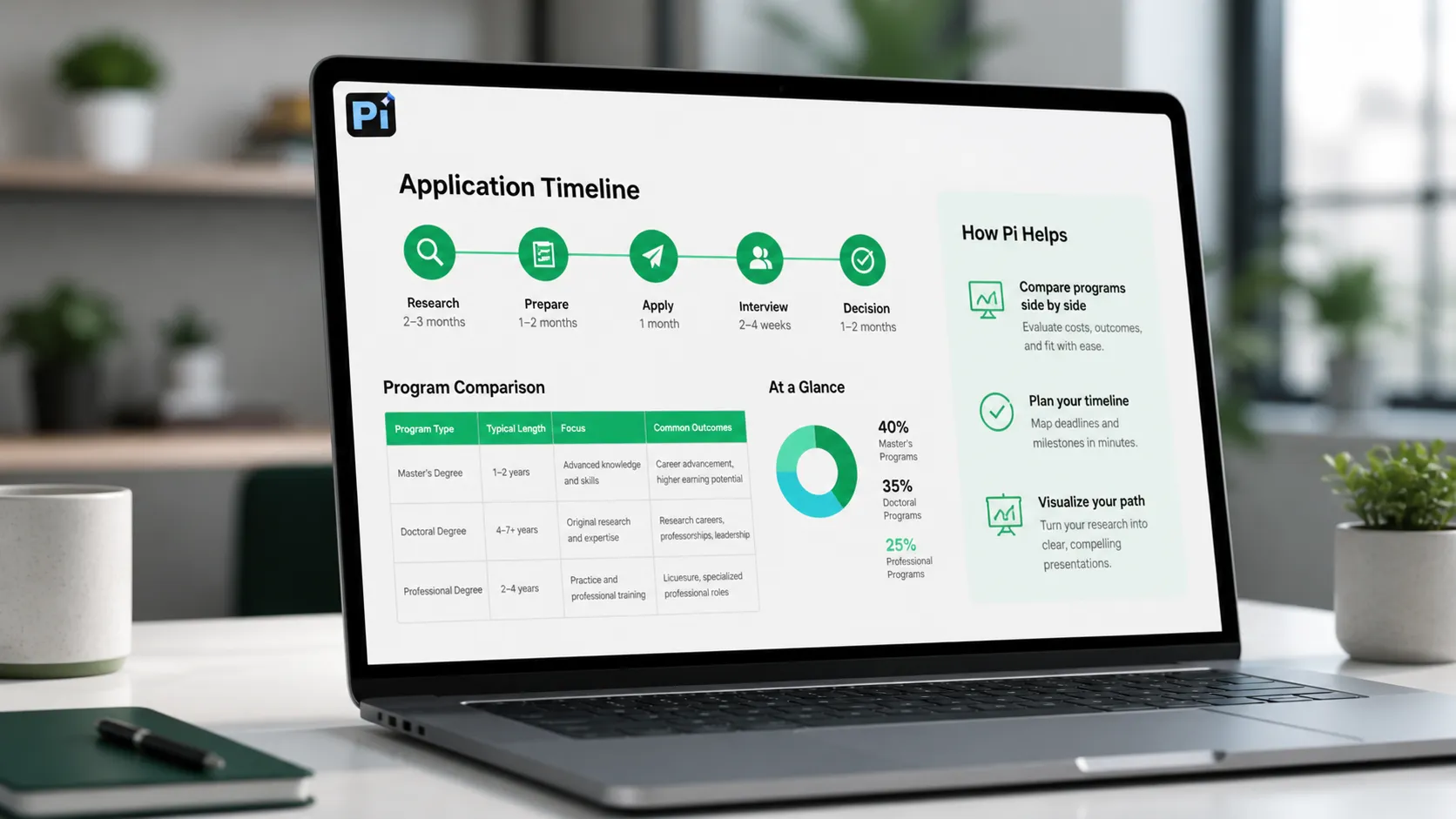
Turn this grad school guide into a clear presentation with Pi. ↗
Frequently Asked Questions (FAQ)
Q: What is grad school?
Grad school is education after a bachelor’s degree. It usually leads to a master’s, doctoral, or professional degree.
Q: Is grad school the same as college?
No. College usually refers to undergraduate study, while grad school is more advanced and specialized.
Q: How long does grad school take?
Many master’s programs take one to two years full time. Doctoral and professional programs often take longer, depending on the field.
Q: Do you need grad school to get a good job?
Not always. Some careers require graduate education, but many do not. The right choice depends on your field, goals, cost, and expected career return.