what is machine learning
If you are asking what is machine learning, the simplest answer is this: machine learning is a way for computers to learn patterns from data and use those patterns to make predictions, recommendations, or decisions. Instead of writing every rule by hand, people give the system examples, and the system learns from them.
NIST’s glossary defines machine learning as computer systems that adapt and learn from data to improve accuracy. That sounds technical, but the everyday idea is familiar: the more useful examples the system sees, the better it can recognize patterns.
what is machine learning in simple terms
Machine learning is a branch of artificial intelligence. IBM, Google Cloud, Microsoft Azure, and AWS all explain it in a similar way: machine learning uses data and algorithms to train systems that can make predictions or find patterns without being explicitly programmed for every case.
Imagine teaching a child to recognize dogs. You do not list every possible ear shape, tail length, and fur color. You show examples. Over time, the child learns the pattern. Machine learning works in a similar spirit, but with data, math, and algorithms.
How Machine Learning Works
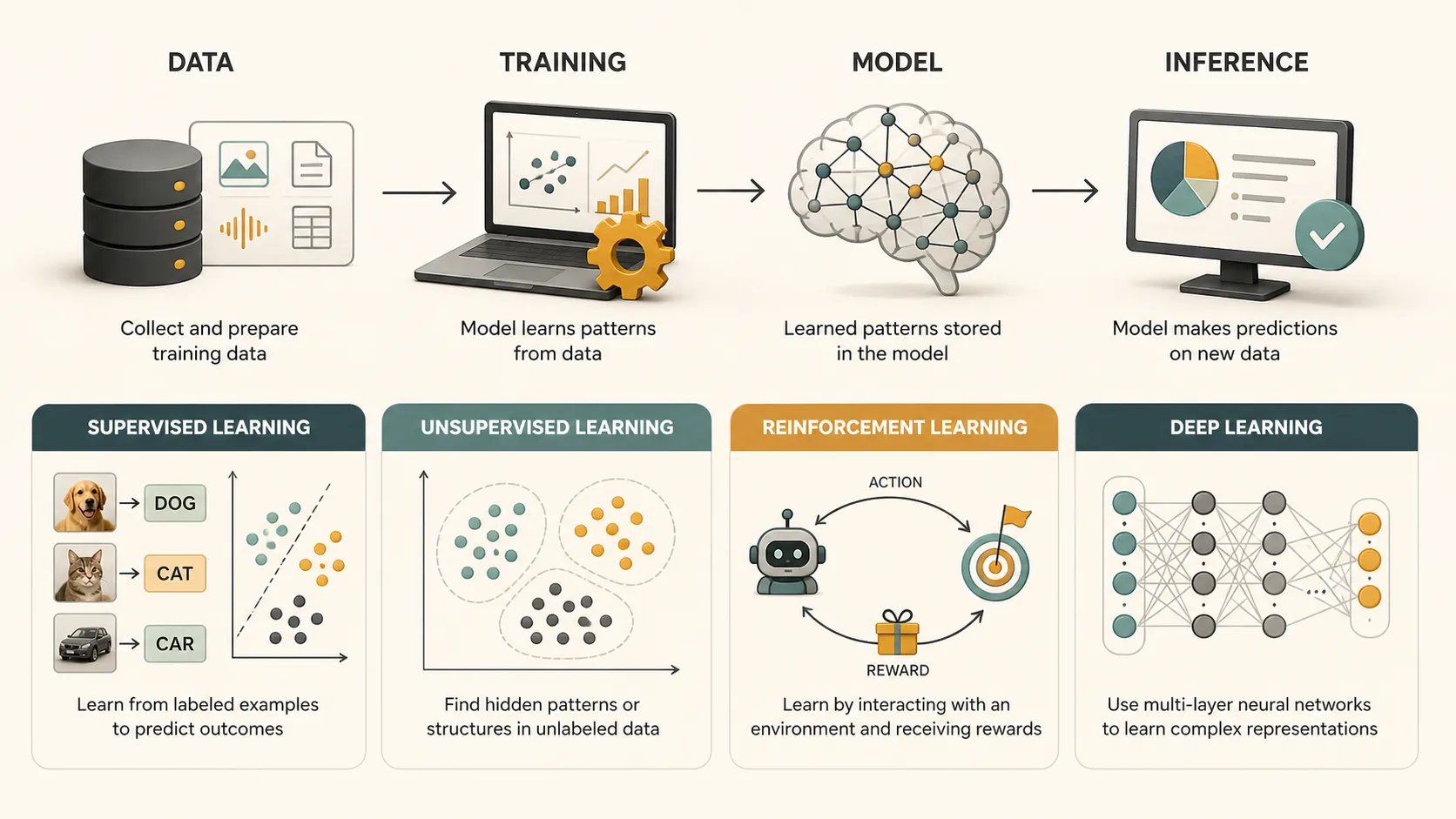
Most machine learning projects follow a basic flow: collect data, prepare it, train a model, test it, and then use the model on new inputs. AWS’s guide to building a machine learning application describes this as an iterative process: define the problem, prepare the data, create useful features, train the model, evaluate it, and use it for predictions.
A spam filter is a simple example. The system learns from emails labeled “spam” and “not spam.” During training, it notices patterns: suspicious links, repeated phrases, sender behavior, or formatting. During inference, it applies what it learned to a new email and predicts whether it is spam.
The important word is “predicts.” Machine learning does not understand the world like a person. It finds statistical patterns. That can be powerful, but it also means the quality of the data matters enormously.
Common Types Of Machine Learning
Machine learning is not one single method. It includes several major approaches:
| Type | what is machine learning used for here? | Example |
|---|---|---|
| Supervised learning | Learning from labeled examples | Predicting house prices from past sales |
| Unsupervised learning | Finding patterns without labels | Grouping customers by behavior |
| Reinforcement learning | Learning through rewards and penalties | Training a game-playing agent |
| Deep learning | Using layered neural networks | Image recognition or speech transcription |
Stanford CS229 teaches machine learning through core topics like supervised learning, unsupervised learning, neural networks, and reinforcement learning. Google’s Machine Learning Crash Course is also useful for beginners because it explains the concepts with practical examples. For people who want hands-on documentation, the scikit-learn user guide and TensorFlow machine learning basics are strong technical references.
Machine Learning Vs AI Vs Deep Learning
People often mix up AI, machine learning, and deep learning. They are related, but not identical.
Artificial intelligence is the broad field: building systems that can perform tasks associated with human intelligence, such as reasoning, language, perception, learning, or decision-making. Machine learning is one way to build AI systems. Deep learning is a type of machine learning that uses neural networks with many layers.
So the relationship is simple: AI is the big category. Machine learning sits inside AI. Deep learning sits inside machine learning.
A calculator follows fixed rules, so it is not machine learning. A recommendation system that improves by learning from user behavior is machine learning. A large language model that uses deep neural networks is deep learning.
Real Examples Of Machine Learning
Machine learning is already part of ordinary life. Streaming services use it to recommend videos. Banks use it to detect unusual transactions. Email services use it to filter spam. Translation tools use it to convert language. Search engines use it to understand relevance and ranking signals.
In healthcare, the FDA maintains a list of AI-enabled medical devices, many of which use AI or machine learning techniques for imaging, diagnostics, or clinical support. This is a good reminder that machine learning can be useful, but high-stakes systems need testing and oversight.
Science is another strong example. AlphaFold uses AI to predict protein structures, helping researchers study biology more efficiently. It shows that machine learning is not only for ads, apps, and dashboards; it can also support scientific discovery.
Why Data Quality Matters
A machine learning model is only as good as the data and assumptions behind it. If the training data is incomplete, biased, outdated, or poorly labeled, the model can learn the wrong patterns.
For example, a hiring model trained on biased past hiring data may repeat those patterns. A medical model trained mainly on one population may perform worse for another. A recommendation model may become too narrow and keep showing users more of the same thing.
Good machine learning work includes data cleaning, testing, validation, monitoring, and human review. It also means asking uncomfortable questions: Who is represented in the data? Who is missing? What happens if the model is wrong?
Explaining Machine Learning Visually With Pi
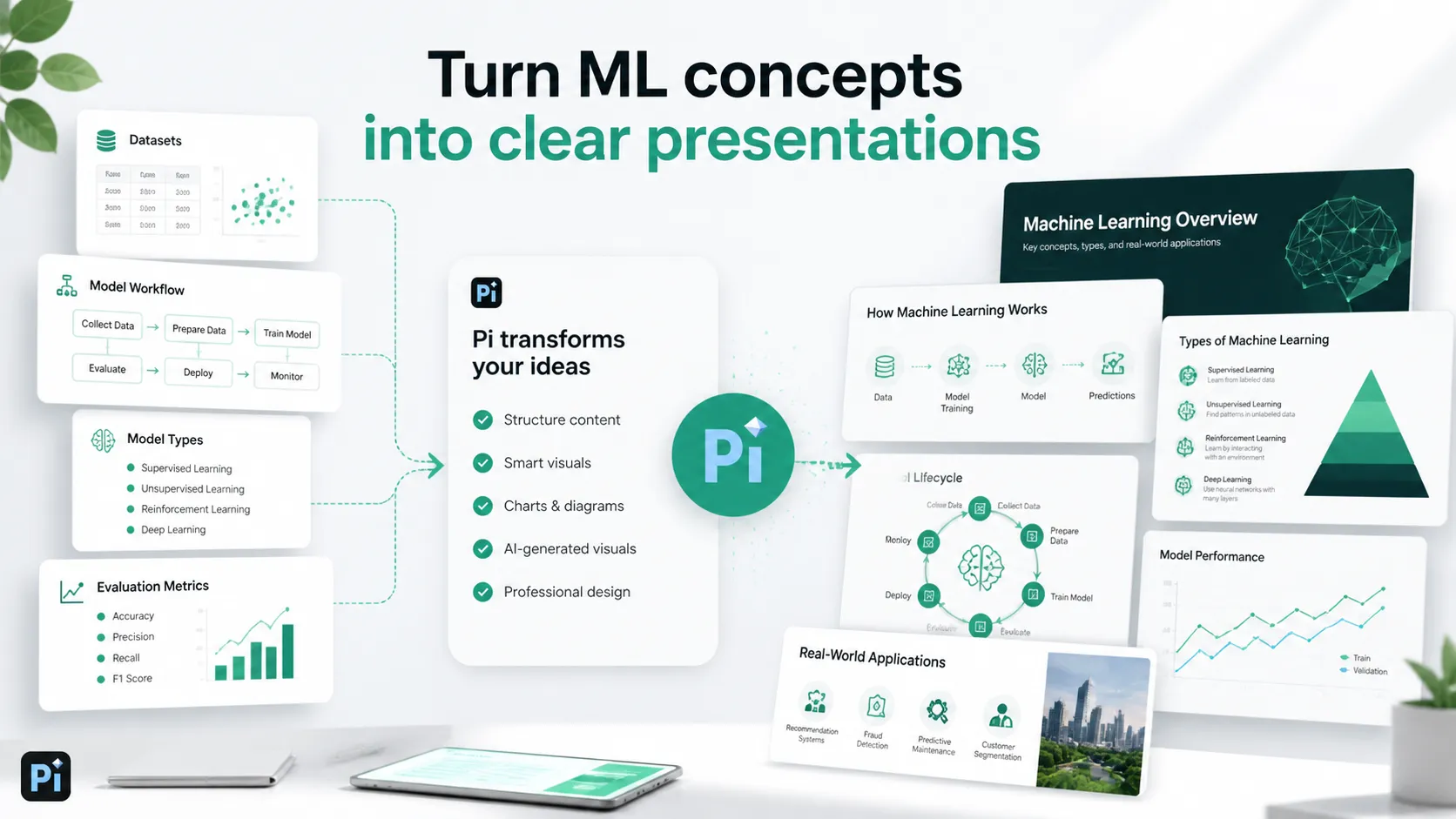
Machine learning can feel abstract because the important work is often invisible: data preparation, model training, evaluation, deployment, and feedback loops. Visual explanation helps people see the process.
With Pi, you can turn machine learning concepts into a presentation: a data-to-model workflow, a comparison of supervised and unsupervised learning, a chart showing model accuracy, or an icon-based explanation of training and inference. Pi can also customize themes, colors, layouts, icons, charts, and AI-generated visuals, which makes technical ideas easier to present to students, clients, founders, or internal teams.
Risks And Responsible Use
Machine learning systems can make mistakes. They can amplify bias, expose private information, create unfair outcomes, or become hard to explain. That is why responsible AI matters.
The NIST AI Risk Management Framework gives organizations a way to think about trustworthy AI risks. The OECD AI Principles emphasize human-centered values, fairness, transparency, robustness, safety, and accountability.
For beginners, the takeaway is simple: machine learning should not be judged only by accuracy. It should also be judged by fairness, safety, privacy, explainability, and real-world impact.
The Verdict
Machine learning is the practice of teaching computers to learn patterns from data and apply those patterns to new situations. It is one of the main engines behind modern AI, from recommendations and fraud detection to medical tools and scientific research.
The concept is simple, but the practice requires care. Good machine learning needs good data, clear goals, testing, monitoring, and responsible use. The best models are not just clever. They are useful, reliable, and appropriate for the people affected by them.
Frequently Asked Questions (FAQ)
Q: What is machine learning?
A: Machine learning is a branch of AI where computers learn patterns from data and use those patterns to make predictions, recommendations, or decisions.
Q: Is machine learning the same as artificial intelligence?
A: No. AI is the broader field. Machine learning is one method used to build AI systems. Deep learning is a smaller category inside machine learning.
Q: What are common examples of machine learning?
A: Common examples include recommendation systems, spam filters, fraud detection, voice recognition, image classification, translation tools, and some medical AI systems.
Q: Do you need coding to learn machine learning?
A: You can understand the basic ideas without coding, but building real machine learning models usually requires programming, statistics, data handling, and testing skills.