White House AI Summit: The New Safety Framework Explained
On August 4th, the White House AI Summit placed the US federal approach to artificial intelligence back at the center of the global policy debate. The headline was not simply that Washington wants more oversight. It was that the new AI Safety Framework appears designed to define how the most powerful AI systems can continue scaling while meeting higher expectations for national security, transparency, and public accountability.
For OpenAI, Meta, Google, and Anthropic, the message is clear: frontier AI is no longer only a product race. It is becoming a governance race. The companies that build the most capable models will increasingly need to prove how those models are tested, monitored, documented, and controlled before they reach large-scale deployment.
What Happened at the August 4th White House AI Summit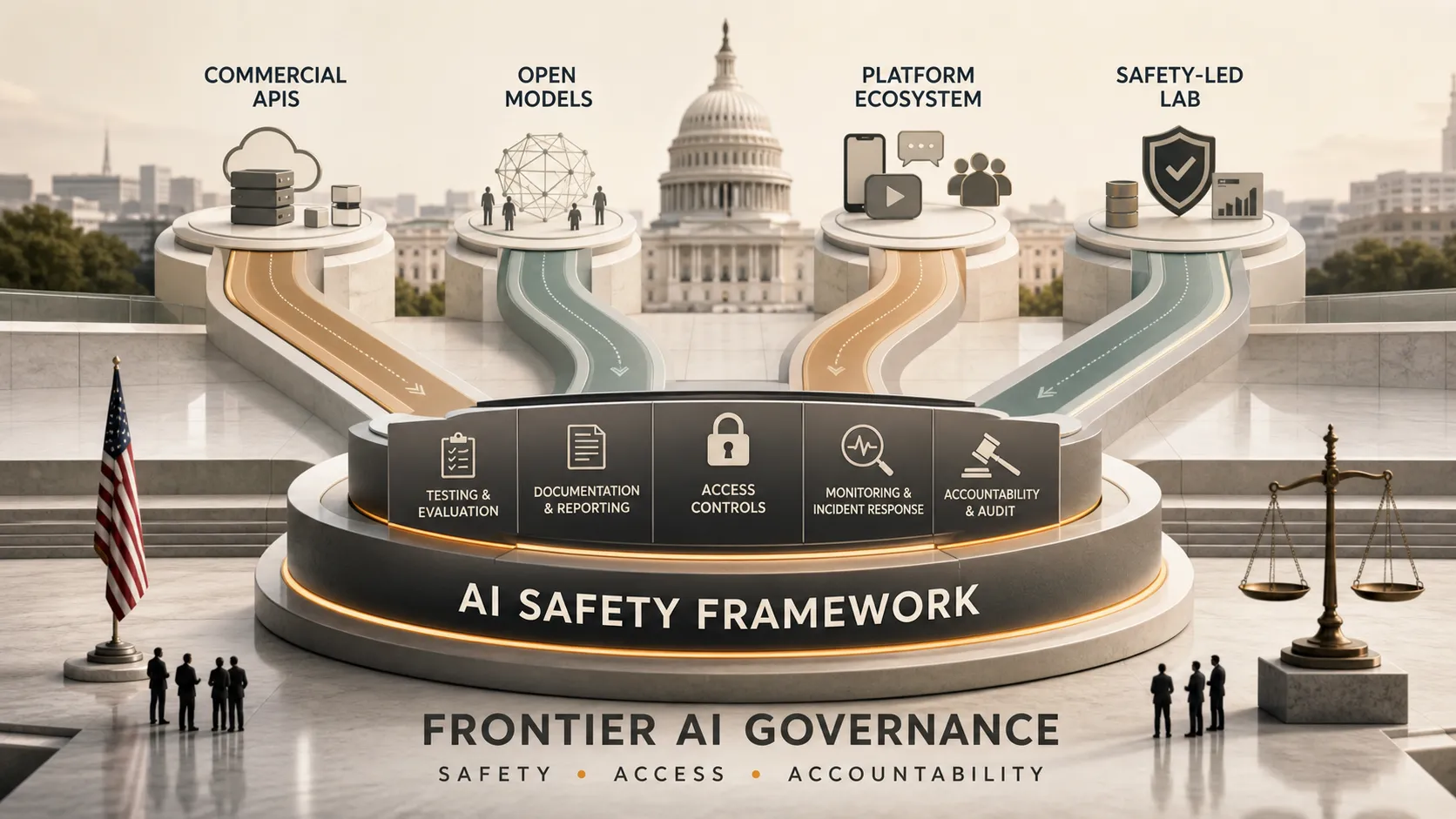
The August 4th AI summit brought together federal priorities around AI safety, industry responsibility, and America’s competitive edge. Rather than treating AI regulation as a single rulebook, the White House framed safety as a strategic operating layer for frontier model development.
The AI Safety Framework is best understood as a policy signal: leading AI companies will be expected to demonstrate stronger safeguards as their models become more capable and widely deployed. This does not mean every principle is immediately legally binding. But it does suggest that voluntary commitments, federal guidance, procurement expectations, and regulatory standards are beginning to converge.
This matters because AI systems are moving from experimental tools into critical business, government, and security workflows. The policy question is no longer whether AI should be governed, but how to govern it without undermining innovation or commercial competitiveness.
What the AI Safety Framework Is Trying to Solve
The AI Safety Framework is responding to a practical problem: the most advanced models can generate enormous economic value, but they can also create risks that traditional software governance was not built to manage.
The central concerns include unpredictable frontier model capabilities, misuse involving cyber operations or fraud, limited transparency around model training, weak accountability in high-impact workflows, and national security risks tied to global competition in advanced AI.
The framework pushes the industry toward a higher standard of evidence. It is not enough for companies to claim a model is safe. They must show how they evaluated safety, what risks were identified, what mitigations were added, and how the system will be monitored after release.
How the US Approach Differs From the EU AI Act
The US framework should not be confused with the EU AI Act. The EU model is explicitly rights-based, with a strong focus on fundamental rights, risk categories, and compliance obligations across different AI use cases.
The US approach, in contrast, is more closely tied to national security, commercial competitiveness, frontier model safety, and Big Tech accountability. Instead of building a broad rights-first regulatory architecture, Washington appears focused on the conditions under which powerful AI companies can keep building, deploying, and exporting advanced systems.
What This Means for OpenAI, Meta, Google, and Anthropi
The new framework affects each of the major AI companies differently because their business models, distribution channels, and safety philosophies are not the same.
| Company | Core Exposure | Strategic Challenge |
|---|---|---|
| OpenAI | Commercial frontier models and enterprise deployment | Proving safety before rapid product expansion |
| Meta | Open-source and downloadable models such as Llama | Applying safety controls after public release |
| AI across Search, Cloud, Workspace, Android, and ads | Coordinating governance across a large ecosystem | |
| Anthropic | Safety-led frontier model development | Turning safety positioning into verifiable evidence |
OpenAI may face the most direct pressure around deployment pacing. Its commercial model depends on turning frontier capabilities into widely adopted products, APIs, and enterprise workflows. Under the AI Safety Framework, faster releases will need stronger documentation, more persuasive model evaluations, and clearer evidence that commercial demand is not outrunning safety discipline.
Meta faces a different and potentially harder dilemma. Its Llama strategy has made open models a major competitive advantage. Yet a federal framework that favors controlled access, traceable deployment, and monitored risk mitigation sits uneasily with open-source distribution. Once a model is downloaded, fine-tuned, and modified by third parties, Meta has less control over downstream behavior. The question is not whether open models can be safe, but whether safety can be demonstrated to federal expectations after decentralization.
Google’s challenge is scale. AI is embedded across search, productivity software, cloud infrastructure, advertising tools, mobile systems, and developer products. That breadth gives Google enormous strategic power, but it also multiplies compliance complexity. A safety failure in one product area can become a reputational and regulatory issue for the entire ecosystem.
Anthropic enters the framework discussion from a stronger narrative position because safety has always been central to its brand. But even Anthropic will face a higher bar. A safety-first culture is no longer enough on its own. Policymakers will want repeatable testing processes, auditable documentation, and clear evidence that governance practices hold up as model capabilities increase.
Why the Framework Changes the AI Business Model
The AI Safety Framework does not merely add paperwork. It changes how companies must think about speed, distribution, and trust.
In the previous phase of generative AI competition, the market rewarded rapid launches, model benchmarks, developer adoption, and user growth. In the next phase, those advantages still matter, but they will sit alongside evidence-based governance. A frontier model release may increasingly require safety reports, red-team findings, risk mitigations, escalation policies, and post-deployment monitoring plans.
This creates a new operating reality for Big Tech AI regulation. Product teams, policy teams, legal teams, and security teams will need to work together earlier in the development cycle. Safety can no longer be treated as a review at the end of model training. It must become part of the model roadmap itself.
What Business Teams Should Watch Next
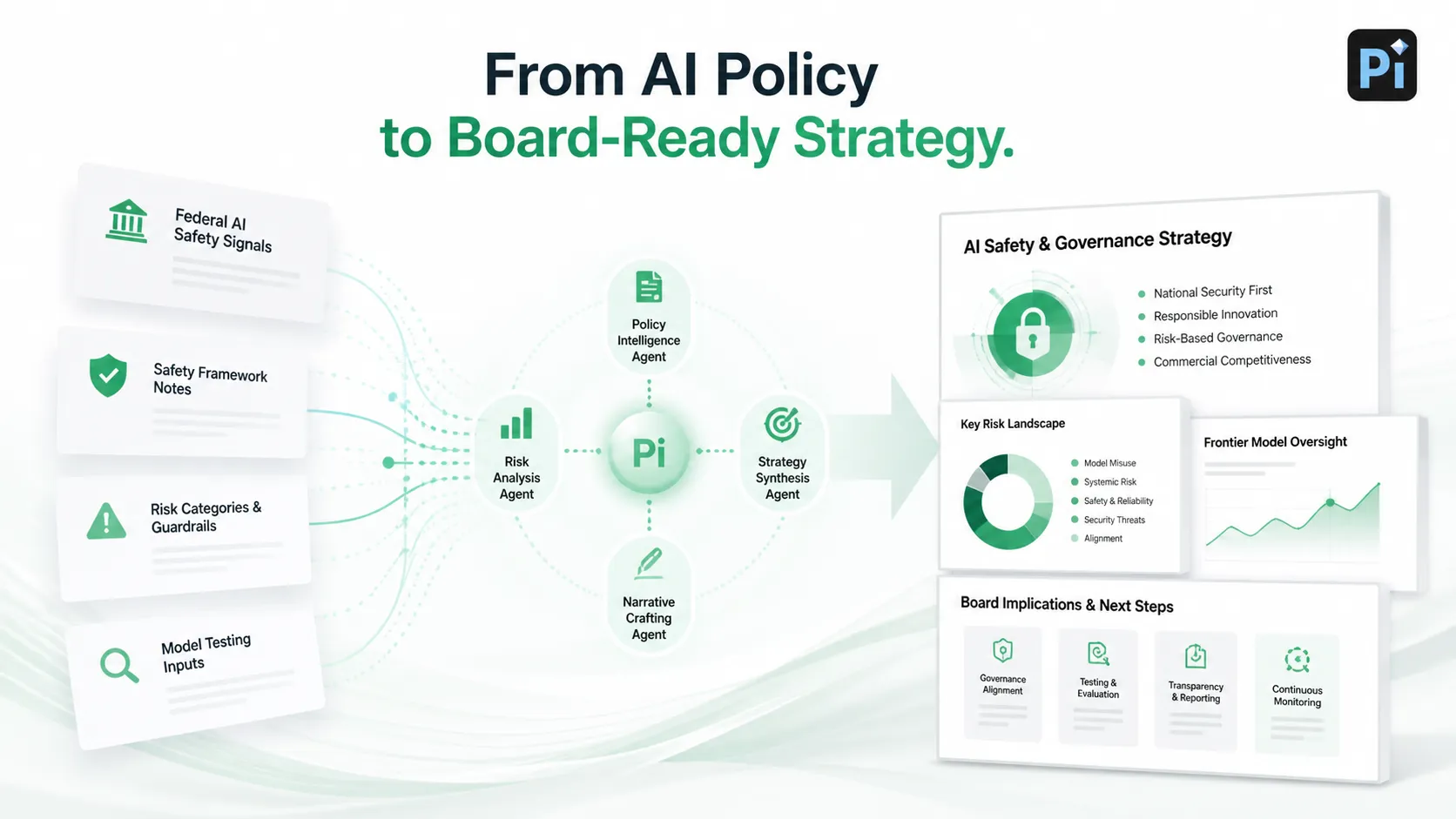
The White House AI Summit is not only relevant to AI labs. It also affects enterprises that buy, integrate, or present AI strategies to boards, clients, investors, and regulators. When federal expectations change, the way companies explain AI adoption must also change.
Business teams will need clearer internal narratives around three questions: which AI systems they use, what risks those systems create, and how governance is handled. This is especially important for executive presentations, consulting reports, investor updates, and product launch decks where AI capability must be explained without overstating certainty.
For organizations navigating these high-stakes discussions, practical tools that bridge regulatory complexity with structured professional communication are increasingly critical. Whether it is translating policy changes into board-ready narratives or synthesizing competitive implications, platforms like Pi are emerging as valuable assets for strategy teams looking to move from reactive reporting to proactive executive storytelling.
The Verdict: AI Safety Is Becoming a Competitive Requirement
The White House AI Summit and the accompanying AI Safety Framework represent a clear inflection point for the AI industry. They signal that federal oversight is no longer hypothetical. For the major AI laboratories, safety has transitioned from an internal engineering priority to a core compliance and governance requirement.
The framework will not halt AI development, but it will reshape how models are built, tested, documented, and released. Ultimately, the companies that thrive in this new environment will not be those with the strongest models alone, but those with the most credible safety narratives.
The next stage of this debate will center on how those claims are verified. That is why frontier model testing via NIST standards is becoming the critical bridge between policy intent and real-world AI deployment.
Frequently Asked Questions (FAQ)
Q: What was announced at the White House AI Summit?
A: The White House AI Summit highlighted a new AI Safety Framework focused on frontier model safety, national security, transparency, and accountability for leading AI companies.
Q: What is the AI Safety Framework?
A: The AI Safety Framework is a US policy approach aimed at improving governance around powerful AI systems, especially through safety testing, misuse prevention, documentation, and responsible deployment.
Q: How does the framework affect OpenAI, Meta, Google, and Anthropic?
A: OpenAI faces pressure to prove safety before rapid deployment, Meta must address open-source control challenges, Google needs ecosystem-wide governance, and Anthropic must turn its safety positioning into verifiable evidence.
Q: What is frontier model testing?
A: Frontier model testing is the process of evaluating advanced AI systems before and after deployment through capability assessments, misuse testing, robustness checks, alignment evaluation, and ongoing risk monitoring.