Best AI Presentation Prompts for Business Decks
The best AI presentation prompts do more than ask an AI tool to “make a deck.” They define the audience, business objective, context, narrative, slide structure, and level of polish required. That difference matters when the output is not just a school-style summary, but a pitch deck, client proposal, strategy report, sales deck, or executive presentation.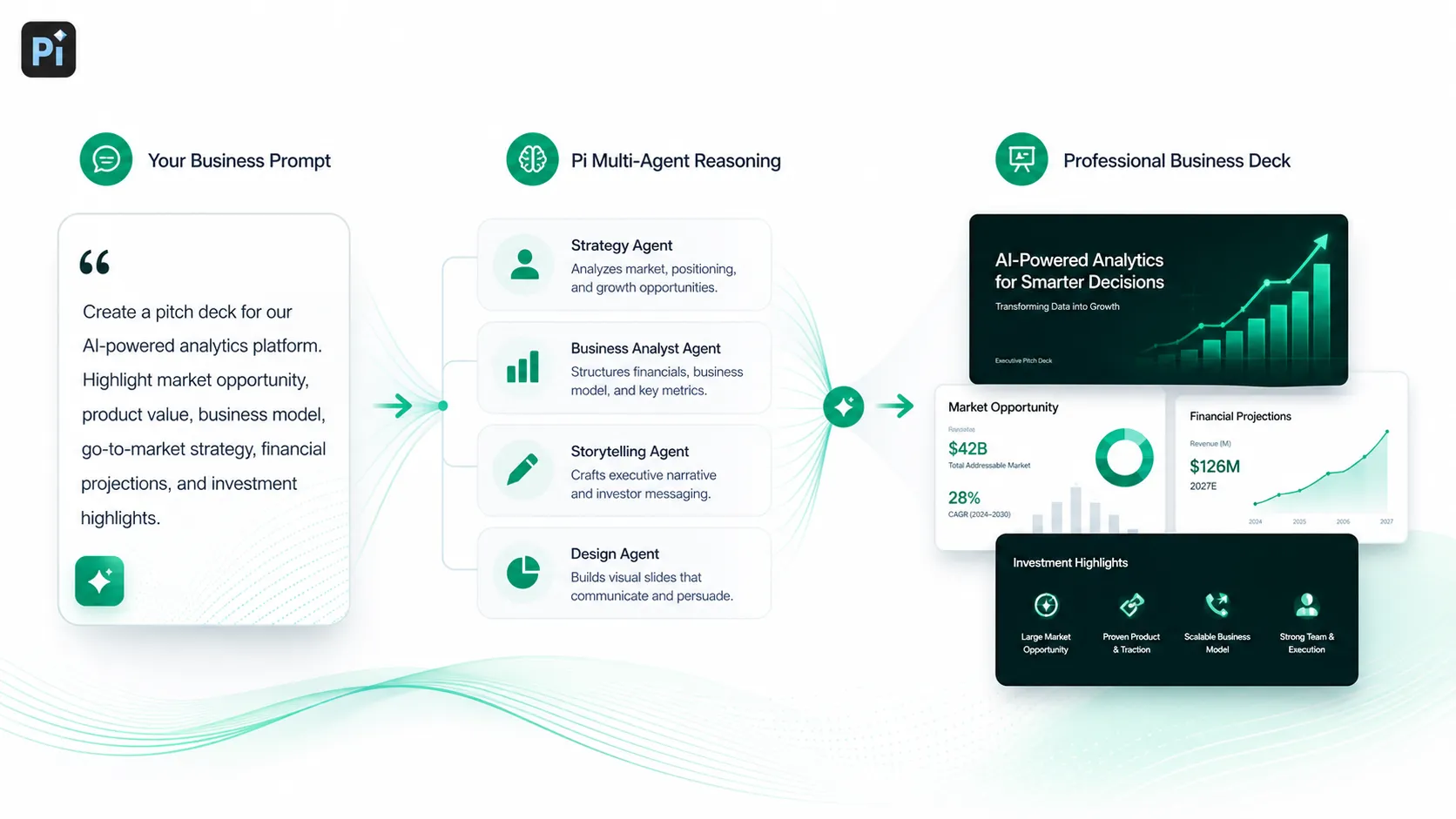
Business teams often use AI because they want to move faster. But speed alone is not enough. A useful business presentation prompt should help AI think like a strategic drafting partner: what decision must be influenced, what evidence matters, what story should the deck tell, and what should the audience do next?
Below are copy-ready AI presentation prompts you can adapt for high-stakes business decks.
Why Generic AI Presentation Prompts Often Fall Short
A vague AI prompt usually produces a vague deck. If you type “create a business presentation about our company,” the AI has very little to work with. It may create a clean outline, but the messaging will likely feel generic, the slide sequence may be shallow, and the deck will still need heavy editing before it is ready for a real meeting.
Generic prompts tend to fail because they do not specify:
- Who the audience is and what they already know
- What decision the presentation should support
- Which business context, constraints, or assumptions matter
- What level of detail is appropriate
- Whether the deck should persuade, inform, recommend, or summarize
AI can accelerate presentation creation, but it cannot reliably guess your strategy. The more clearly your prompt defines the business situation, the more useful the first draft becomes.
The Business Presentation Prompt Formula
A strong business presentation prompt usually includes nine elements: role, audience, objective, context, deck type, key argument, slide structure, tone, and output requirements.
A reusable formula is:
“Act as a [role]. Create a [deck type] for [audience]. The objective is to [business goal]. Context: [company, market, product, challenge, data, constraints]. The core argument is [main message]. Structure the deck as [number of slides or sections]. Use a [tone] tone. Make each slide include a concise headline, key points, and suggested visual direction. State assumptions clearly and flag any claims that require verification.” https://www.ibm.com/think/topics/ai-hallucinations
This formula works because it tells AI what kind of thinking is needed, not just what topic to cover. It also creates boundaries, which is especially important for business presentations involving financial claims, market sizing, customer promises, or strategic recommendations.
AI Presentation Prompts for Pitch Decks
For a startup fundraising deck, try:
“Act as a venture fundraising advisor. Create a 12-slide pitch deck for seed investors evaluating a B2B SaaS startup. The company helps mid-market finance teams automate monthly reporting. The objective is to raise $2 million. Build the narrative around the market pain, current manual workflow, product solution, target customer, traction, business model, go-to-market strategy, competitive differentiation, team, financial assumptions, and funding ask. Use concise investor-style slide headlines. Include speaker notes for each slide and flag any metrics that need verification.”
For a product pitch, use:
“Act as a product marketing strategist. Create a product pitch deck for enterprise buyers considering a new AI analytics platform. The audience includes a CFO, COO, and Head of Data. The objective is to show why the product reduces reporting delays and improves decision quality. Structure the deck around the business problem, cost of inaction, product overview, key use cases, implementation approach, ROI logic, proof points, risk mitigation, and next steps. Keep the tone credible, specific, and executive-friendly.”
For investor narrative refinement, use:
“Review and improve the narrative of an existing pitch deck for a Series A startup. The current story feels too feature-focused. Reframe it around the investor decision: market opportunity, urgency, category potential, traction quality, defensibility, and capital efficiency. Produce a revised slide-by-slide storyline with sharper headlines, missing proof points, and suggestions for where data should be added.”
AI Presentation Prompts for Strategy Reports
Strategy decks need structured analysis, not just summary. A useful AI prompt should ask for options, tradeoffs, and a recommended path.
Try:
“Act as a strategy consultant. Create a 15-slide business strategy report for a leadership team evaluating expansion into a new geographic market. The objective is to recommend whether to enter, delay, or reject the opportunity. Include market context, customer segments, competitive landscape, regulatory considerations, entry options, investment requirements, risks, expected benefits, tradeoffs, and final recommendation. Use a board-ready tone. State assumptions and identify where external validation is required.”
For quarterly planning:
“Create a quarterly planning deck for a B2B sales organization. The audience is the executive leadership team. The objective is to align on priorities for the next quarter. Include performance review, pipeline health, key risks, customer segment trends, resource gaps, three strategic options, recommended priorities, KPI targets, and operating cadence. Make the deck practical, decision-oriented, and concise.”
AI Presentation Prompts for Client Proposals
Client proposal prompts should focus on the client’s pain points, the proposed approach, measurable outcomes, timeline, and proof points. The deck must make the buyer feel understood before it presents the solution.
Try:
“Act as a senior consulting partner. Create a client proposal deck for a retail company struggling with declining customer retention. The audience is the CMO and customer experience leadership team. The objective is to win approval for a 10-week diagnostic and growth strategy project. Structure the deck around the client challenge, likely root causes, proposed workstreams, methodology, timeline, deliverables, expected outcomes, team credentials, proof points, and commercial next steps. Use a confident but not exaggerated tone.”
For a B2B sales proposal:
“Create a B2B solution presentation for an enterprise cybersecurity buyer. The audience includes technical evaluators and budget owners. The objective is to show how our platform reduces incident response time and improves visibility across cloud environments. Include buyer pain points, business impact, solution overview, deployment model, integration plan, security proof points, expected ROI logic, implementation timeline, and decision next steps. Keep claims grounded and flag any numbers that require validation.”
AI Presentation Prompts for Executive Summaries
Executive summary decks should reduce complexity without removing judgment. The goal is to help leaders quickly understand what matters, what decision is needed, and what happens next.
Use this prompt:
“Act as an executive communications advisor. Create a 6-slide executive summary from the following business report: [paste report or notes]. The audience is the CEO and executive team. The objective is to support a decision on whether to approve the recommended initiative. Include the situation, key insight, strategic options, recommendation, risks, decision required, and next steps. Use short slide headlines that communicate the takeaway, not just the topic. Keep the tone direct, analytical, and board-ready.”
For board materials:
“Condense the following 30-page strategy document into an 8-slide board update. Prioritize only what directors need to know: business context, performance signal, strategic issue, management recommendation, financial implications, key risks, governance decision, and next milestones. Avoid unnecessary detail. State assumptions clearly.”
How to Make AI Prompts More Business-Ready
A strong AI prompt should reduce ambiguity. Before generating slides, add the seniority of the audience, the decision context, the constraints, and the intended outcome. A prompt for a CFO should sound different from a prompt for a product team, even if the topic is the same.
Ask AI for slide-by-slide logic before asking for final slide content. This helps you inspect the argument before polishing the wording. Require concise action-oriented headlines, not labels like “Market Overview” or “Our Solution.” A better headline might be “Manual reporting creates a recurring cost that finance teams can no longer absorb.”
Finally, ask AI to separate facts from assumptions. For business decks, especially pitch decks and strategy reports, AI-generated market data, forecasts, and financial projections should be verified before use.
Where Pi Fits in a Professional Presentation Workflow
Good prompts improve AI output, but business teams often need more than a text outline. They need the prompt https://www.ibm.com/think/topics/multiagent-system to become a structured, visually polished, professional deck. Pi, short for Presentation Intelligence, is an AI presentation maker built for workflows where business logic, narrative structure, and premium visual quality all matter.
1. Business Logic Comes Before Slide Styling
Pi is useful when the presentation needs to communicate a clear argument, not just fill slides with content. Its Multi-Agent AI approach helps interpret the business goal, organize the storyline, and shape the deck around the decision the audience needs to make.
2. Professional Structure Supports High-Stakes Use Cases
Pitch decks, consulting reports, executive presentations, brand proposals, market research decks, and product launch decks each require different structures. Pi helps turn a detailed AI prompt into a deck format that fits the use case, rather than forcing every topic into the same generic layout.
3. Premium Visual Quality Reduces Manual Rework
A strong prompt can produce useful content, but teams still need slides that look credible in front of investors, clients, or senior leaders. Pi supports business-grade aesthetics so the output feels closer to a professional presentation, not only a rough AI draft.
Prompt Quality vs. Deck Quality
| Workflow Type | Structure | Business Logic | Visual Polish | Professional Readiness |
|---|---|---|---|---|
| Weak AI prompt | Generic outline | Limited context | Inconsistent | Needs major revision |
| Strong AI prompt | Clear slide flow | Audience-aware | Depends on tool | Better first draft |
| Pi-assisted workflow | Use-case specific | Decision-oriented | Premium quality | Closer to meeting-ready |
A strong prompt is the foundation. The presentation workflow determines how much of that thinking becomes a polished, usable deck.
A Practical Verdict for Business Teams
AI presentation prompts work best when they are specific, contextual, and decision-oriented. If you define the audience, objective, business situation, desired structure, tone, and output requirements, AI can produce a much stronger first draft.
Still, high-stakes business decks require human judgment. Teams should verify market data, financial assumptions, customer claims, competitive statements, and strategic recommendations before presenting them. AI can accelerate the drafting process, but the final deck still needs credible thinking, clear narrative, and professional execution.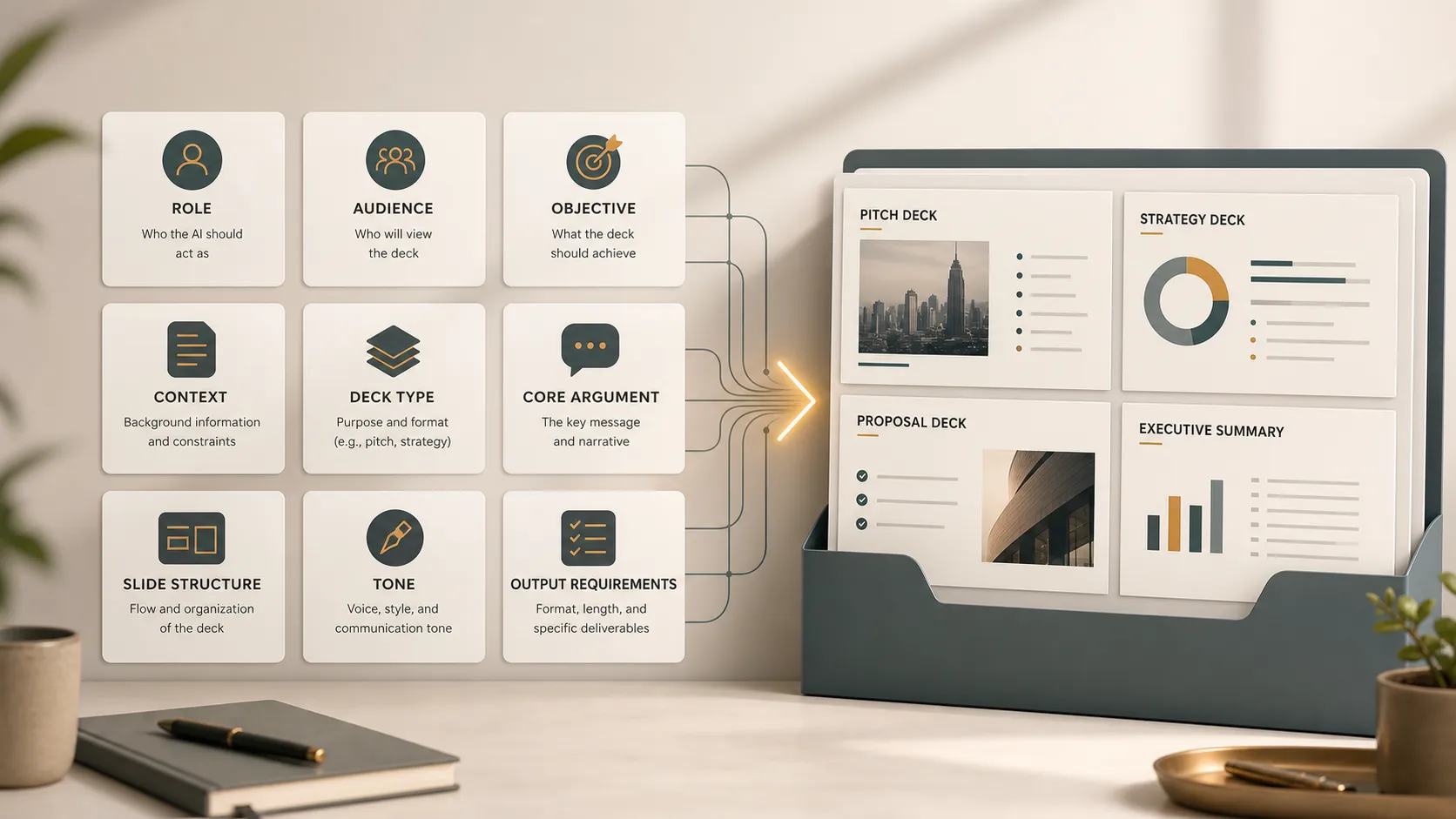
For teams that want prompts to become investor-ready, client-ready, or executive-ready presentations, Pi can fit naturally into the workflow by helping translate business intent into structured, premium slides.
Frequently Asked Questions (FAQ)
Q: What are AI presentation prompts? A: AI presentation prompts are instructions that tell an AI tool what kind of presentation to create, who it is for, what objective it should support, and how the output should be structured.
Q: What makes a good business presentation prompt? A: A good business presentation prompt includes the audience, business goal, context, deck type, core message, slide structure, tone, constraints, and output format. The more specific the prompt, the more useful the deck draft.
Q: How detailed should a pitch deck prompt be? A: A pitch deck prompt should be detailed enough to cover the market problem, solution, customer, traction, business model, competition, team, financial assumptions, and funding ask. It should also ask AI to flag claims that need verification.
Q: Can AI create professional business presentations? A: AI can create strong first drafts and speed up the presentation process. For professional use, the best results come from combining detailed prompts, human validation, and a presentation workflow such as Pi that supports business logic, structure, and premium visual quality.