Demonstration Speech Ideas: Topics That Are Easy to Present
Choosing a demonstration speech topic can feel harder than giving the speech itself. The topic needs to be interesting, but it also has to be practical. It should be easy to explain step by step, simple enough to show within the time limit, and clear enough for the audience to understand without confusion.
The best demonstration speech ideas are not necessarily the most impressive ideas. They are the ones you can present confidently, with visible steps and a useful final result. Whether you are preparing for a class assignment, workplace training, product demo, or short how-to presentation, the right topic makes the entire process easier.
Whether you are preparing for a class assignment, workplace training, product demo, or short how-to presentation, the right topic makes the entire process easier.
What Makes a Good Demonstration Speech Topic?
A strong demonstration speech topic gives the audience a process they can follow. It should not be too abstract, too dangerous, too expensive, or too complicated to complete in front of others. If the audience can see the transformation from problem to result, the presentation becomes much easier to remember.
Before choosing a topic, check whether it meets these basic criteria:
- It can be explained in clear steps.
- It fits the available time limit.
- It uses safe, simple, and accessible materials.
- It has a visible or understandable final result.
- It gives the audience something useful to learn.
For example, “how to organize a study schedule” works well because the steps are clear and the result is practical. “How to repair a car engine” may be interesting, but it is usually too complex for a short demonstration speech.
Easy demonstration speech ideas for beginners
If you need a topic quickly, choose something familiar, safe, and easy to show in steps. Beginner-friendly topics reduce pressure because you do not need to memorize every detail; you only need to organize a process you already understand.
Good demonstration speech ideas for beginners include:
- For students: how to make effective flashcards
- For daily life: how to organize a backpack
- For short speeches: how to clean a phone screen properly
- For creative topics: how to build a mood board
- For technology: how to organize digital files
- For business: how to structure a meeting agenda
These topics work because they are visual, practical, and simple enough to explain within a short time limit.
Practical how-to presentation ideas
Practical how-to presentation ideas are useful because they solve real problems. These topics are especially good when your audience wants advice they can apply immediately.
You could demonstrate how to create a simple monthly budget, prepare for a job interview, organize an email inbox, plan a weekly meal schedule, or build a basic home workout routine. Each of these topics has a clear audience benefit and can be broken into a logical sequence.
For example, a speech on budgeting could move from identifying income, to listing fixed expenses, to setting savings goals, to tracking spending. A presentation on interview preparation could show how to research a company, prepare answers, choose professional clothing, and follow up after the interview.
Creative demonstration speech ideas
Creative demonstration speech topics are useful when you want the audience to remember your presentation visually. They often involve design, personal expression, or simple hands-on creation.
You might demonstrate basic calligraphy, how to make a vision board, how to decorate a notebook, how to create a simple logo concept, or how to build a mood board for a project. These topics allow you to show a before-and-after result, which helps keep the audience engaged.
The key is to keep the creative task simple. A five-minute speech should not attempt to teach a complete design system or advanced art technique. Instead, focus on one small skill, such as choosing a color palette for a mood board or drawing three basic letter styles.
Demonstration speech ideas for school or class presentations
For school presentations, the best topics are safe, appropriate, and easy to complete in a classroom. They should also work with limited time and limited equipment.
Classroom-friendly speech topics include how to make flashcards effectively, how to prepare a study guide, how to solve a simple math trick, how to demonstrate a basic science concept with household materials, or how to take better class notes.
A good school demonstration speech does not need to feel childish. You can make a simple topic more thoughtful by explaining why each step matters. For example, instead of only showing how to make flashcards, explain how spacing, question format, and review timing affect memory.
Demonstration speech ideas for business or professional settings
In business settings, demonstration speeches often become training sessions, product walkthroughs, or process explanations. The goal is usually not entertainment alone; it is clarity, alignment, and action.
Professional demonstration speech ideas include how to structure a meeting agenda, explain a simple sales process, demonstrate a product feature, walk through a customer onboarding step, create a basic KPI dashboard, or prepare a short project update.
These topics work well because they are practical and outcome-focused. A manager might demonstrate how to run a more efficient team meeting. A sales lead might show how to qualify a prospect. A product marketer might explain how a feature solves a customer pain point.
How to choose the right demonstration speech topic
The right topic depends on your audience, your time limit, and your own confidence. A topic that works for a classroom may not work for a professional workshop. A topic that sounds exciting may fail if it requires too many materials or too much background knowledge.
Start by asking what your audience already knows and what they would find useful. Then consider whether you can show the process visually. If every step has to be explained only through abstract language, the topic may be better suited to an informative speech than a demonstration speech.
The University of Minnesota’s open public speaking text explains that presentation aids should support a specific part of the speech and be easy for the audience to see and understand. That is a useful test for demonstration topics: if the audience cannot see the process or result clearly, the topic may need to be simplified.
Also consider your comfort level. If you are nervous about public speaking, choose a familiar topic with low technical risk. Confidence often comes from knowing that the process is simple enough to recover from if something does not go exactly as planned.
How to turn a demonstration speech idea into slides
Slides can make a demonstration speech easier to follow, especially when the process has several steps. A strong slide structure gives the audience a map before you begin and a reminder as you move through the demonstration.
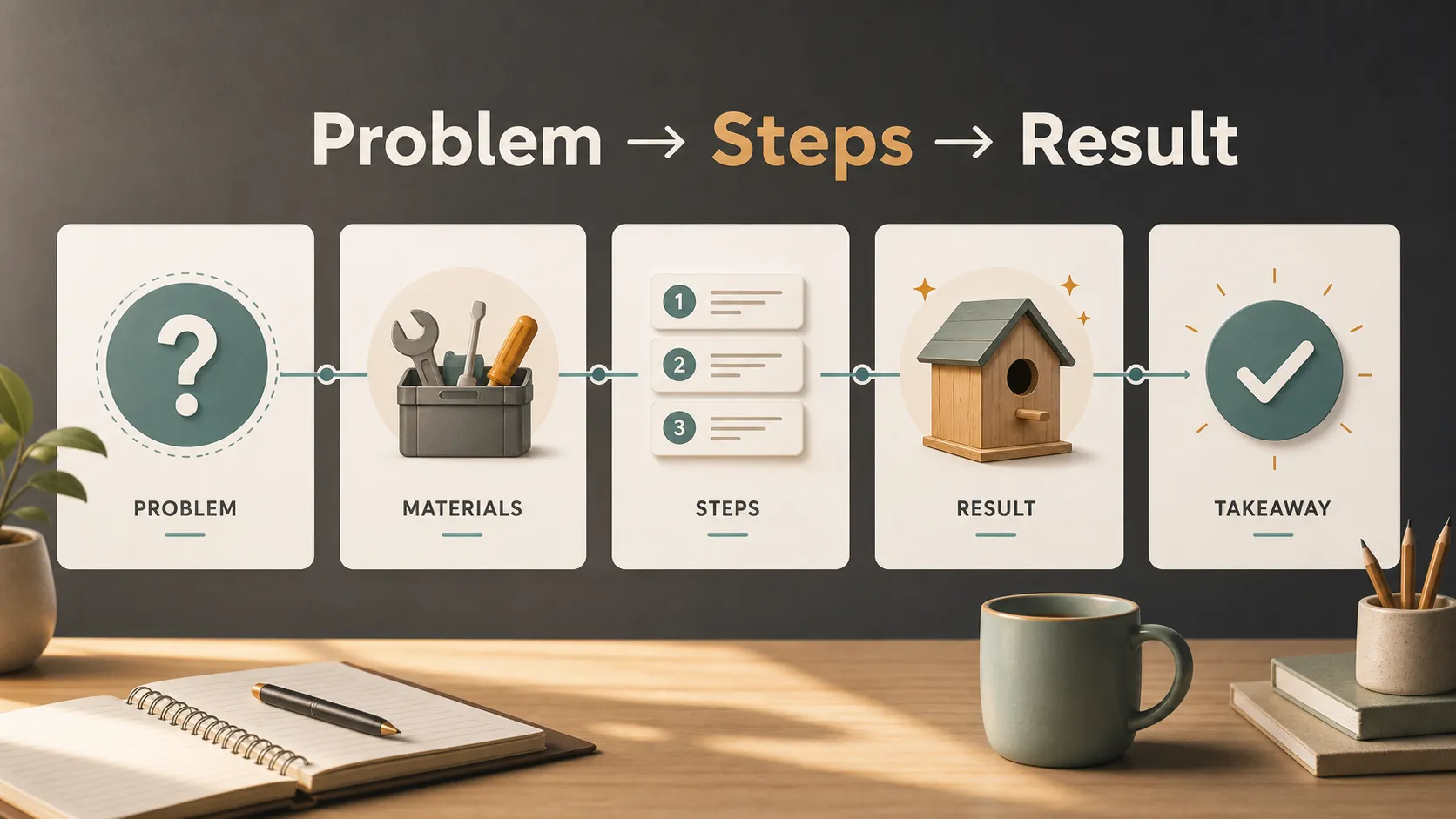
A simple structure is:
- Problem: explain why the topic matters
- Materials: show what is needed
- Steps: walk through the process
- Mistakes: point out what to avoid
- Result: show the final outcome
- Takeaway: summarize what the audience should remember
NN/g’s guide to visual hierarchy is helpful because strong slides should guide attention, not just display information. Toastmasters also recommends using visual aids and props to support the speech without distracting from the speaker.
For example, if your topic is "how to prepare for an interview," your slides might cover the problem of poor preparation, the materials needed, the preparation timeline, common mistakes, and the final checklist. The slides should support the demonstration, not replace it.
Purdue Global’s guide to creating effective PowerPoint presentations also emphasizes audience, purpose, clear organization, and readable slide design. Those basics matter even when the topic is simple.
Using Pi to build a clear how-to presentation
Pi can help turn demonstration speech ideas into structured, polished slide decks. It is especially useful when your topic needs more than a basic list of steps, such as a product demo, training presentation, sales walkthrough, or executive process explanation.
A good how-to presentation needs logical flow before visual polish. Pi helps organize the explanation around the audience’s need, the process being demonstrated, and the final outcome.
This can help turn a topic into a clearer slide sequence: why the topic matters, what the audience needs, how the process works, what mistakes to avoid, and what result they should remember.
Best demonstration speech topics by situation
| Presentation context | Suitable topic type | Example topic |
|---|---|---|
| Beginner-friendly speech | Simple daily process | How to organize a backpack |
| Classroom presentation | Safe educational process | How to make effective flashcards |
| Creative presentation | Visual before-and-after task | How to build a mood board |
| Professional setting | Repeatable business process | How to structure a meeting agenda |
| Short time limit | Low-material demonstration | How to clean a phone screen properly |
This table can help you narrow your choice quickly. If your presentation is short, choose a topic with fewer steps. If your audience is professional, choose a topic that improves a workflow or decision. If your goal is engagement, choose something visual with a clear result.
Demonstration speech topics to avoid
Some ideas sound interesting but are difficult to present safely or clearly. Avoid topics that are:
- Unsafe or risky
- Too messy for the room
- Too expensive to prepare
- Too technical for the audience
- Too long for the time limit
- Dependent on equipment that may fail
- Better explained in a written guide than a live demonstration
This does not mean your topic has to be boring. It means the topic should match the real presentation setting. A simple topic done clearly usually works better than a complicated topic rushed through with confusion.
A simple way to pick a topic you can actually present
The best demonstration speech topic is the one you can explain clearly, safely, and confidently within the time available. It does not need to be unusual to be effective. A familiar topic presented with strong structure is usually better than a complex topic presented with confusion.
Before you commit, test your topic by speaking through the steps out loud. If you can explain the process without rushing, show a clear result, and answer basic questions, you probably have a strong topic. If the explanation feels too long or requires too many exceptions, simplify it or choose another idea.
OpenStax’s public speaking guidance notes that delivery affects how audiences judge both the speaker and the message. That is another reason to choose a topic you can present smoothly, not just a topic that looks impressive on paper.
A strong demonstration speech helps the audience learn by seeing. Choose a topic with practical value, organize it into visible steps, and use slides to reinforce the process. That combination will make your presentation easier to deliver and easier to remember.
Frequently Asked Questions (FAQ)
Q: What is the easiest demonstration speech topic?
A: The easiest demonstration speech topic is usually a simple daily process you already know well, such as organizing a backpack, making flashcards, cleaning a phone screen, or preparing a simple snack. Familiar topics are easier to explain confidently.
Q: How long should a demonstration speech be?
A: Many demonstration speeches are between three and ten minutes, depending on the assignment or setting. Choose a topic that fits the time limit without rushing. A short speech should have fewer steps and minimal materials.
Q: What demonstration speech topics should I avoid?
A: Avoid topics that are unsafe, messy, expensive, illegal, too technical, or difficult to complete in the presentation space. Also avoid topics that require special equipment unless you are certain it will be available.
Q: How can I make a demonstration speech more engaging?
A: Make the speech more engaging by showing a clear problem, using visible steps, explaining common mistakes, and ending with a useful final result. Slides can also help the audience follow the process and remember the main takeaway.