How to Create an Investor Presentation
An investor presentation is not a prettier version of your business plan. It is a focused story that helps investors understand the problem, believe the opportunity is real, trust your team, and see why now is the right time to build. A good deck does not answer every possible question. It creates enough clarity for the next conversation.
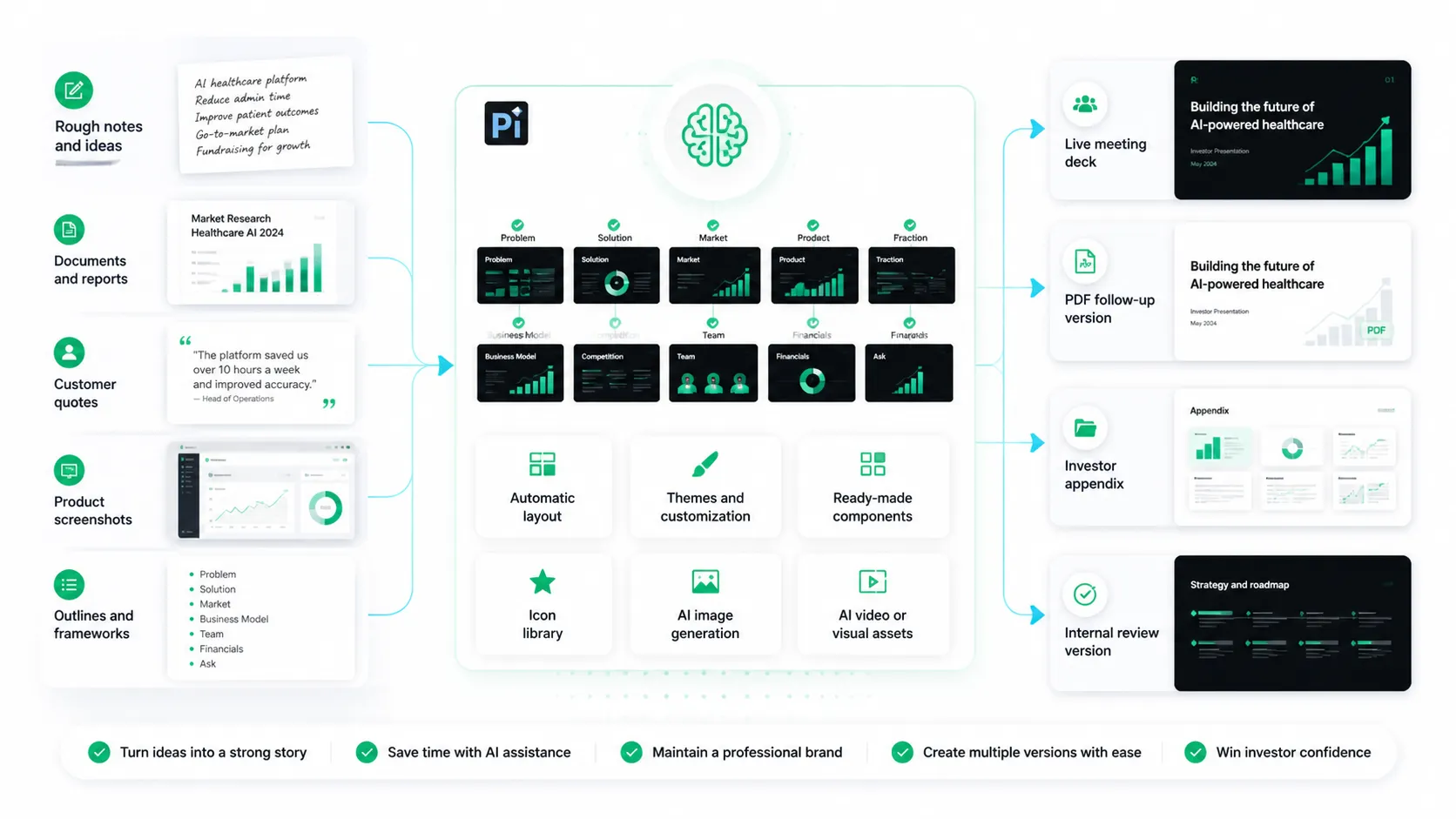
Most founders do not begin with a perfect deck. They begin with scattered notes, customer quotes, old slides, product screenshots, market research, and half-formed arguments. A tool like Pi is useful when it helps organize that mess into a sharper presentation, not when it is dropped in as a random product mention.
Start With What Investors Need To Believe
Before making slides, ask what an investor needs to believe by the end. Usually, they are asking whether the problem is painful, the market is large enough, the solution is credible, the timing is right, and the team can execute.
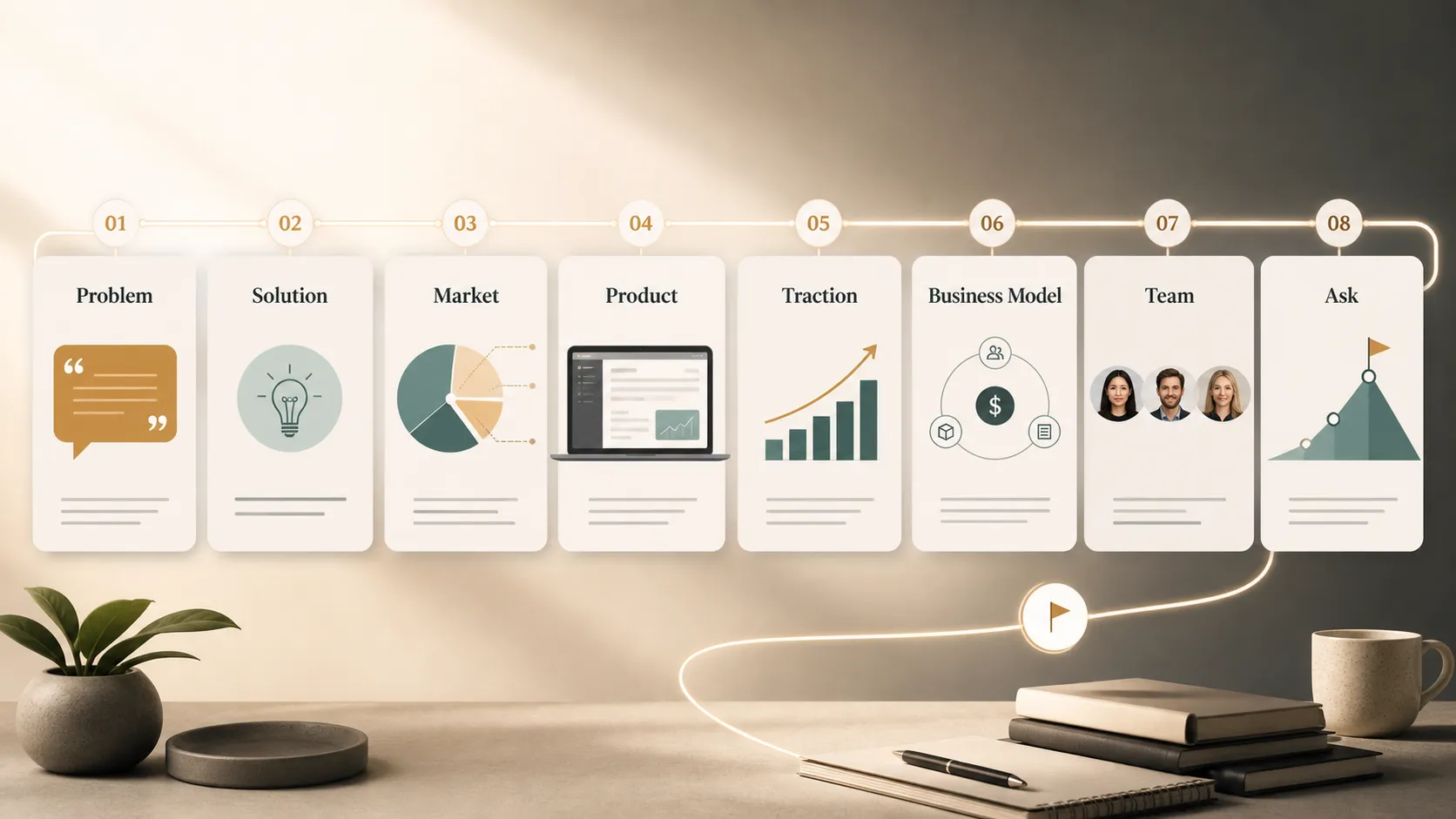
Sequoia Capital’s guide to writing a business plan is useful because it focuses on fundamentals: purpose, problem, solution, why now, market, competition, business model, team, financials, and vision. For an investor deck, those ideas need to become a simple story.
This is one natural place for Pi to help. If your thoughts are still in a memo, outline, or meeting notes, Pi can help shape them into sections so you are not starting from a blank slide. You still decide what matters. Pi just helps you see the bones of the deck faster.
Build A Story, Not A Slide Stack
A weak investor presentation is a stack of information. A stronger one has movement. It starts with pain, shows why the pain matters now, introduces the product, proves demand, explains how the business grows, and ends with a clear ask.
| Deck section | What investors need to understand | Common mistake |
|---|---|---|
| Problem | The pain is real and specific | Using vague language |
| Solution | The product solves the pain | Hiding behind jargon |
| Market | The opportunity can become large | Showing a huge number with no logic |
| Traction | There is evidence of demand | Listing every metric |
| Business model | The company can make money | Being unclear about pricing |
| Competition | You know the landscape | Pretending there are no competitors |
| Ask | The raise has a clear purpose | Saying “growth” without milestones |
This is not a rigid template. Some decks need more product detail. Others need more traction or market education. But the logic should be easy to follow: problem, belief, proof, plan.
Make The Problem Specific
The problem slide should not sound like a startup slogan. “Teams waste time on manual work” is too broad. “Finance teams spend two days every month reconciling reports across five systems” is much easier to believe.
A strong problem slide often uses one clear example, one painful metric, or one customer quote. The goal is not to make the problem sound huge immediately. The goal is to make it feel real. If the pain is buried in notes or research, Pi can help turn it into a quote slide, a before-and-after workflow, or a simple diagram.
Show The Solution Without Jargon
The solution slide should answer one question: what changes because your product exists?
Avoid vague phrases like “AI-powered platform for enterprise transformation” unless you immediately explain what that means in real life. Investors hear abstract positioning all day. What they need is a clear before-and-after.
A better solution slide might show the old workflow and the new workflow, the user before and after using the product, a three-step process, a screenshot with short annotations, or a simple product diagram. If motion would explain the product better than a static screen, Pi can help create video-style visual assets so the product story feels easier to grasp.
Keep The Market Slide Honest
Investors care about market size, but a market slide should not be a giant number floating in space. A better market slide explains your first customer segment, why that segment is reachable, and how the company can expand over time.
Y Combinator’s guide to seed fundraising is helpful because it pushes founders toward clarity: what you are building, why it can grow, and what evidence supports the story.
A good market slide might show three layers: the first wedge you can win now, the adjacent market you can expand into next, and the long-term category you could grow toward. That is more convincing than simply writing “$50B market” in large type.
Make Traction Easy To Read
Traction is where the presentation becomes more credible. Revenue, retention, active users, pilots, signed customers, usage growth, partnerships, waitlists, and case studies can all help. But a traction slide should not show every number you have. It should show the numbers that prove momentum.
A consumer app may show active users and retention. A B2B company may show revenue, pilots, pipeline, or expansion inside accounts. Metrics can become clean cards, customer proof can become a logo strip, and growth can become a simple chart. Pi’s components, icons, and automatic layout can make those proof points easier to scan.
Explain The Business Model And The Ask
A good investor presentation explains how the company will make money and what funding will unlock. The business model slide may include pricing, customer type, sales motion, gross margin, or expansion strategy.
The ask slide should be direct: how much you are raising, what it funds, and what milestone it helps you reach. For early-stage fundraising, Y Combinator’s SAFE financing documents are often referenced, though founders should still get legal advice.
Instead of writing “use of funds: hiring, product, growth,” make the use of funds concrete: product team, go-to-market experiments, customer onboarding, compliance work, or runway to a revenue milestone.
Design For Trust
Investor decks do not need to be flashy. They need to feel clear, consistent, and credible. Use readable type, strong contrast, clean spacing, and a visual system that does not change every two slides.
Microsoft’s guide to PowerPoint themes is useful because themes help keep fonts, colors, and effects consistent.
Good design reduces friction. A chart should be easy to read. A product screenshot should be labeled. A comparison table should have a clear takeaway. Pi can support this by generating themes, customizing styles and colors, and keeping layouts coherent while the deck keeps changing.
Build Versions Without Losing The Story
The deck you present live is not always the same deck you send afterward. In a live meeting, slides can be lighter because you are there to explain them. In a PDF follow-up, slides may need more context because the deck has to travel without you.
Also prepare appendix slides for churn, acquisition cost, unit economics, roadmap, competitors, hiring plan, or financial assumptions. Pi can help turn extra notes into a clean appendix, or create different versions of the same story for meetings, PDFs, follow-ups, and internal review.
The Verdict
To create an investor presentation, start with the investor’s question, not the slide design. Build a clear story around the problem, solution, market, traction, business model, team, and ask. Make every slide earn its place.
Pi fits best when it supports that story: turning rough material into structure, making complex ideas visual, keeping design consistent, generating AI images or videos, and helping you revise quickly. Used well, it does not take over the founder’s judgment. It helps the deck become easier to read, easier to present, and easier to remember.
Frequently Asked Questions (FAQ)
Q: What should be included in an investor presentation?
A: A strong investor presentation usually includes the problem, solution, market, product, traction, business model, competition, team, financial direction, and fundraising ask.
Q: How long should an investor presentation be?
A: Many investor decks work best around 10 to 15 slides for the main meeting deck, with appendix slides for deeper questions.
Q: How can Pi help create an investor presentation?
A: Pi can turn notes or outlines into a structured deck, create themes and layouts, add icons, generate AI images or videos, and help make versions for meetings, PDFs, and follow-ups.
Q: Should an investor deck be highly designed?
A: It should be polished, but not overdesigned. Investors need clarity first. Good design should make the business easier to understand.