how to study effectively
Studying effectively is not about studying longer. It is about using attention, memory, review, and feedback better. You can spend hours rereading a chapter and still remember very little. You can also spend one focused session testing yourself, fixing mistakes, and reviewing the right material, and learn much more.
The goal is to stop treating studying as simply looking at information. Better studying means working with information: recalling it, explaining it, applying it, organizing it, and checking what you still do not understand.
Cornell’s Learning Strategies Center has a useful guide to effective study strategies that covers retrieval practice, interleaving, spaced practice, and sleep as part of long-term learning.
Why Rereading And Highlighting Are Not Enough
Rereading feels productive because the material becomes familiar. Highlighting feels active because you are marking the page. But familiarity is not the same as learning.
The problem is that rereading often helps you recognize information without being able to recall it later. You may look at a paragraph and think you know it because you have seen it before. Then, during a quiz or exam, you realize you cannot explain it without the page in front of you.
Highlighting can help mark important material, but it should not be the whole method. After highlighting, do something with the material: summarize it, quiz yourself, turn it into a diagram, or explain it from memory.
APA’s article on research-tested ways to study better explains why strategies that require remembering information are stronger than passive review.
Study Methods That Actually Help
| Method | Best use | Common mistake |
|---|---|---|
| Active recall | Remembering ideas | Looking too soon |
| Spaced repetition | Long-term memory | Reviewing too late |
| Practice testing | Exam prep | Avoiding hard questions |
| Interleaving | Problem solving | Mixing too much too early |
| Teaching aloud | Checking understanding | Staying vague |
| Focus blocks | Deep work | Studying while distracted |
You do not need to use every method every day. The best study plan usually combines several of them.
Use Active Recall
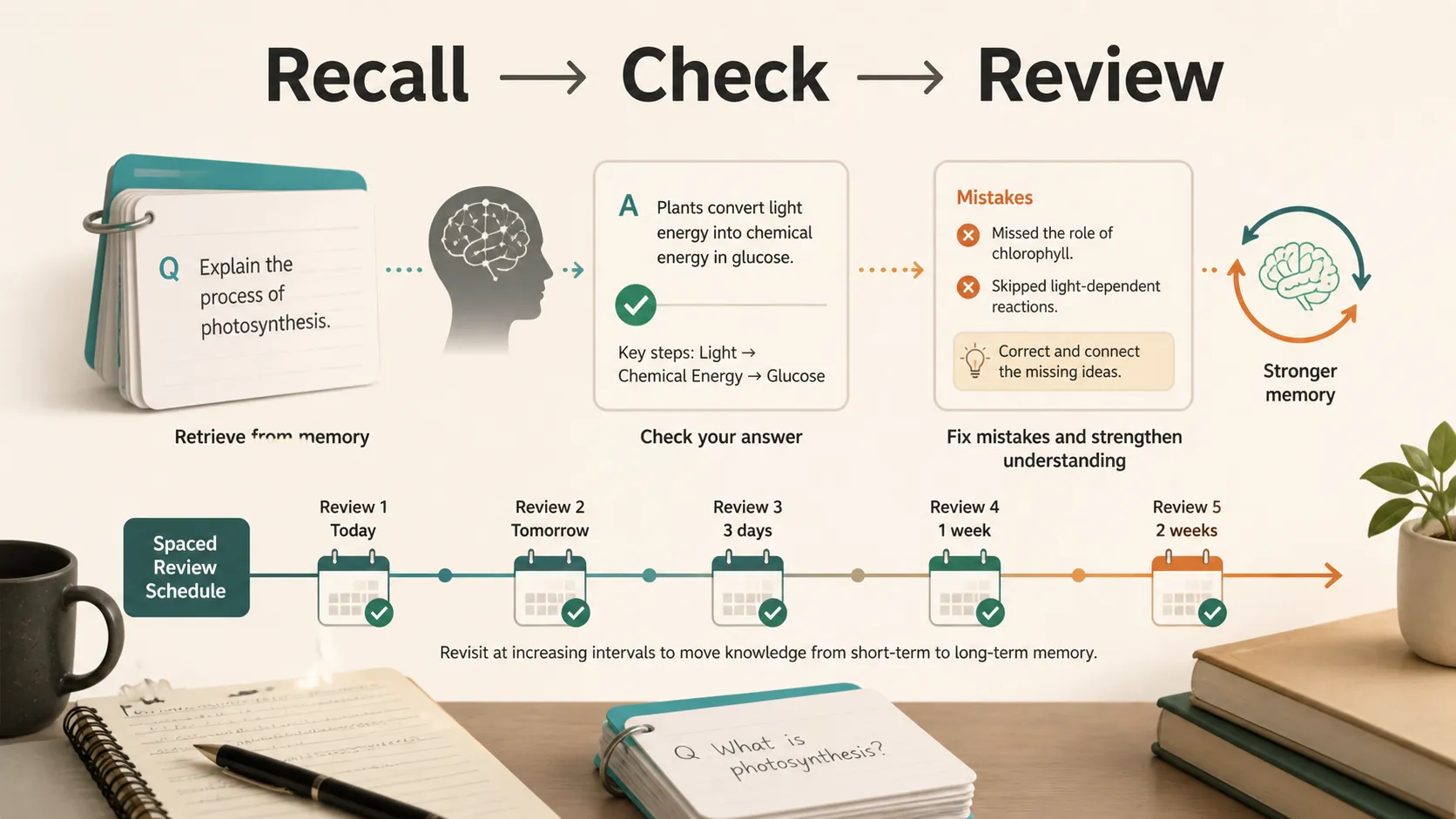
Active recall means trying to bring information back from memory before looking at the answer. It feels harder than rereading, but that effort is what makes it useful.
You can use active recall by closing the book and writing what you remember, answering practice questions, making flashcards, drawing a process from memory, or explaining a concept out loud.
A simple method is the blank page test. After reading a section or reviewing a lecture, take a blank page and write everything you remember. Then compare it with the source material and fill in what you missed.
The point is not to get everything right immediately. The point is to find the gaps while you still have time to fix them.
Space Your Review
Spaced repetition means reviewing material over several sessions instead of cramming everything at once. Cramming may help for a short quiz, but it is weak for long-term memory.
A simple review pattern could be:
- Review new material the same day
- Review again after one or two days
- Review again after a week
- Review again before the exam
- Return to difficult topics more often
Spacing works because forgetting is part of learning. When you wait a little, recall becomes harder. When you successfully recall the material again, the memory becomes stronger.
Harvard Summer School’s guide on retaining what you learn also emphasizes active learning and review as part of keeping information available later.
Test Yourself Before You Feel Ready
Practice testing is one of the fastest ways to find out what you know and what only feels familiar. Do not wait until you feel prepared. Testing yourself early shows you what needs work.
Use old exams, textbook questions, flashcards, self-made quizzes, timed problem sets, or short written explanations.
When you get something wrong, pause and ask why. Did you forget a fact? Misread the question? Use the wrong formula? Mix up two ideas? Skip a step?
Mistakes are feedback. They show you what to practice next.
Use Focused Study Blocks
Long study sessions are not automatically better. After a while, attention drops, and the extra time becomes low-quality.
Try focused blocks instead. Work for 25 to 50 minutes, then take a short break. Before each block, choose one clear task.
“Study chemistry” is too vague. “Solve ten equilibrium problems and review every mistake” is much better.
Remove obvious distractions before you begin. Put the phone away, close unrelated tabs, and keep only the materials you need for that block.
Study From Textbooks, Slides, And Lecture Notes
Different materials need different strategies.
For textbooks, preview the headings first. Turn headings into questions, then read to answer those questions. After each section, close the book and write a short summary from memory.
For lecture slides, do not just reread the bullet points. Ask what the instructor was trying to emphasize. Slides often show structure, but not the full explanation. Use them as prompts for recall.
For lecture notes, review them soon after class. Clean up unclear points, add examples, and mark questions to ask later. Waiting a week makes your notes harder to understand.
Cornell’s broader How to Study page includes resources on exam preparation, note-taking, reading strategies, and learning from digital materials.
Prepare For Exams Differently Than You Learn Long Term
Exam preparation and long-term learning overlap, but they are not exactly the same.
For an exam, study the format. If the test is problem-based, practice problems matter more than rereading notes. If it is essay-based, practice outlining answers. If it is multiple choice, test your ability to notice small differences between similar ideas.
For long-term learning, keep returning to major concepts after the exam. Connect them to later material. Use spaced review, cumulative practice, and summaries that show how topics fit together.
Turn Study Notes Into Visual Summaries With Pi
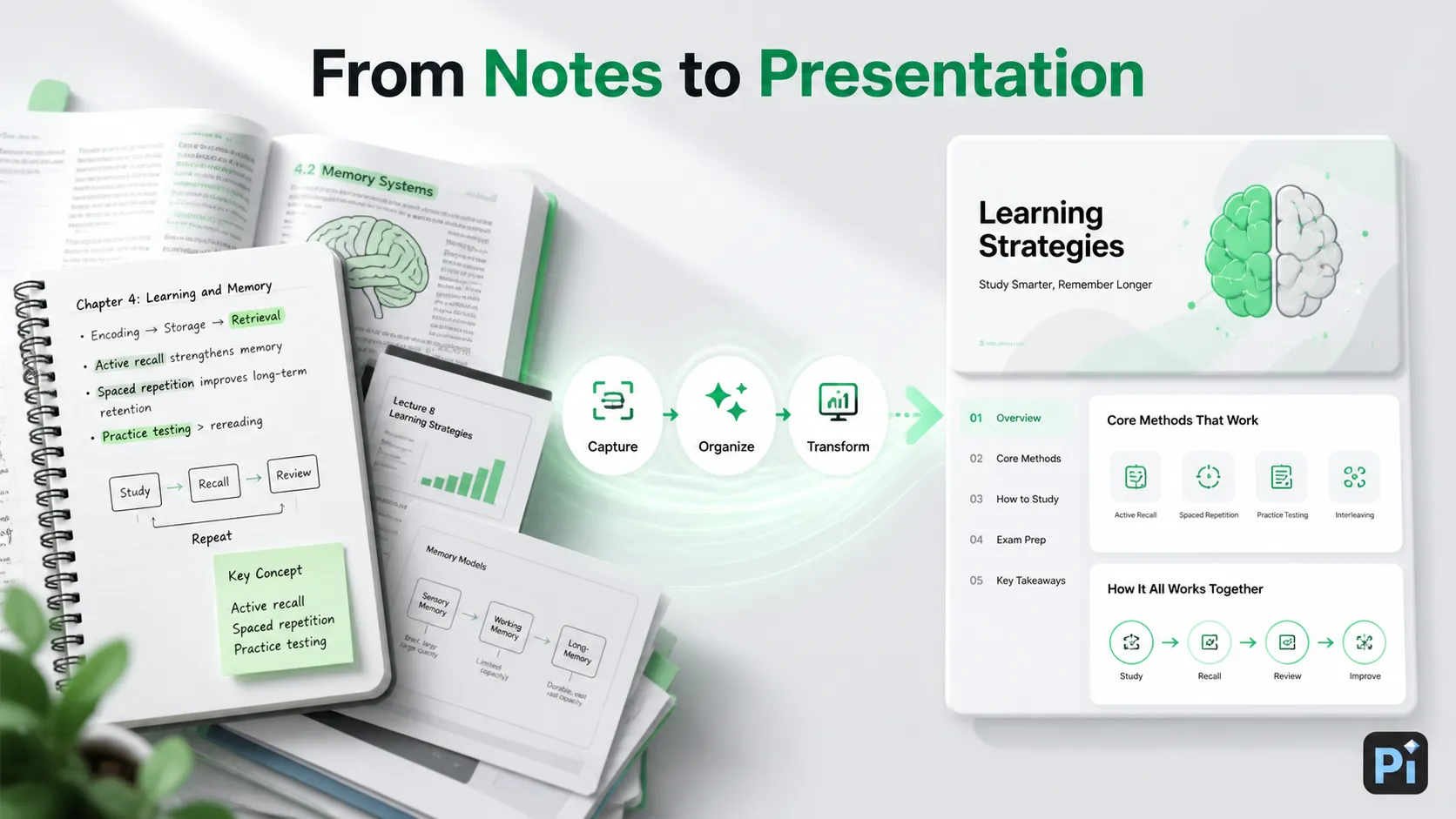
Studying effectively is also about reorganizing information so the structure becomes easier to see. This is where visual summaries can help, especially when a class has many concepts, timelines, processes, formulas, or comparison points.
After you finish reading a chapter, reviewing lecture slides, or整理 class notes, you can put that material into Pi and turn it into a clearer study summary. Instead of keeping everything as long paragraphs, Pi can help organize the content into sections, diagrams, comparison slides, timelines, concept maps, and visual explanations.
This is useful for personal review, but it is also useful when you need to present what you learned. If you are preparing a class report, study group explanation, project presentation, or exam review session, Pi can help turn your notes into a polished presentation that is easier for others to follow.
Pi also lets you customize the theme, colors, layout style, icons, image effects, and visual direction. You can export the result as a PPT file and continue editing or presenting it in PowerPoint or other compatible tools.
The Verdict
To study effectively, stop measuring only time and start measuring quality. Rereading and highlighting can support learning, but they should not be the whole plan.
Use active recall to test memory. Use spaced repetition to review over time. Use practice testing to prepare for exams. Use mistakes as feedback. Use focused blocks to protect attention. Use sleep and breaks as part of the system.
And when your notes, textbook summaries, or lecture materials need to become something visual, Pi can help turn them into a clear study summary or presentation for review, teaching, or class reporting.
Frequently Asked Questions (FAQ)
What is the best way to study effectively?
The best way is to combine active recall, spaced repetition, practice testing, focused study blocks, and review of mistakes. Do not rely only on rereading.
How long should I study each day?
It depends on your workload, but focused blocks are usually better than long distracted sessions. Start with clear tasks and short review sessions spread across the week.
Is highlighting a good study method?
Highlighting can help mark important material, but it is weak by itself. After highlighting, quiz yourself, summarize the idea, or explain it from memory.
Can Pi help with studying?
Yes. Pi can turn notes, textbook summaries, slides, or study materials into visual summaries and presentations that are useful for review, teaching, study groups, or class reports.