Kimi K3: What Million-Token Context Means for AI Workflows
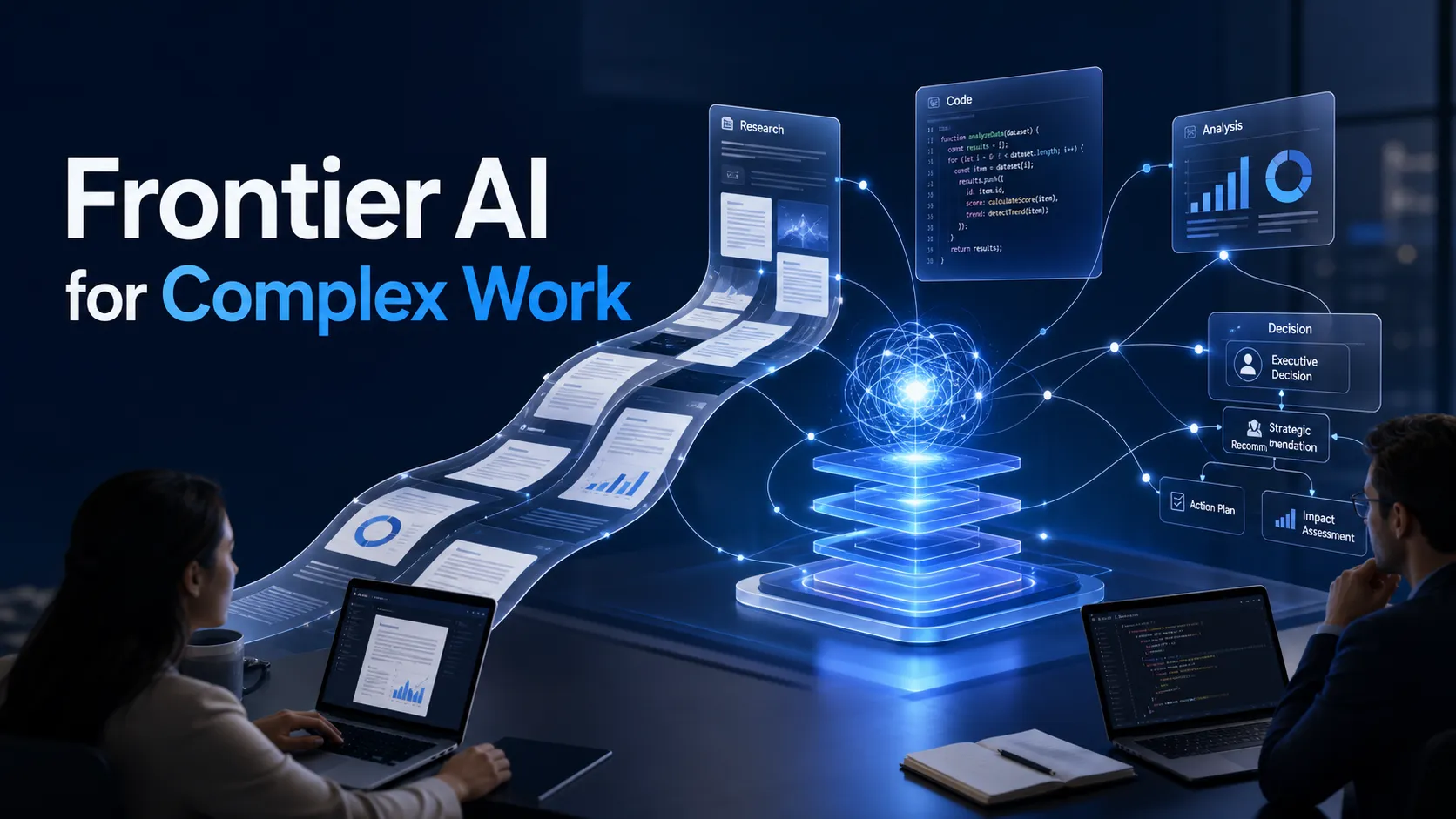
AI is moving from short prompt-and-response tasks toward larger workflows. The next shift is not only generating text faster; it is helping teams process complex information, keep continuity across long inputs, and reduce the manual work of preparing documents for analysis.
That is why Kimi K3 is getting attention. Its reported million-token context suggests a future where teams can work with long reports, contract collections, code repositories, meeting archives, and research libraries without constantly splitting everything into small pieces. Still, a larger context window does not automatically create better judgment. The real question is how long-context AI changes research, reasoning, verification, and communication.
Why Kimi K3 Is Getting Attention
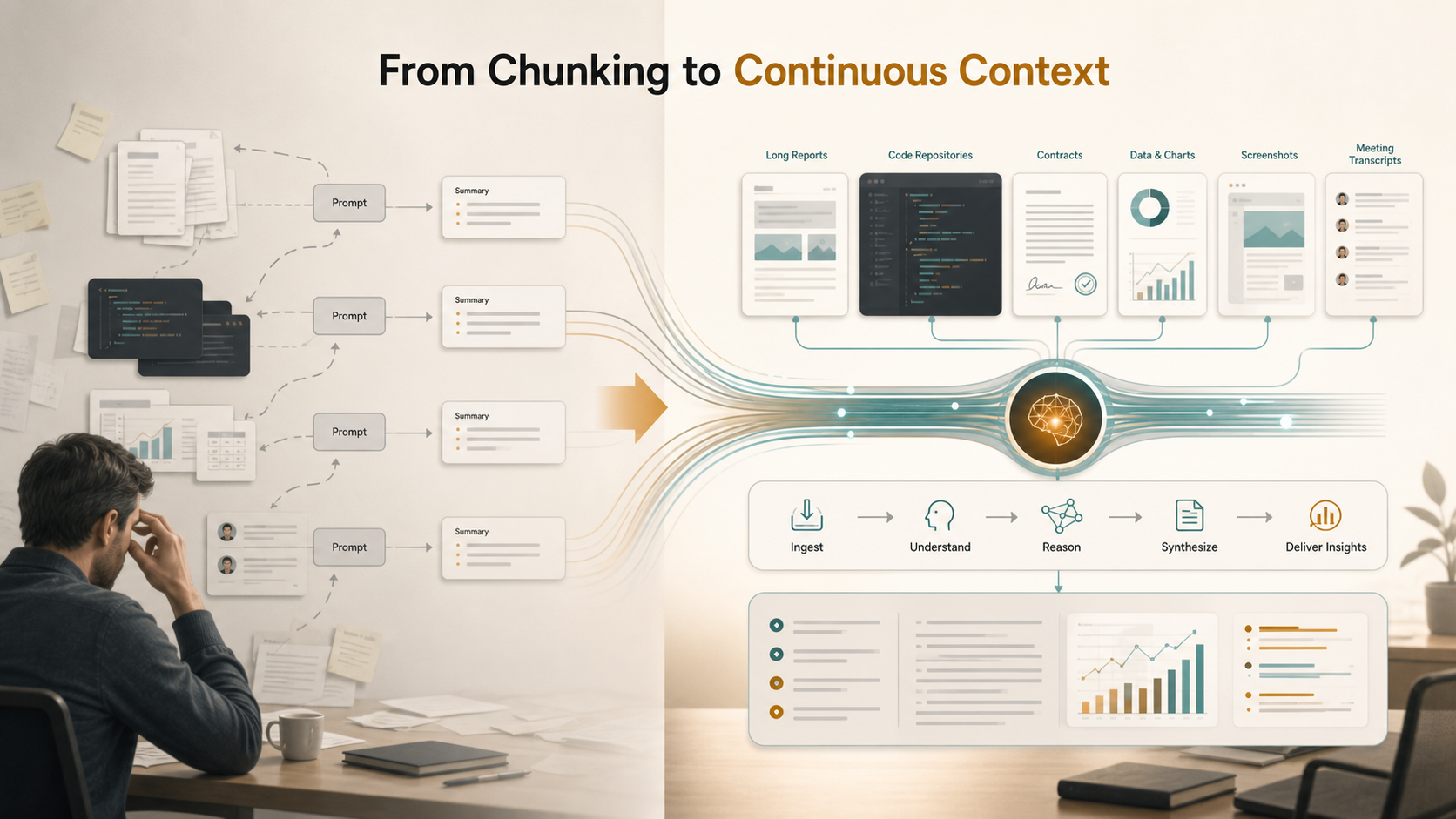
Kimi K3 is associated with Moonshot AI, a company known for long-context AI development. The main reason people are discussing it is the Kimi K3 context window: the ability to consider a very large amount of text or information within one interaction.
For business and technical teams, the appeal is practical. More context can reduce preparation work, preserve continuity, and support more complex AI workflows. Native vision may expand inputs beyond text, while agent capabilities point to multi-step workflows where the model reads, plans, acts, checks, and continues.
What a Million-Token Context Window Means
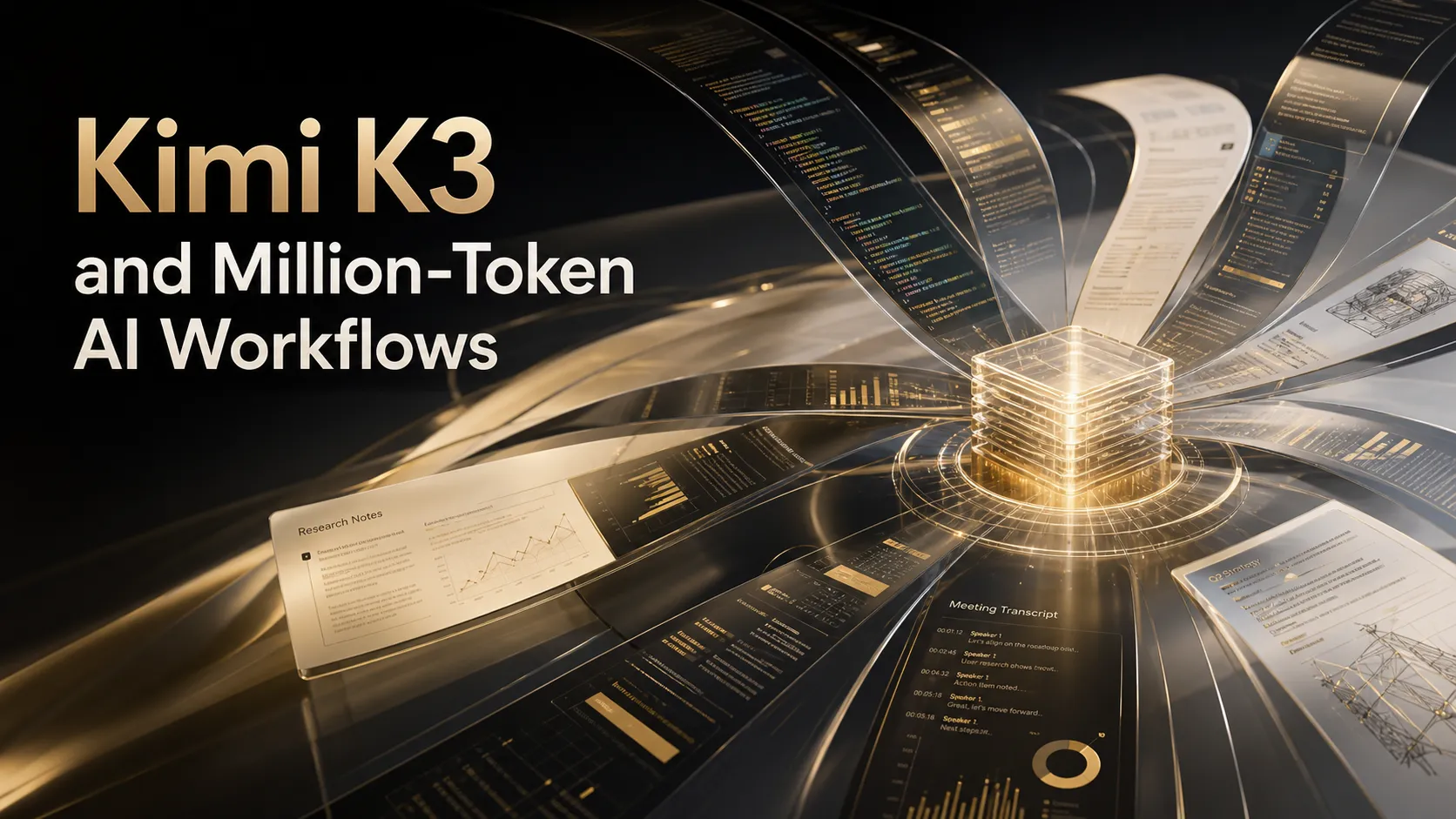
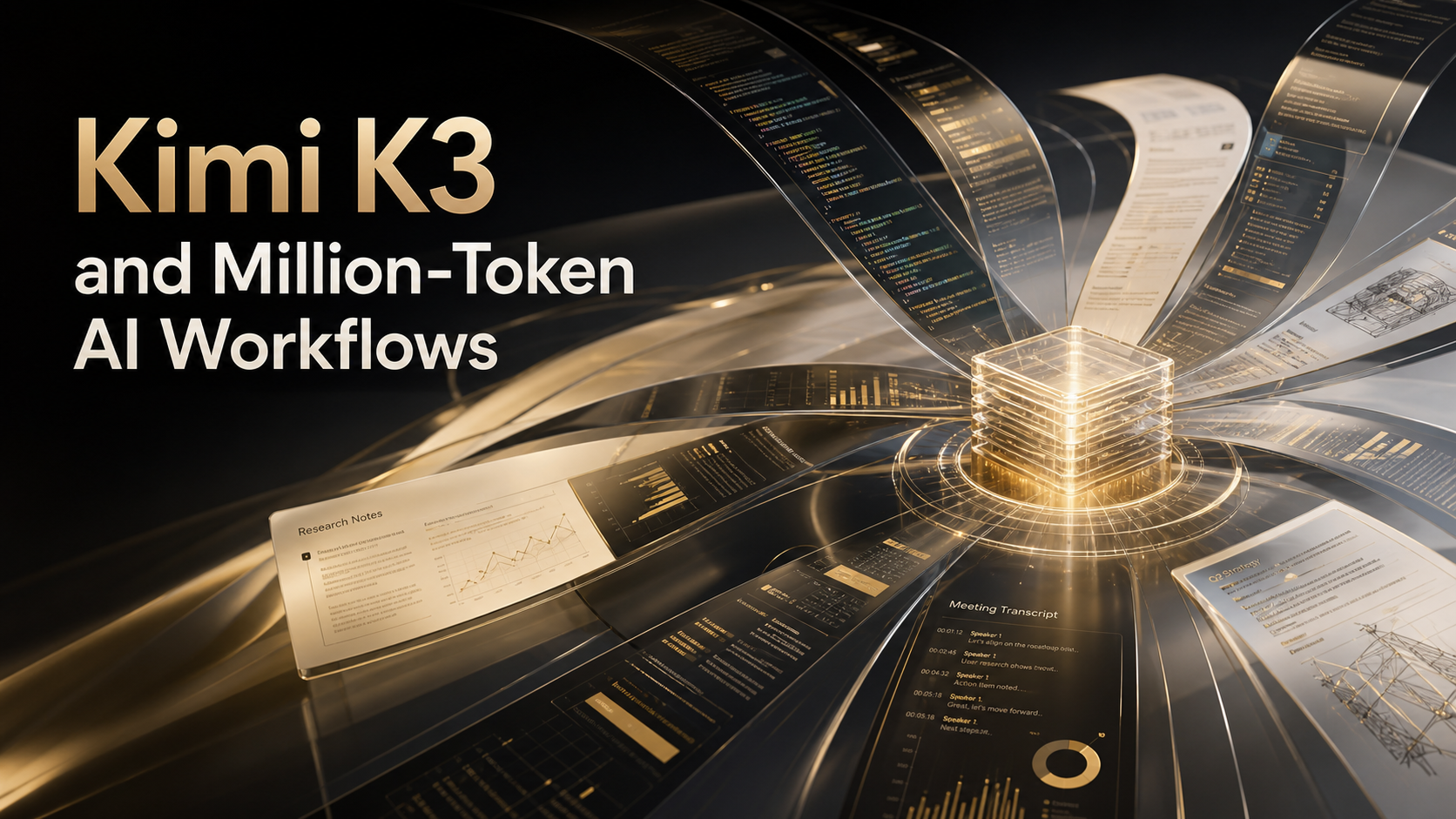
A context window is the amount of information an AI model can consider at one time. Tokens are the units a model reads, usually parts of words, numbers, or symbols. A million-token context means the model may be able to process a very large set of material in one session.
In practice, that could include a long market research report, a collection of contracts, a technical specification, a large codebase, or months of meeting transcripts. Instead of summarizing one document at a time, users can ask questions across a broader information set.
This matters because professional tasks are rarely isolated. Legal review may require comparing clauses across many agreements. Product strategy may combine customer feedback, roadmap notes, market data, and executive memos. Software engineering may require understanding how files, functions, and dependencies connect across a repository.
Long context gives the model more room to “see” surrounding information. It does not guarantee perfect reasoning, but it changes the input boundary.
From Prompting to Information Handling
Traditional AI workflows often require users to chop information into small parts. They summarize one section, paste another, ask a follow-up question, and then manually reconcile the answers. This can work, but it creates fragmentation. Important context may be lost between prompts, and users spend too much time managing the model instead of using the output.
Long-context AI changes that pattern. Users can provide broader source material and ask the model to review, compare, extract, map, and synthesize across it more directly. This supports more continuous analysis, fewer repeated explanations, and less manual summarization before the real work begins.
The shift is not simply “bigger prompts.” It is a move toward AI systems that act more like large-scale information handlers. For teams, AI can feel less like a chat box and more like a research, coding, or analysis environment.
Kimi K3 Use Cases for Research, Coding, Documents, and Agents
The most useful Kimi K3 use cases will likely appear where large inputs create bottlenecks.
Research synthesis is a clear example. Analysts can work across reports, transcripts, articles, survey results, and internal notes to identify themes, contradictions, and open questions. The benefit is not just faster summarization; it is the ability to compare evidence across a wider base of material.
Document review is another strong use case. Long-context AI can help examine contract sets, policy documents, regulatory material, procurement files, or due diligence folders. It may flag recurring clauses, missing sections, inconsistent language, or risks that require human attention.
Coding workflows may also benefit. A long-context model can inspect multiple files, understand architectural patterns, explain dependencies, and help reason about bugs or refactoring tasks. For developers, the value is continuity: the model can keep more of the codebase in view while assisting with specific changes.
Native vision expands the scope further. If Kimi K3 can handle visual inputs, teams may analyze charts, screenshots, interface flows, scanned documents, product images, or dashboard captures alongside text.
Agentic workflows are also relevant. AI agents often need persistent context to plan steps, remember constraints, and check progress. A larger context window can help agents maintain more task history and source material, especially in research, operations, and technical support.
Where Long Context Still Falls Short
A larger context window solves an input problem, not every workflow problem. More information can help, but it can also create noise. If the model receives a million tokens of uneven material, it still needs guidance on what matters, what is reliable, and what output format is useful.
Teams should stay careful about several limits:
- Long context does not eliminate hallucinations or reasoning errors.
- Source quality and source ranking still matter.
- Sensitive documents require privacy and access controls.
- Larger inputs can increase latency, cost, and review complexity.
- Human experts still need to verify high-stakes outputs.
The boundary is simple: long-context AI can read more, but reading more is not the same as understanding priorities, making decisions, or communicating clearly.
From Long-Context Analysis to Business-Ready Output
After a model processes a large amount of information, teams still need to turn findings into something usable. Executives rarely need a raw synthesis dump. Clients do not want a long AI summary without a clear recommendation. Product teams need decisions, trade-offs, and next steps.
This is where workflow design matters. The output from long-context AI must become narratives, frameworks, arguments, and materials that fit the audience. A research synthesis may need to become a market research deck. A codebase review may need to become an engineering roadmap update. A customer feedback analysis may need to become a product launch recommendation.
The value of long-context AI increases when teams connect it to the next layer: professional communication.
How Pi Fits Into Complex AI Workflows
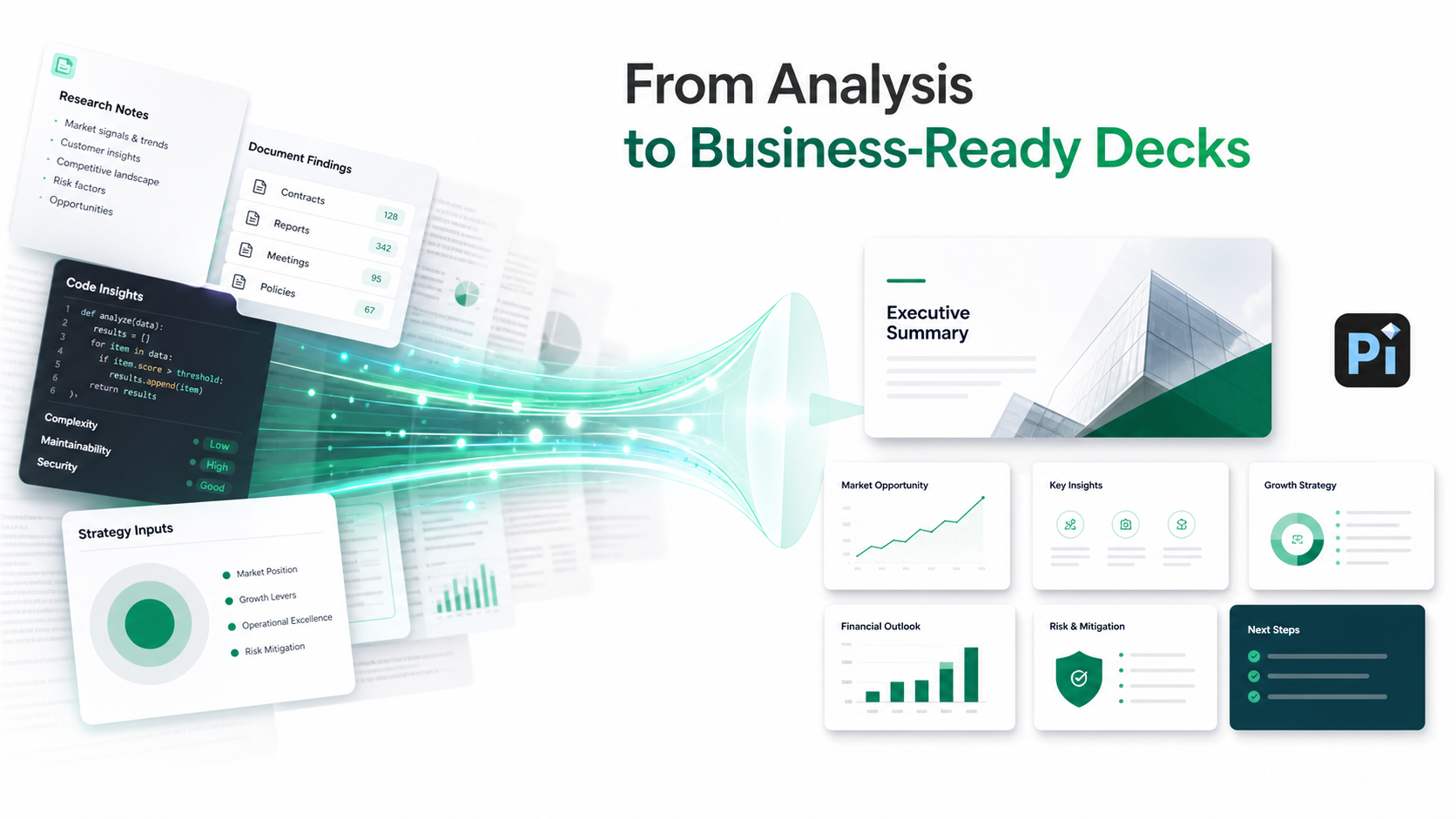
Pi, short for Presentation Intelligence, fits naturally at the output stage of complex AI workflows. Long-context models can help teams process research, documents, transcripts, and strategy material. Pi helps transform that material into structured, premium business presentations.
A professional presentation is not just a visual artifact. It needs a clear argument, relevant context, and a logical sequence. Pi helps teams move from dense material into business-ready structure, whether the goal is an executive update, consulting report, market research deck, sales deck, or product strategy presentation.
1. Business Logic Comes Before Slide Styling
After long-context analysis, the hardest question is often: what should the audience understand, believe, or decide? Pi helps organize findings around that decision path, not only around slide decoration.
2. Multi-Agent AI Supports Deeper Deck Workflows
Pi uses Multi-Agent AI to support presentation creation beyond simple slide generation. Different layers of thinking are needed: outlining, prioritizing, structuring, writing, and visualizing. When teams bring in findings from long-context AI, Pi can help organize them into a coherent deck flow.
3. Premium Output Matters for High-Stakes Communication
Strategic material often fails when it is presented as dense text. Pi focuses on professional structure and premium visual quality, helping teams convert complex input into slides that are easier to read, discuss, and act on. This is especially useful for investor narratives, sales decks, executive presentations, brand proposals, consulting reports, and product launch decks.
Long-Context AI vs Presentation Intelligence
| Capability | Long-Context AI such as Kimi K3 | Pi |
| Primary role | Process large inputs | Create business-ready presentations |
| Best input | Documents, code, transcripts, images, research | Findings, strategy, notes, source material |
| Core strength | Large-scale information handling | Business logic and slide structure |
| Output focus | Answers, summaries, analysis, task steps | Executive-ready decks and reports |
| Human review need | Verification and source judgment | Message alignment and stakeholder fit |
This distinction is important. Kimi K3 and Pi serve different workflow layers. A long-context model helps teams work across larger bodies of information. Pi helps teams convert intelligence into structured communication that can support decisions.
The Practical Verdict for Teams
Kimi K3’s million-token context window signals an important direction for long context AI. If models can work across much larger inputs, AI workflows can become less fragmented and more capable. Teams may spend less time chunking documents and more time asking higher-value questions.
Still, practical value depends on the full workflow. Source ingestion, prompt design, verification, privacy, reasoning, and output quality all matter. A million-token context window can expand what teams put into an AI system, but teams still need to decide what the information means and how it should be used.
For professional organizations, the opportunity is not only longer prompts. It is a better pipeline from information overload to clear decisions. Long-context models can help with the analysis layer. Tools like Pi can help turn that analysis into business-ready presentations that stakeholders can understand, evaluate, and act on.
Frequently Asked Questions (FAQ)
Q: What is Kimi K3?
A: Kimi K3 is an AI model associated with Moonshot AI that is attracting attention for long-context capabilities, including discussion around a million-token context window, native vision, and agent-oriented workflows.
Q: What does million-token context mean?
A: It means the model can consider a very large amount of information in one interaction, which can help with long documents, code repositories, research archives, meeting transcripts, and other complex source material.
Q: What are the best Kimi K3 use cases?
A: Strong use cases include research synthesis, document analysis, coding support, multimodal review, and AI agents that need persistent context across multi-step workflows.
Q: Does long-context AI replace presentation or reporting workflows?
A: No. Long-context AI can help process and analyze large inputs, but teams still need to verify findings and turn them into clear business communication. Pi supports that downstream stage by helping create structured, professional presentations.