Pitch Deck Example: Slide-by-Slide Analysis

A useful pitch deck example does more than display attractive slides. It shows how an investor story is built: what each slide must prove, why the sequence matters, and how evidence turns a startup idea into a fundable business case.
This article analyzes a realistic startup pitch deck for a fictional B2B SaaS company called FlowOps, a workflow automation platform for mid-market finance teams. FlowOps helps finance leaders reduce manual month-end reporting work by connecting spreadsheets, ERP exports, approvals, and executive dashboards.
The company is raising a $2.5 million seed round. It has 18 paying customers, $420K ARR, strong pilot-to-paid conversion, and a focused target market: finance teams at companies with 200–2,000 employees.
A Realistic Startup Pitch Deck Example
This investor presentation example is built around one argument: finance teams still lose too much time to fragmented reporting workflows, and FlowOps has early proof that automated reporting operations can replace manual coordination.
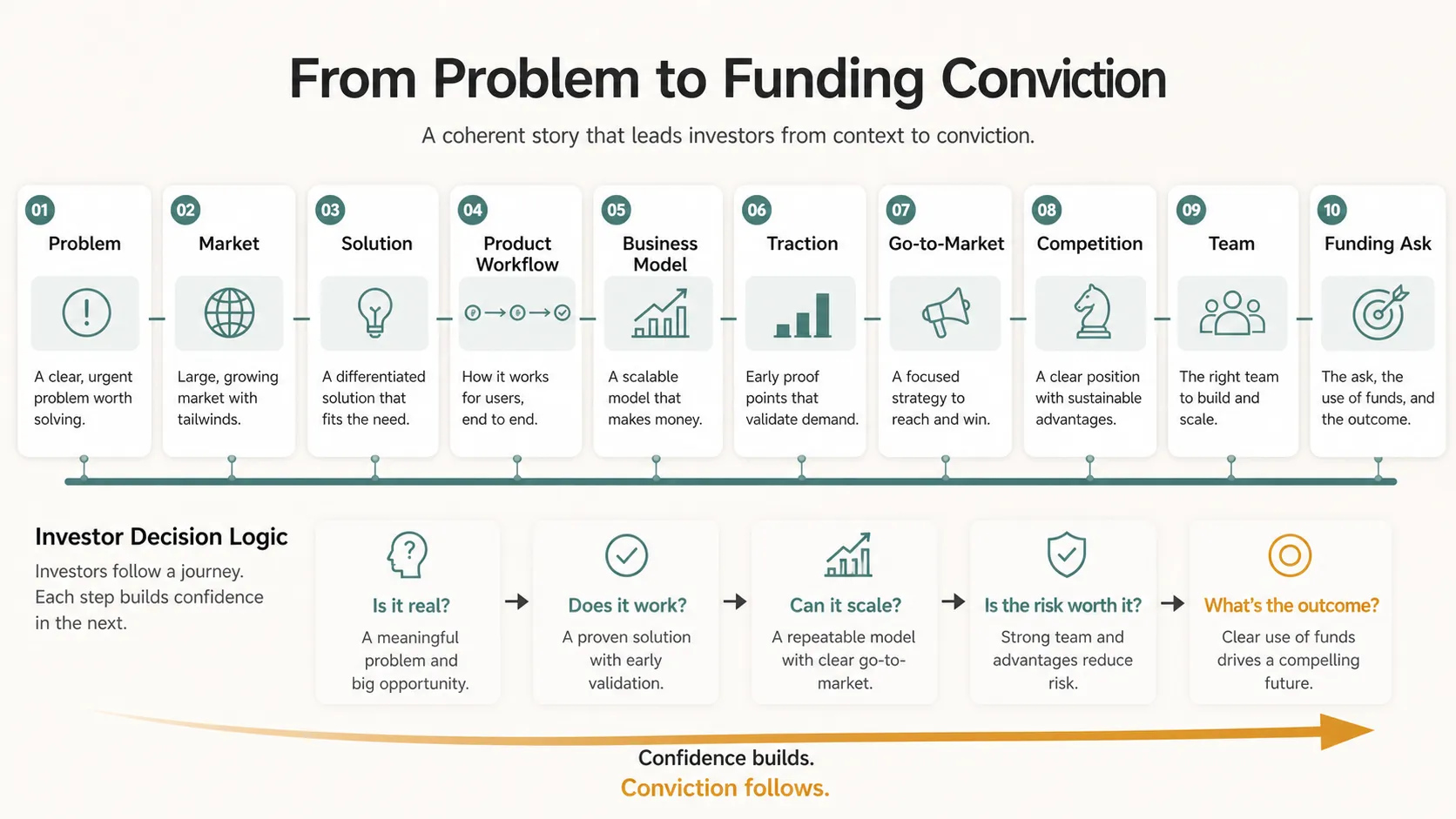
The deck does not explain every feature. It follows the investor’s decision path: Is the problem painful? Is the market large enough? Is the solution clear? Is there proof customers want it? Can the team scale? Is the funding ask reasonable?
That focus makes the deck useful for pitch deck analysis. Each slide has a specific job, and the full sequence works as a business story.
Slide-by-Slide Pitch Deck Analysis
Slide 1: Cover Slide
The cover slide introduces FlowOps as “Automated reporting workflows for modern finance teams.” Its job is to establish the company name, category, and positioning quickly.
The hierarchy places the company name first, the positioning line second, and “Seed round | 2026” third. A restrained layout with one abstract workflow graphic helps investors understand the company before the founder starts speaking.
Slide 2: Problem
The problem slide focuses on a concrete pain: mid-market finance teams spend 40–60 hours per month consolidating reports across disconnected systems.
The key message is that month-end reporting is expensive, repetitive, and risky. Three symptoms support the headline: manual data pulls, approval bottlenecks, and inconsistent executive reporting. A left-to-right friction diagram works well because it shows exactly where time is lost.
Slide 3: Market Opportunity
This slide defines the target market: mid-market companies with growing finance teams and fragmented reporting systems.
The message is that FlowOps starts with a focused wedge and can expand into broader finance operations. A strong version shows the initial serviceable market first, then adjacent expansion areas. Three concentric market layers help balance ambition with credibility.
Slide 4: Solution
The solution slide introduces FlowOps as a centralized workflow layer for finance reporting.
Its message should connect directly to the problem: FlowOps automates reporting from data collection to approval to dashboard delivery. A before-and-after layout works better than a long feature list because it makes the transformation clear: from scattered manual work to coordinated automated reporting.
Slide 5: Product Workflow
This slide shows a simplified user journey: connect data sources, assign reporting tasks, approve changes, and publish executive dashboards.
Its purpose is to make the solution feel real. The message is that FlowOps fits into how finance teams already work rather than forcing a full process replacement. Four numbered product moments with small UI-style panels can help investors imagine the customer experience without needing a full demo.
Slide 6: Business Model
The business model slide explains subscription pricing by company size, with expansion based on seats and reporting volume.
The key message is that FlowOps has a scalable SaaS model with room for account growth. A compact pricing table and short revenue formula are enough. Investors do not need every pricing detail; they need to understand how revenue grows and why customers can expand over time.
Slide 7: Traction
The traction slide presents selected proof: 18 paying customers, $420K ARR, 71% pilot-to-paid conversion, and short customer quotes.
Its purpose is to reduce perceived risk. The message is that customers are already paying and expanding usage. Large metric cards should come first, followed by supporting customer signals. This works because it highlights meaningful evidence instead of overwhelming the slide with every KPI.
Slide 8: Go-to-Market Strategy
This slide explains how FlowOps reaches finance leaders through founder-led sales, partner referrals, and targeted content around month-end reporting pain.
The key message is that the company has a practical acquisition path. A strong structure starts with the ideal customer profile, then shows channels, sales motion, and expected conversion milestones. A funnel with three acquisition paths helps connect strategy to buyer behavior.
Slide 9: Competitive Landscape
The competitive landscape slide maps options by workflow automation depth and finance-specific focus.
Its purpose is positioning, not criticism. The message is that FlowOps sits between generic workflow tools and large enterprise finance systems. A two-axis matrix makes the market fit visible quickly and avoids long comparison text.
Slide 10: Team
The team slide presents the founders: one former finance operations lead and one engineering leader experienced in workflow automation systems.
The key message is that the team understands the problem and can build the product. The slide should highlight relevant experience first, then advisory support. It works best when credentials are directly tied to execution risk.
Slide 11: Financials and Funding Ask
The final slide shows the $2.5 million seed ask, use of funds, and three-year revenue direction.
Its purpose is to turn the story into an investment decision. The message is that funding will extend runway, deepen the product, and accelerate repeatable sales. A simple allocation chart with milestone bullets helps connect the ask to the operating plan.
Common Patterns in Strong Investor Presentation Examples
Across this pitch deck example, the strongest pattern is discipline. Each slide has one main job. The problem slide does not explain the full product. The traction slide does not become a financial model. The team slide does not list every career detail.
| Presentation Element | Role in the Example | Investor Benefit |
| Clear slide headline | States the main point | Reduces interpretation effort |
| Focused hierarchy | Prioritizes key evidence | Makes the deck easier to scan |
| Visual restraint | Supports the story | Keeps attention on the business case |
| Evidence before ambition | Proves demand first | Builds credibility before projection |
| Connected sequence | Answers the next question | Creates narrative momentum |
The deck works because it feels intentional. It does not simply include the expected slide types; it uses each slide to advance investor understanding.
How Pi Helps Recreate This Pitch Deck Structure
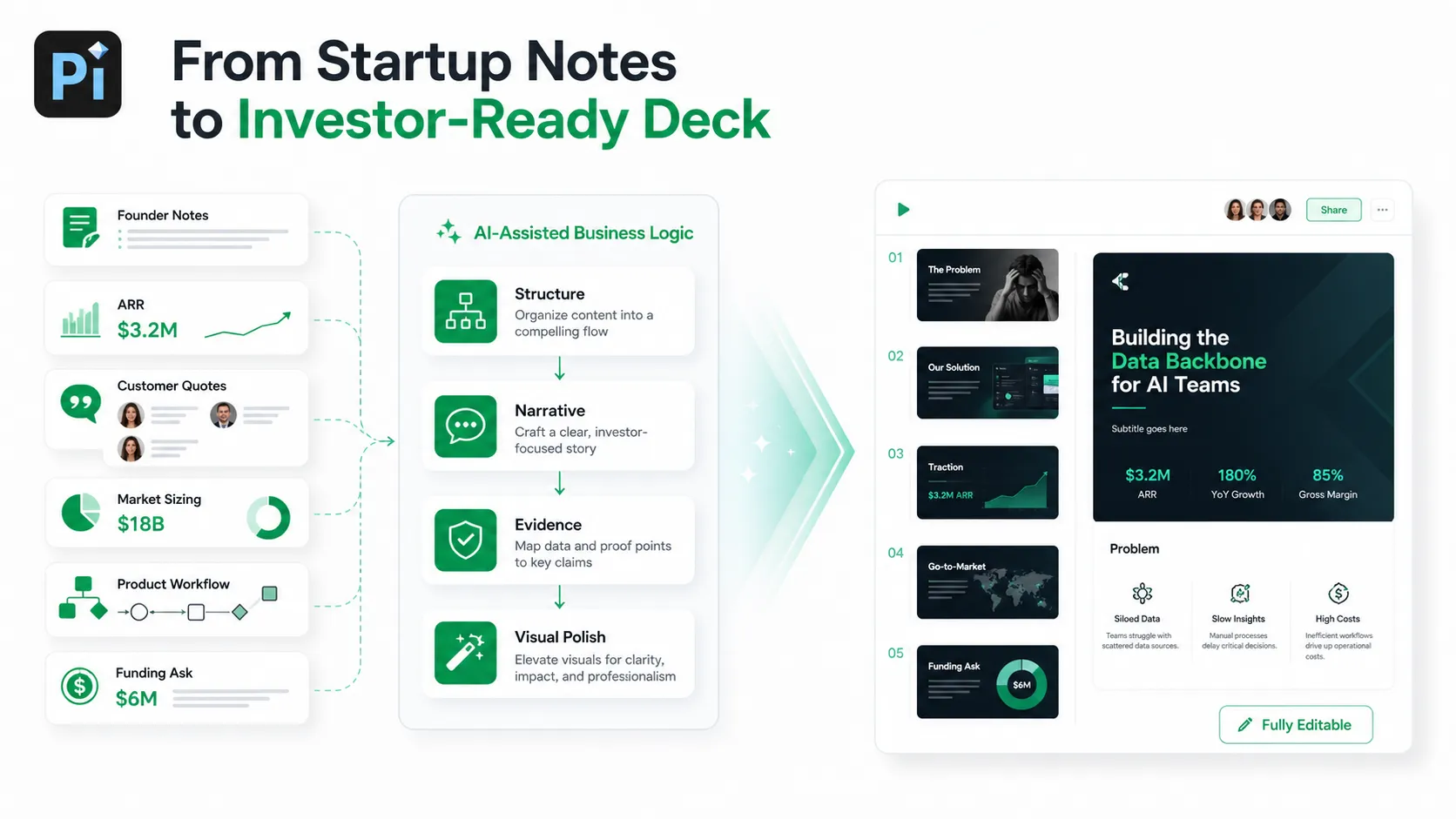
After studying a strong investor presentation example, the next challenge is applying the structure to your own company. Pi helps founders and business teams move from raw notes, metrics, and strategy into a polished, editable deck.
1. Business Logic Comes Before Slide Styling
Pi is built around Presentation Intelligence, so the argument comes before decoration. For a pitch deck, that means organizing the story around investor questions: problem, market, solution, proof, growth, team, and ask.
Instead of starting with isolated slides, Pi helps shape the deck as a business narrative. This is useful when founders have strong ideas but need a clearer investor-facing sequence.
2. Professional Slides Stay Editable
A pitch deck changes many times before a meeting. Metrics update, positioning sharpens, slide order shifts, and investors ask for different emphasis.
Pi helps create business-grade slides with premium visual quality while keeping the deck editable. Teams can refine headlines, replace metrics, adjust visuals, and tailor the presentation for different investor conversations without rebuilding from scratch.
3. The Structure Can Adapt to Your Stage
The FlowOps example is not a rigid formula. A pre-revenue company may emphasize founder insight, market timing, and product vision. A company with traction may move proof earlier and spend more time on retention, sales efficiency, and expansion.
Pi supports this restructuring because the deck is treated as a strategic flow, not a fixed template.
Final Takeaway: A Pitch Deck Is a Business Story
A strong pitch deck is not just a collection of polished slides. It is a structured business story that moves investors from problem awareness to market belief, product understanding, traction confidence, and funding conviction.
This slide-by-slide pitch deck analysis shows how each page contributes to that journey. When you are ready to build your own investor deck, Pi can help turn your company story, metrics, and strategy into a professional, editable presentation.
Frequently Asked Questions (FAQ)
Q: What should a pitch deck example include?
A: A strong pitch deck example usually includes the problem, market opportunity, solution, product workflow, business model, traction, go-to-market strategy, competition, team, financials, and funding ask.
Q: How long should a startup pitch deck be?
A: Many startup pitch decks are around 10–12 slides, but the right length depends on company stage, complexity, and investor audience. Clarity matters more than an exact slide count.
Q: What makes an investor presentation example effective?
A: An effective investor presentation has a clear narrative, one main message per slide, strong information hierarchy, credible evidence, and a funding ask connected to the growth plan.
Q: Can Pi help create a pitch deck?
A: Yes. Pi can help turn startup information into a structured, polished, and editable pitch deck, especially when founders need business logic, professional slide flow, and investor-ready visual quality.