101 Controversial Topics for Presentations and Debates
Choosing controversial topics for a presentation is not about finding the loudest opinion in the room. A strong topic should be debatable, researchable, appropriate for your audience, and specific enough to support a clear argument. The best debate topics create space for evidence, counterarguments, and respectful disagreement.
Whether you need presentation topics for school, college, a speech assignment, or a discussion-based project, the goal is to frame a question people can reasonably answer in more than one way. Below are 101 speech ideas organized by category, followed by practical guidance for turning a sensitive subject into a structured deck.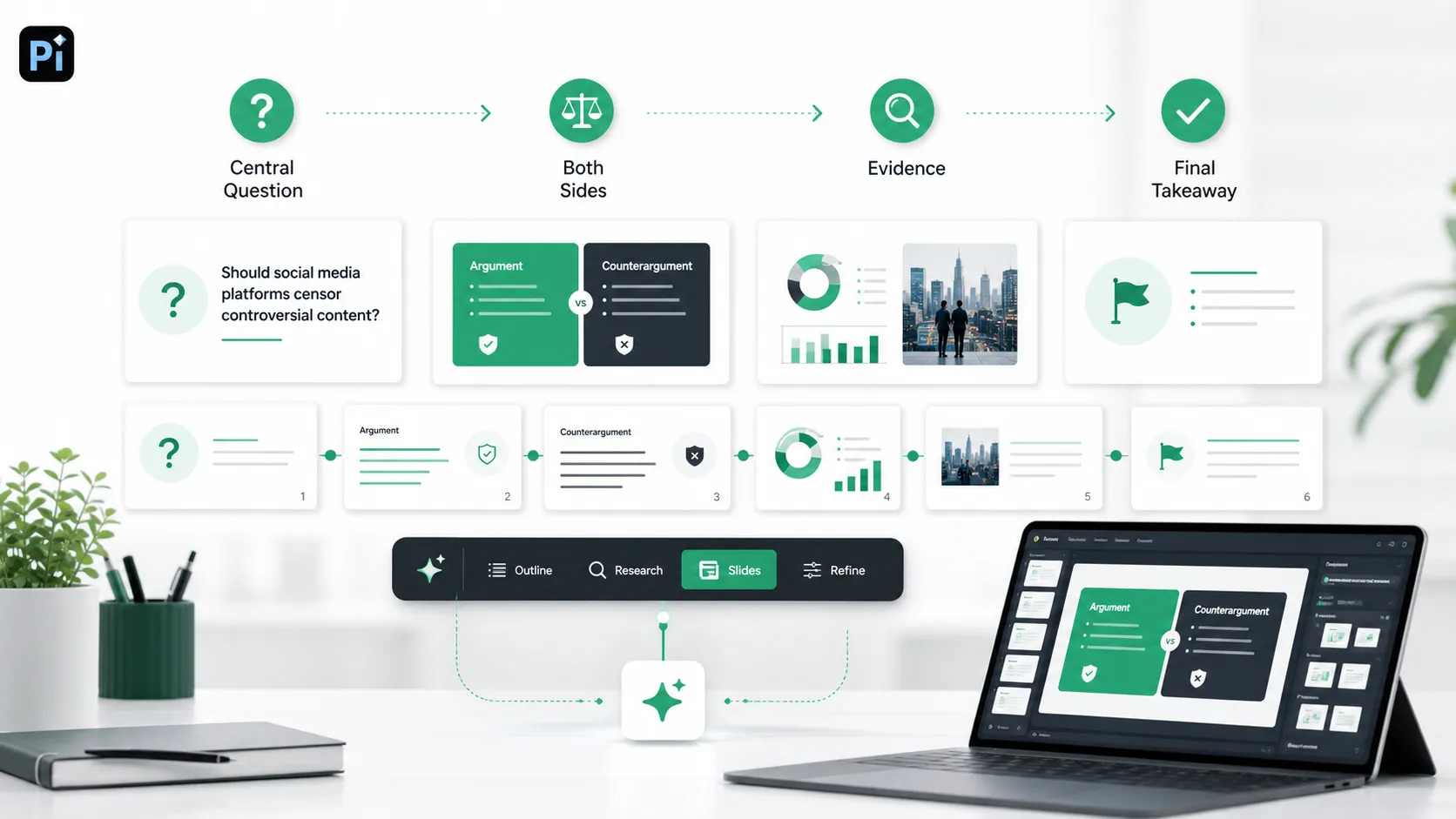
What Makes a Good Controversial Presentation Topic?
A good controversial presentation topic has tension, but it should not rely on shock value. It should invite analysis rather than personal attacks.
Use these criteria before choosing:
- Clear opposing viewpoints: Reasonable people can disagree.
- Available evidence: You can find credible data, examples, or expert commentary.
- Audience relevance: The topic connects to your class, community, field, or assignment.
- Manageable scope: The question is narrow enough for your time limit.
- Respectful framing: The topic can be discussed without stereotyping or dehumanizing others.
For example, “technology is bad” is too broad. “Should schools limit smartphone use during the school day?” is clearer, more debatable, and easier to research.
Controversial Topics About Society and Culture
Controversial social media topics work especially well because most audiences already understand the context. The challenge is not explaining what social media is. The challenge is turning a familiar issue into a focused debate question.
Good angles include privacy, algorithms, teen safety, influencer marketing, misinformation, platform accountability, and free expression. For background, Pew Research Center’s social media usage data can help you understand platform behavior, while the U.S. Surgeon General’s youth mental health advisory is useful for topics about teens and well-being.
| Topic type | Presentation angle |
|---|---|
| Controversial social media topics | age limits, teen mental health, algorithms, privacy, misinformation |
| Influencer topics | edited photos, sponsorship labels, product claims, audience trust |
| Platform responsibility | content moderation, anonymous accounts, data collection, political speech |
For influencer-related debates, the FTC’s endorsement disclosure guidance can support topics about sponsored posts, brand deals, and transparency.
101 Controversial Topics by Category
Instead of reading a long numbered list, use this category table to scan for a topic that fits your assignment. Each phrase can be turned into a debate question.
| Category | Topic ideas |
| Social media | age limits for social media; teen mental health; algorithms and public debate; influencer disclosures; edited photos; anonymous accounts; school phone bans; misinformation moderation; platform data collection; targeted ads for minors; screen time regulation; online activism; recommendation transparency |
| Society and culture | facial recognition in public spaces; tipping culture; cancel culture; parental monitoring; four-day school weeks; short-term rentals; celebrity activism; controversial books in libraries; generational labels; changing traditions; required community service; dress codes |
| Education | homework limits; standardized tests; school uniforms; participation grades; AI in classrooms; legacy admissions; letter grades; later school start times; financial literacy; exam retakes; online learning; tuition-free college; group projects |
| Technology and AI | AI-generated content labels; AI hiring tools; deepfake regulation; screen time rules; digital surveillance; workplace monitoring; automation and jobs; AI art copyright; facial recognition in schools; smart device privacy; AI essay drafting; autonomous vehicle ethics |
| Politics and law | mandatory voting; voting at 16; term limits; campaign spending limits; jury duty pay; alternative sentencing; police body cameras; election misinformation rules; protest permits; national service; congestion pricing; public campaign funding |
| Health and ethics | junk food ads to children; school mental health services; vaccination rules; genetic testing; workplace wellness incentives; sugar taxes; flu vaccines for healthcare workers; performance-enhancing technology; medical data sharing; warning labels at restaurants; mental health days; cosmetic surgery ads; health data privacy |
| Business and work | permanent remote work; four-day workweek; gig worker benefits; CEO pay limits; social responsibility metrics; influencer marketing rules; AI customer service; unpaid internships; inflation-linked minimum wage; productivity tracking; brands and social issues; automation taxes; pay transparency |
| Environment, media, and sports | single-use plastics; fast fashion taxes; electric vehicle subsidies; lifestyle changes vs climate policy; nuclear energy; private car limits; meat reduction policies; carbon pricing; bottled water restrictions; tourism in protected areas; climate education; college athlete pay; opinion labels in media |
Strong Debate Questions You Can Use
If you want a topic that is easy to turn into slides, start with a question that already contains tension.
Good examples include:
- Should children have age limits for social media?
- Do social media algorithms harm public debate?
- Should schools start later in the morning?
- Should students be allowed to use AI for first drafts?
- Should companies disclose when content is AI-generated?
- Should influencer marketing face stricter rules?
- Should remote work become a permanent option?
- Should climate education be mandatory?
For education topics, the CDC’s information on school start times and sleep can support debates about later school schedules. For AI in education, UNESCO’s generative AI guidance can help frame both the benefits and risks.
How to Choose the Right Topic for Your Audience
The right topic depends on your setting. A classroom presentation may need a balanced discussion topic, while a college debate may allow a sharper policy question.
Before choosing, ask:
- Can I explain both sides fairly?
- Can I find credible evidence?
- Will the audience understand why the topic matters?
- Is the topic narrow enough for my time limit?
- Can I discuss it respectfully?
A useful test is to turn the topic into a central question. Instead of presenting “AI in education,” ask, “Should students be allowed to use AI tools for first drafts?” This creates a clearer argument, a more focused evidence search, and a better presentation structure.
How to Turn a Controversial Topic Into a Clear Presentation
A controversial topic needs more structure than a simple informative speech. Your audience should understand the issue, the competing viewpoints, and the evidence behind your position.
| Presentation need | Weak approach | Strong approach |
| Topic framing | broad summary | clear central question |
| Argument flow | random points | structured logic |
| Counterarguments | brief mention | fair opposing views |
| Evidence | personal opinion | credible sources |
| Slide design | dense text | clear visual hierarchy |
Purdue OWL’s argumentative writing guide is useful when you need to build a claim, support it with evidence, and respond to opposing views.
For AI or technology topics, NIST’s AI risk framework can help you discuss risk, trust, and responsible use without relying only on opinion.
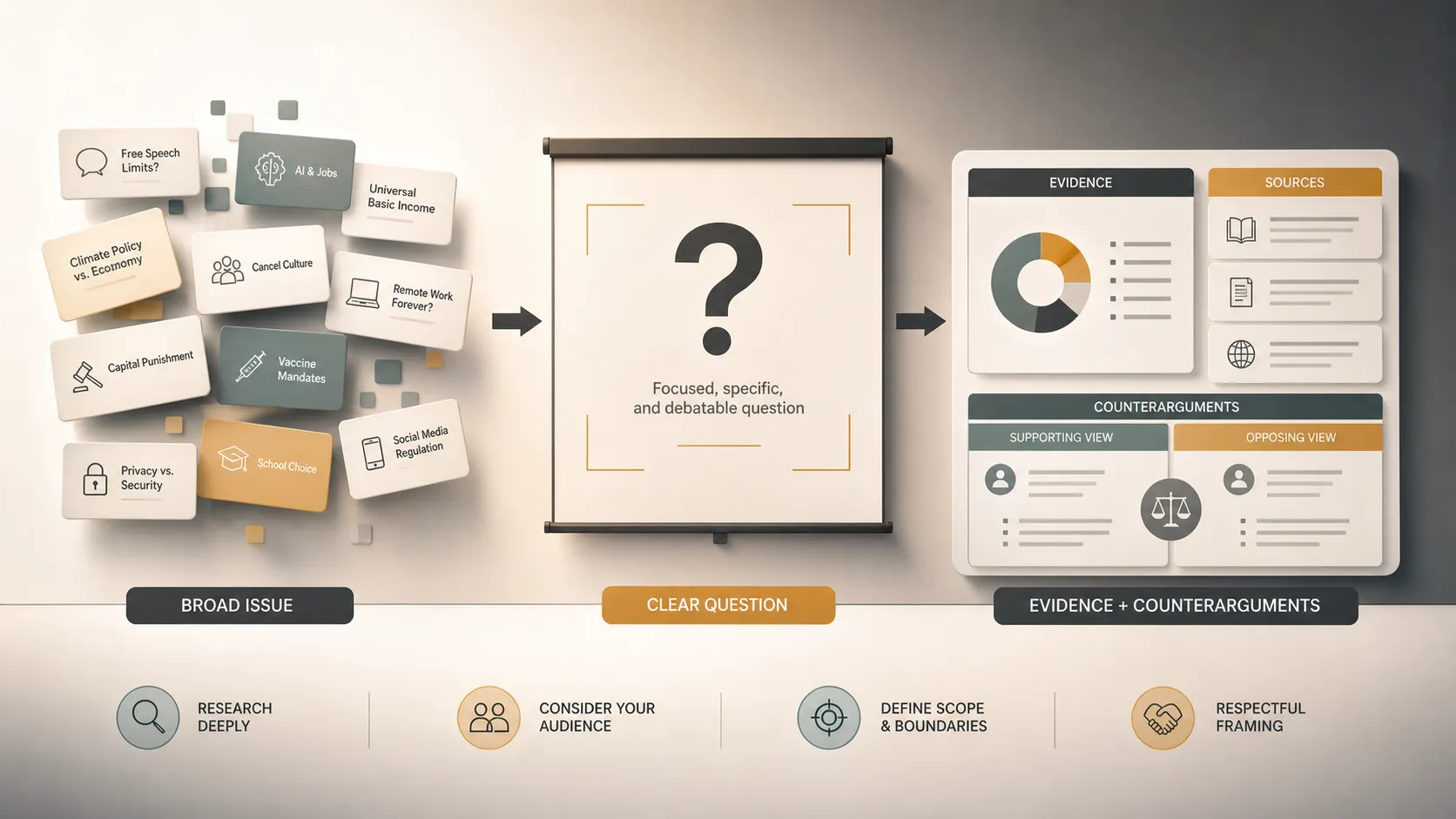
A Simple Structure for Debate Presentations
Use this structure when you want the deck to feel clear instead of chaotic:
- Start with the central question.
- Explain why the issue matters.
- Present one side of the debate.
- Present the strongest opposing view.
- Add evidence, examples, or data.
- Explain your position.
- Address one counterargument.
- End with a clear takeaway.
For delivery, keep your slides readable and accessible. W3C’s accessible presentation guidance is helpful when preparing slides for a broad audience.
How Pi Helps Turn Debate Topics Into Slides
Pi presentation maker can help turn a controversial topic into a clear deck when you have an idea but do not yet have a strong structure. This is especially useful for debate topics because the slides need to show the issue, both sides, supporting evidence, and a final takeaway.
For controversial social media topics, Pi can help shape a broad idea like “Do social media algorithms harm public debate?” into a focused presentation flow. Instead of starting with a blank slide file, you can organize the topic into background, key question, argument, counterargument, examples, and conclusion.
The goal is not to make the topic less serious. The goal is to make the argument easier to follow.
The Verdict
Controversial topics for presentations work best when they are specific, evidence-based, and respectful. Choose a question people can reasonably debate, then build the presentation around clear logic instead of shock value.
If you want a focused angle, controversial social media topics are a strong choice because they connect technology, behavior, privacy, mental health, and public discussion. With the right structure, they can become thoughtful presentations instead of one-sided opinion pieces.
Frequently Asked Questions (FAQ)
Q: What are good controversial topics for students?
A: Good student-friendly topics include homework policies, school uniforms, AI in classrooms, smartphone bans, college admissions, mental health days, and social media age limits. These are debatable, researchable, and relevant to school or college audiences.
Q: How do I make a controversial topic appropriate for school?
A: Use neutral wording, avoid personal attacks, and frame the topic as a question rather than an accusation. Choose evidence-based issues and define a narrow angle that can be discussed respectfully.
Q: What should I avoid in a debate presentation?
A: Avoid stereotypes, exaggerated claims, unreliable evidence, and topics that are too broad to cover well. You should also avoid presenting only one side, even if your assignment asks you to defend a position.
Q: How should I structure a presentation on a controversial topic?
A: Start with a hook and background, introduce the central question, explain both sides, present your argument with evidence, address counterarguments, and end with a clear takeaway that summarizes your position.