PowerPoint Night Ideas: Funny, Smart, and Easy Deck Topics
A great PowerPoint night does not need a perfect topic. It needs a topic that your group understands quickly, cares about instantly, and can laugh about without needing a long explanation. The best PowerPoint night ideas are usually simple: a strange ranking, a dramatic theory, a fake investigation, or a very serious analysis of something deeply unserious.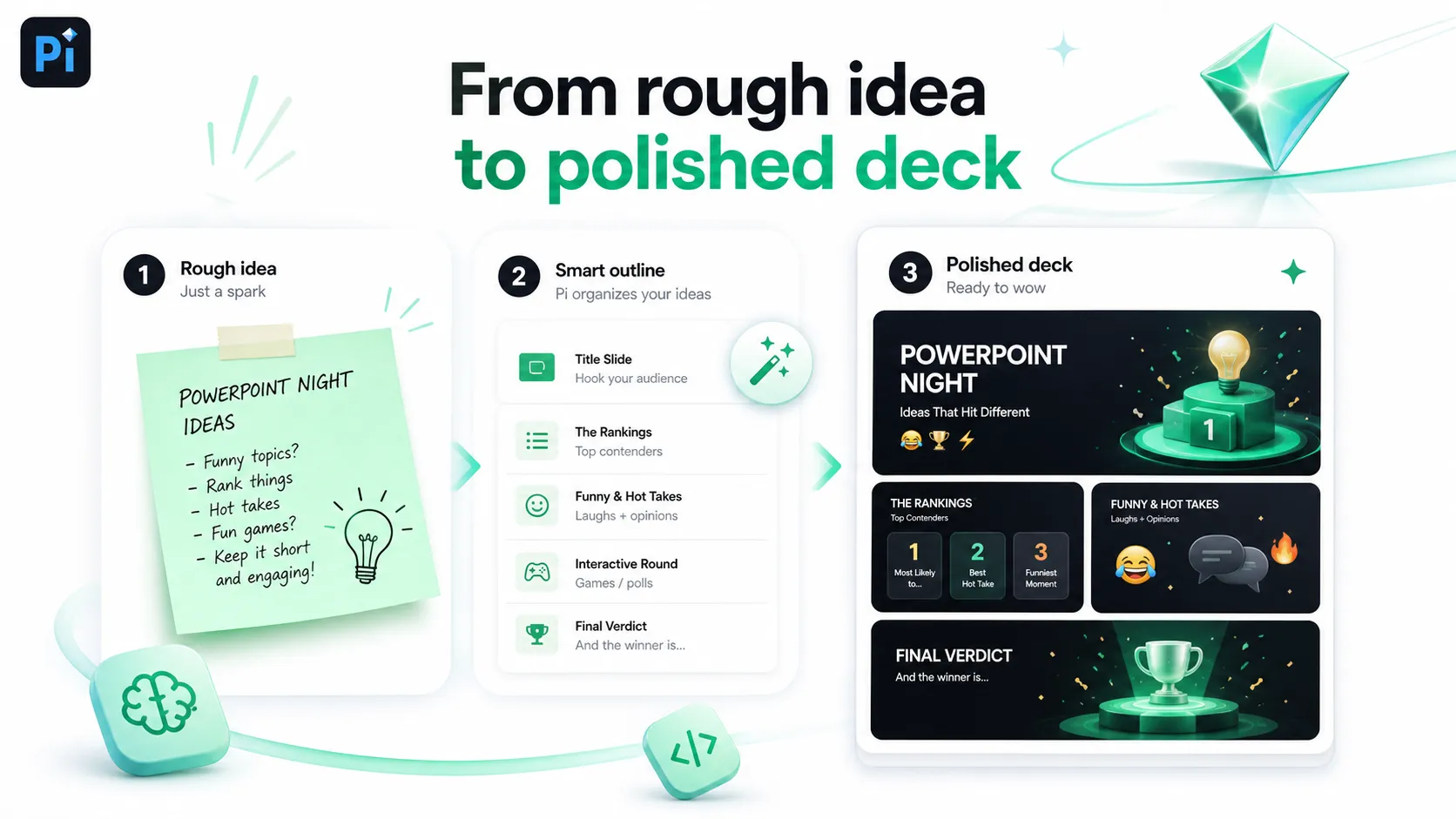
Whether you are planning a casual hangout, a birthday activity, a couples night, or a full presentation party, the goal is the same: turn a small idea into a fun mini-deck. This guide shares funny presentation ideas, clever slideshow ideas, and easy last-minute topics you can build without spending your entire evening formatting slides.
What Makes a Good PowerPoint Night Topic?
A strong PowerPoint night topic is specific enough to feel personal, but broad enough that everyone can follow it. If the idea needs ten minutes of background before the first joke lands, it is probably too complicated. If it can be explained in one sentence and immediately creates opinions, you are on the right track.
The best topics usually have four qualities:
- They are easy to explain in under 15 seconds.
- They connect to your group, your habits, or shared pop culture.
- They can become 5 to 10 slides without heavy research.
- They have a built-in structure, such as a ranking, argument, investigation, or final verdict.
For example, "Which friend would win a reality show?" works because everyone knows the format, the stakes are fake, and the evidence can be funny. A topic that sounds clever but requires too much explanation may feel more like homework than a party deck.
Funny PowerPoint Night Ideas
Funny PowerPoint night ideas work best when the presenter commits to the bit. The topic can be ridiculous, but the delivery should feel confident and overly serious. That contrast is what makes the slideshow entertaining.
You could rank your friends as fictional characters, assign everyone a theme song, or create a fake scientific theory explaining why one person always arrives late. Another reliable approach is to defend an unpopular opinion with dramatic evidence, such as “Why fries are a main course,” “Why the villain was actually right,” or “Why group trips should have a constitution.”
You can also turn everyday behavior into a mock documentary. Present “The Five Stages of Someone Saying They Are ‘Almost Ready,’” or “A Field Guide to People Who Say ‘Let’s Play It by Ear.’” These topics are funny because they exaggerate tiny truths everyone recognizes.
If your group enjoys chaos, try fake awards: “Most Likely to Start a Podcast,” “Most Likely to Survive on Vibes Alone,” or “Best Performance in a Group Chat Meltdown.” Keep it affectionate, not mean. The safest humor makes people feel seen without making them feel exposed.
Smart but Still Entertaining Slideshow Ideas
Not every presentation party idea has to be pure chaos. Some of the best funny PowerPoint ideas feel smart while still being playful. The trick is to analyze something low-stakes with the seriousness of a boardroom presentation.
For example, you could present "A Strategic Analysis of Our Group Chat," including communication styles, peak activity hours, emoji usage, and crisis-response patterns.
You could also create "A Market Forecast for Our Friend Group in 2030," predicting who becomes a wellness influencer, who moves abroad, who starts a mysterious business, and who still refuses to answer texts.
Niche obsessions also make excellent topics. If you love a reality show, sports team, coffee order, video game, or celebrity scandal, explain it like a serious business case. The humor comes from treating your obsession as if it deserves a quarterly investor update.
Public speaking basics are useful here because even casual presentations benefit from audience awareness, clear structure, and practice.
| Presentation Need | Casual Slideshow Approach | More Polished Deck Approach |
|---|---|---|
| Quick laughs | Rankings and fake awards | Strong titles and visual punchlines |
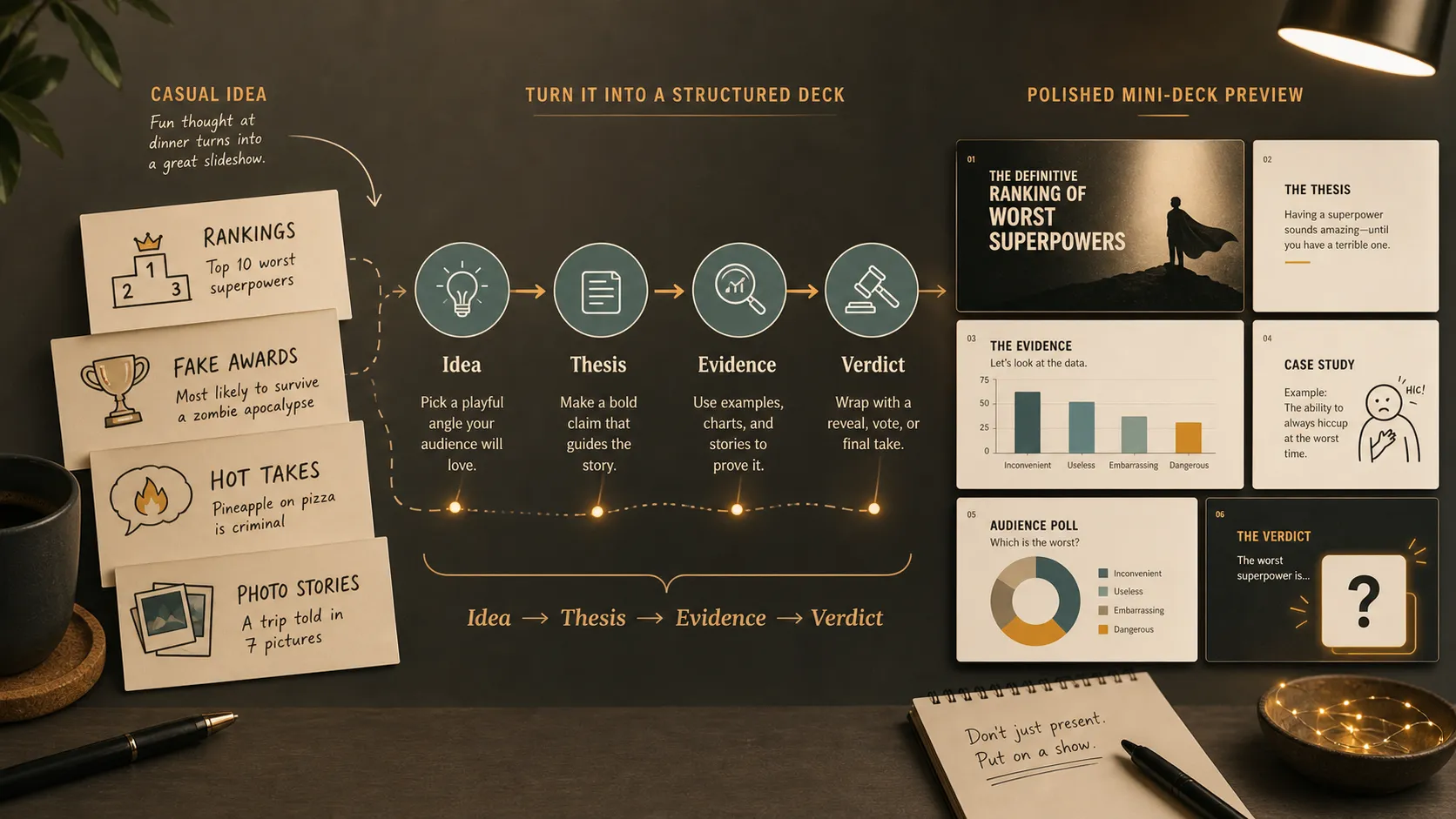
| Clever analysis | Group chat patterns | Clear thesis, evidence, and verdict |
| Personal stories | Photo-based memories | Narrative structure with callbacks |
| Niche interests | Passionate explanation | Data-style slides and sharp framing |
The more polished version does not need to feel corporate. It simply gives the joke more structure, which often makes it funnier.
Easy last-minute PowerPoint party ideas
If PowerPoint night is tonight, choose a topic that does not require research. Personal photos, rankings, hot takes, and simple comparisons are your best options.
Fast topic formats include:
- My camera roll, explained like evidence
- A ranking of meals I would eat during a personal crisis
- The official guide to surviving a weekend with us
- The official personality types of people at brunch
- A dramatic analysis of everyone's texting habits
- Bad decisions that were actually worth it
If you are truly short on time, use a three-part formula:
- Make a claim.
- Show three pieces of evidence.
- End with a dramatic conclusion.
That is enough for a fun 5-slide deck.
PowerPoint Night Ideas for Friends, Couples, and Groups
The right topic depends on the audience. A close friend group can handle more inside jokes, while a mixed group needs broader humor. Couples can lean into playful compatibility topics, but should avoid anything that feels like a real argument disguised as a joke.
For friends, choose topics based on shared memories: “Which Era of Our Friend Group Was the Most Iconic?” or “Who Would Be Cast as Whom in the Movie Version of Our Lives?” These work because the group already has emotional context.
For couples, try light topics such as “Our Relationship as a Streaming Platform,” “A Scientific Breakdown of Our Different Spending Styles,” or “Which Vacation Destination Matches Our Conflict Resolution Style?” Keep the tone affectionate and balanced.
For larger groups, use universally recognizable topics. “The Taxonomy of Party Guests,” “Types of People at Game Night,” and “A Ranking of Fictional Places We Could Actually Live” are easy for everyone to enjoy, even if they do not know each other well.
How to Turn a Topic into a Fun Slide Deck
A funny idea becomes a better presentation when it has a clear flow. You do not need a complicated outline. You need enough structure for the audience to follow the joke and anticipate the reveal.
Presentation storytelling matters even when the topic is absurd. A clear setup, a few examples, and a final reveal make the joke easier to follow.
1. Start with a strong thesis
Your first slide should make the premise obvious. Instead of "Friend Group Rankings," write:
A Data-Backed Investigation Into Who Would Betray Us First on a Reality Show
The title sets the tone before you say a word.
2. Build evidence before the reveal
Give the audience a reason to believe your argument. Use screenshots, photos, fake charts, quotes, rankings, or invented scoring systems.
The evidence does not have to be real, but it should feel internally consistent.
3. Keep slides easy to read
Funny decks work better when the slide is not overloaded. Visual hierarchy helps people know what to look at first.
Use short titles, big punchlines, and simple visuals. If the slide needs a full paragraph to explain the joke, the joke may need a sharper setup.
4. End with a final verdict
Do not let the presentation fade out. End with a ranking, award, prediction, warning, or final recommendation.
A strong closing makes the entire deck feel intentional, even if the topic is ridiculous.
Quick tips for making your PowerPoint night funnier
A funny presentation is usually less about adding more jokes and more about timing.
Use these tips:
- Keep slides simple so people listen to you instead of reading.
- Use serious design for unserious content.
- Build suspense before revealing the answer.
- Use fake data, rankings, and charts carefully.
- Make the title slide do some of the comedic work.
- Avoid overexplaining the joke.
- Tease shared habits, not real insecurities.
Accessibility still matters, even for casual decks. Microsoft's guide to accessible PowerPoint slides recommends readable text, meaningful slide titles, alt text, and sufficient contrast.
How Pi can help with PowerPoint night ideas
Pi can help turn a rough PowerPoint night idea into slides when you have the joke but are not sure how to structure it. Instead of starting from a blank deck, you can use Pi to shape the premise, slide order, visual direction, and final reveal.
For example, you can ask Pi:
Create a funny 7-slide PowerPoint night deck about why our group chat needs a crisis management team. Include a strong title, fake evidence, three examples, and a final verdict.Pi can help organize the topic into a title, setup, evidence, examples, and ending. You still add the personal jokes, screenshots, friend-specific details, and delivery style that make the deck funny.
This is especially helpful for last-minute PowerPoint night decks, presentation parties, funny slideshow ideas, and group activities where you want the deck to look sharper without spending the whole night formatting.
A good workflow is simple:
- Start with a funny premise.
- Ask Pi for a slide-by-slide structure.
- Add your personal examples and screenshots.
- Keep only the strongest jokes.
- Use Pi to polish the flow before presenting.
The goal is not to make the presentation less personal. It is to make the idea easier to present, so the jokes land clearly and the deck feels more finished.
The best PowerPoint night idea is the one your group will recognize
The winning topic is not always the most original. It is the one that makes your group say, "That is so accurate." Recognition creates the laugh. Structure keeps the laugh going.
Choose an idea that feels specific, playful, and easy to explain. Add a simple argument, a few examples, and a final verdict.
Whether your deck is a fake investigation, a dramatic ranking, or a serious analysis of a ridiculous habit, the best PowerPoint night ideas make ordinary things feel presentation-worthy.
Choose an idea that feels specific, playful, and easy to explain. Add a simple argument, a few examples, and a final verdict. Whether your deck is a fake investigation, a dramatic ranking, or a serious analysis of a ridiculous habit, the best PowerPoint night ideas make ordinary things feel presentation-worthy.
Frequently Asked Questions (FAQ)
Q: What are the best PowerPoint night ideas for beginners?
A: Start with rankings, fake awards, personal photo stories, or simple hot takes. These formats are easy to explain and can become a 5 to 7 slide deck quickly.
Q: How many slides should a PowerPoint night presentation have?
A: Most PowerPoint night decks work best at 5 to 10 slides. That is enough for a clear setup, a few examples, and a strong final reveal without making the presentation drag.
Q: What are some funny presentation ideas that are not mean?
A: Try topics based on fictional scenarios, shared habits, pop culture comparisons, or fake scientific theories. Avoid exposing private information or targeting real insecurities.
Q: How can I make a PowerPoint night deck quickly?
A: Choose a topic with a built-in structure, such as a ranking or investigation. Use a simple slide flow: title, thesis, evidence, examples, dramatic reveal, and final verdict. Pi can also help organize your ideas and create a more polished deck faster.