Persuasive Speech Topics: Ideas That Work Well in Presentations
Choosing persuasive speech topics is harder than it looks. A topic can sound interesting in a list, then become difficult to argue once you start building the presentation. Strong persuasion needs more than a bold opinion. It needs a clear claim, audience relevance, credible evidence, and a structure that helps people follow your reasoning.
Whether you are preparing for school, a public speaking class, a workplace meeting, or a debate, the best speech topics for persuasive presentations are specific enough to defend and meaningful enough for the audience to care. The goal is not to manipulate listeners. The goal is to make a fair, evidence-based case that helps them see an issue differently.
What Makes a Persuasive Speech Topic Work?
A persuasive topic works when it creates a real choice for the audience. If everyone already agrees, there is little to persuade. If the issue is too broad, the speech becomes vague. The strongest topics sit between those extremes: focused, debatable, and practical.
A good persuasive topic usually has five qualities:
- Specific: “Schools should limit phone use during class” is stronger than “phones are bad.”
- Debatable: Reasonable people can disagree, which gives your speech tension.
- Audience-relevant: The issue connects to listeners’ daily lives, work, goals, or values.
- Evidence-friendly: https://owl.purdue.edu/owl/general_writing/academic_writing/establishing_arguments/index.html You can support the claim with examples, data, expert views, or case studies.
- Action-oriented: The speech points toward a decision, habit, policy, or mindset change.
This is why “climate change” is not yet a persuasive speech topic. “Local governments should make public transportation cheaper to reduce car dependency” is much more presentation-ready.
How to Choose the Right Persuasive Speech Topic
Start with your audience, not with your opinion. A topic that works in a classroom may not work in a leadership meeting. A topic that excites you may not matter to the people listening. Ask what your audience already believes, what they might resist, and what evidence would feel credible to them.
Next, consider your setting and time limit. A five-minute speech needs one clear claim and two or three strong supporting points. A longer presentation can handle more context, counterarguments, and examples. Also consider your own credibility. You do not need to be an expert, but you should be able to explain why you are a thoughtful voice on the subject.
Finally, test your topic as a sentence: “My audience should believe or do X because Y.” If you cannot complete that sentence clearly, the topic may still be too broad.
Persuasive Speech Topics for Students
Student presentations work best when the issue feels close to daily life. Education, digital habits, campus culture, and well-being all offer strong presentation ideas.
Schools should teach financial literacy as a required subject because students need practical money skills before adulthood. Colleges should offer more career-focused micro-courses because many students need flexible ways to build job-ready skills. Class participation grades should be redesigned because they can reward extroversion more than learning.
Other useful angles include whether homework should be limited on weekends, whether students should have later school start times, whether campus mental health services need more funding, and whether schools should teach AI literacy as part of basic digital education. Each topic gives you a clear audience problem and a practical recommendation.
Persuasive Speech Topics for Business and Workplace Presentations
In professional settings, persuasive speech topics should connect to decisions, performance, culture, or customer value. The best workplace topics do not sound like abstract opinions. They sound like strategic choices.
Companies should measure productivity by outcomes instead of hours because knowledge work depends on focus and results. Remote work policies should be designed by role rather than applied as one universal rule. Managers should receive better training in giving feedback because unclear feedback lowers performance and trust.
Other strong business topics include ethical AI adoption, reducing unnecessary meetings, improving customer onboarding, investing in employee well-being, using sustainability as a business advantage, and building more transparent leadership communication. These topics work well because they can be supported with examples, KPIs, cost implications, and operational recommendations.
Persuasive Speech Topics About Technology and AI
Technology and AI topics are timely because they affect education, work, privacy, creativity, and daily habits. The challenge is to avoid vague claims such as “AI is good” or “social media is harmful.” A persuasive presentation needs a sharper position.
Schools should teach students how to evaluate AI-generated content because misinformation skills are becoming essential. Companies should create clear AI usage policies before scaling automation. Social media platforms should give users more control over recommendation algorithms. Consumers should treat data privacy as a personal safety issue, not just a technical setting.
You could also argue for digital wellness habits, stronger cybersecurity education, transparent AI labeling, or responsible automation that supports workers instead of simply replacing tasks. These topics are persuasive because they combine urgency with practical action.
Persuasive Speech Topics About Society, Health, and Lifestyle
Society, health, and lifestyle topics work well when they connect personal behavior to broader consequences. The key is to avoid moralizing. A respectful persuasive speech shows why a change is useful, realistic, and worth considering.
Communities should invest more in walkable neighborhoods because physical activity should be easier to build into daily life. Employers should normalize mental health days because burnout affects both people and performance. People should learn basic media literacy because online information shapes voting, health choices, and public trust.
Other options include reducing food waste, supporting local businesses, improving public health communication, creating better recycling habits, encouraging preventive healthcare, or limiting multitasking to improve attention. Each topic can become stronger when you define the specific audience and the specific behavior you want to change.
Debate Ideas That Can Become Persuasive Presentations
Debate ideas often begin as questions, but persuasive presentations need a position. Instead of asking “Should AI be used in schools?” turn it into a claim: “Schools should allow AI for brainstorming but not for final writing.” This gives your speech a defendable point of view.
| Debate Topic | Possible Position | Presentation Angle |
|---|---|---|
| Should students use AI for homework? | Allow guided use with clear rules | Balance learning, ethics, and digital skills |
| Is remote work better than office work? | Hybrid policies should depend on role | Focus on productivity and collaboration |
| Should schools ban smartphones? | Limit use during instructional time | Protect attention without ignoring safety |
| Is fast fashion harmful? | Consumers should buy fewer, better items | Connect habits to waste and labor concerns |
| Should companies shorten the workweek? | Test four-day weeks in suitable teams | Link well-being to measurable output |
This table format can help you turn debate ideas into structured presentations. The topic creates tension, the position creates clarity, and the angle tells the audience why it matters.
How to Turn a Topic Into a Persuasive Presentation Structure
Once you choose a topic, build the presentation around a simple argument flow. Open with a hook: a question, statistic, scenario, or brief story that shows the problem. Then state your claim clearly so the audience knows what you want them to believe.
Next, explain the audience problem. Why should they care? What cost, risk, opportunity, or frustration is involved? After that, present evidence in a logical sequence. Use only the strongest points, not every fact you found. Acknowledge one reasonable counterargument, then explain why your position still holds.
End with a recommendation or call to action. This does not need to be dramatic. It can be a policy change, a personal habit, a pilot project, or a new way to think about the issue. A persuasive presentation feels stronger when the audience knows what to do next.
Where Pi Helps After You Pick a Topic
Pi, short for Presentation Intelligence, helps turn a chosen persuasive speech topic into a presentation-ready deck. It is especially useful when your topic needs more than a simple list of slides and requires clear logic, professional structure, and polished visual quality.
1. Business Logic Comes Before Slide Styling
For workplace persuasive presentations, the argument often needs to connect to ROI, KPI impact, customer experience, risk, or leadership priorities. Pi can help shape the topic into a business-ready flow, so the deck does not feel like a collection of opinions.
2. Structure Supports the Speaker
A persuasive speech needs momentum. Pi can help organize the hook, claim, supporting points, counterargument, and recommendation into a coherent slide sequence. That structure helps the presenter stay focused and helps the audience follow the argument.
3. Premium Visual Quality Builds Credibility
Design does not replace evidence, but it affects how seriously the message is received. Pi is built for professional presentation workflows where visual hierarchy https://www.nngroup.com/articles/visual-hierarchy-ux-definition/ , pacing, and premium business-grade aesthetics matter, from executive presentations to sales decks and consulting reports.
A Practical Way to Pick Your Final Topic
The best final topic is not always the most dramatic one. It is the one you can argue clearly for your specific audience. Choose a topic that fits your time limit, gives you enough evidence, and leads to a realistic recommendation.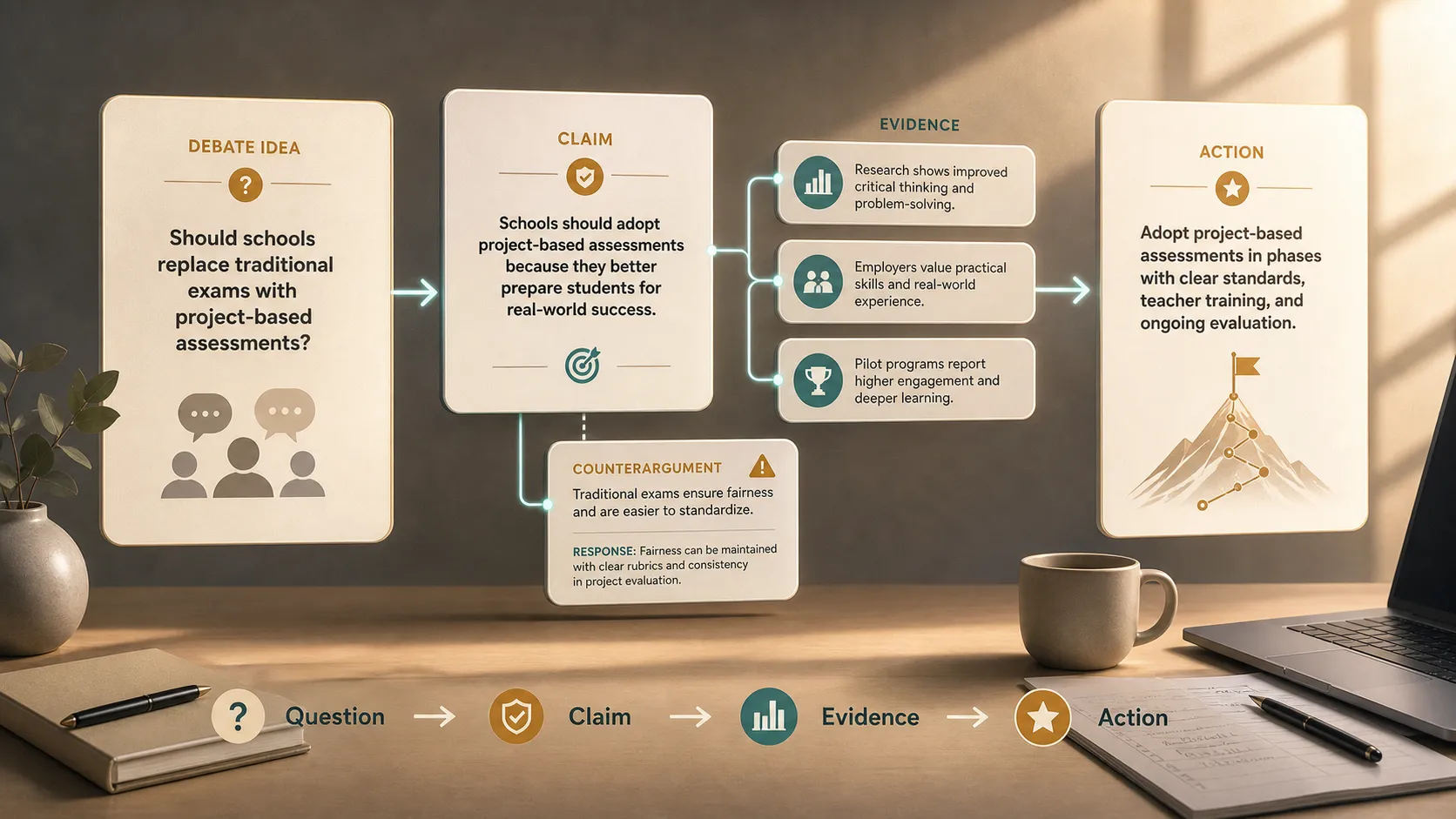
If you are stuck, narrow the topic by audience and action. Instead of “AI in education,” try “High schools should teach students how to cite and critique AI-generated content.” Instead of “workplace culture,” try “Managers should replace status meetings with written weekly updates for routine projects.” Specific topics are easier to research, easier to present, and more persuasive.
Frequently Asked Questions (FAQ)
Q: What are good persuasive speech topics for beginners? A: Good beginner topics are specific, familiar, and easy to support. Examples include limiting phone use in class, teaching financial literacy, reducing unnecessary meetings, improving sleep habits, or encouraging media literacy.
Q: How do I choose between several persuasive speech topics? A: Pick the topic that best matches your audience, time limit, available evidence, and personal credibility. If you can state your claim in one clear sentence and support it with two or three strong reasons, it is likely a good choice.
Q: What is the difference between debate ideas and persuasive speech topics? A: Debate ideas are often framed as questions with two sides. Persuasive speech topics turn that question into a clear position. For example, “Should remote work continue?” becomes “Companies should use role-based hybrid work policies.”
Q: How can I make a persuasive presentation stronger? A: Start with a clear claim, show why the audience should care, use credible evidence, address a fair counterargument, and end with a practical recommendation. Strong structure makes persuasion easier to follow and more ethical.