EU AI Act Explained: What AI Businesses Need to Know in 2026
The EU AI Act is a regulation framework for companies building, buying, or deploying AI systems in 2026. For AI businesses, the key question is which obligations apply to each product, model, or workflow.
Meta description: Understand the EU AI Act, its compliance requirements, transparency obligations, general-purpose AI rules, and what AI businesses need to know in 2026.
What Is the EU AI Act?
The EU AI Act regulates AI systems based on risk. Instead of treating every AI product the same way, it classifies use cases by their potential impact on people, public safety, fundamental rights, and society.
A low-risk writing assistant will not face the same obligations as an AI system used for hiring, credit scoring, education, healthcare, law enforcement, or critical infrastructure. For businesses, this affects product design, data governance, model evaluation, documentation, user communication, and procurement.
Why the EU AI Act Matters for AI Companies
The EU AI Act can apply beyond the European Union when an AI system is placed on the EU market, used in the EU, or produces outputs that affect people in the EU.
This matters for SaaS vendors, API providers, AI model companies, and businesses using generative AI in customer-facing or regulated workflows. It also changes procurement expectations: enterprise buyers increasingly ask for responsible AI documentation, transparency, and model risk controls.
EU AI Act Timeline: What Businesses Should Know in 2026
The EU AI Act applies progressively. According to the European Commission, different parts of the regulation apply at different dates, so companies should avoid treating 2026 as a single deadline for every obligation.
| Date | What Applies |
|---|---|
| 1 August 2024 | The EU AI Act entered into force |
| 2 February 2025 | General provisions, AI literacy requirements, and prohibited AI practices started to apply |
| 2 August 2025 | Rules for general-purpose AI models and governance started to apply |
| 2 August 2026 | Most AI Act rules, including transparency rules, start to apply and enforcement begins for applicable rules |
| 2 December 2027 | Rules for high-risk AI systems listed in Annex III apply |
| 2 August 2028 | Rules for high-risk AI systems embedded in regulated products apply |
For AI businesses, 2026 is especially important because transparency obligations, governance expectations, and enforcement activity become more relevant. Some high-risk obligations apply later depending on the system type.
Source: European Commission AI Act implementation timeline
Understanding the EU AI Act Risk-Based Framework
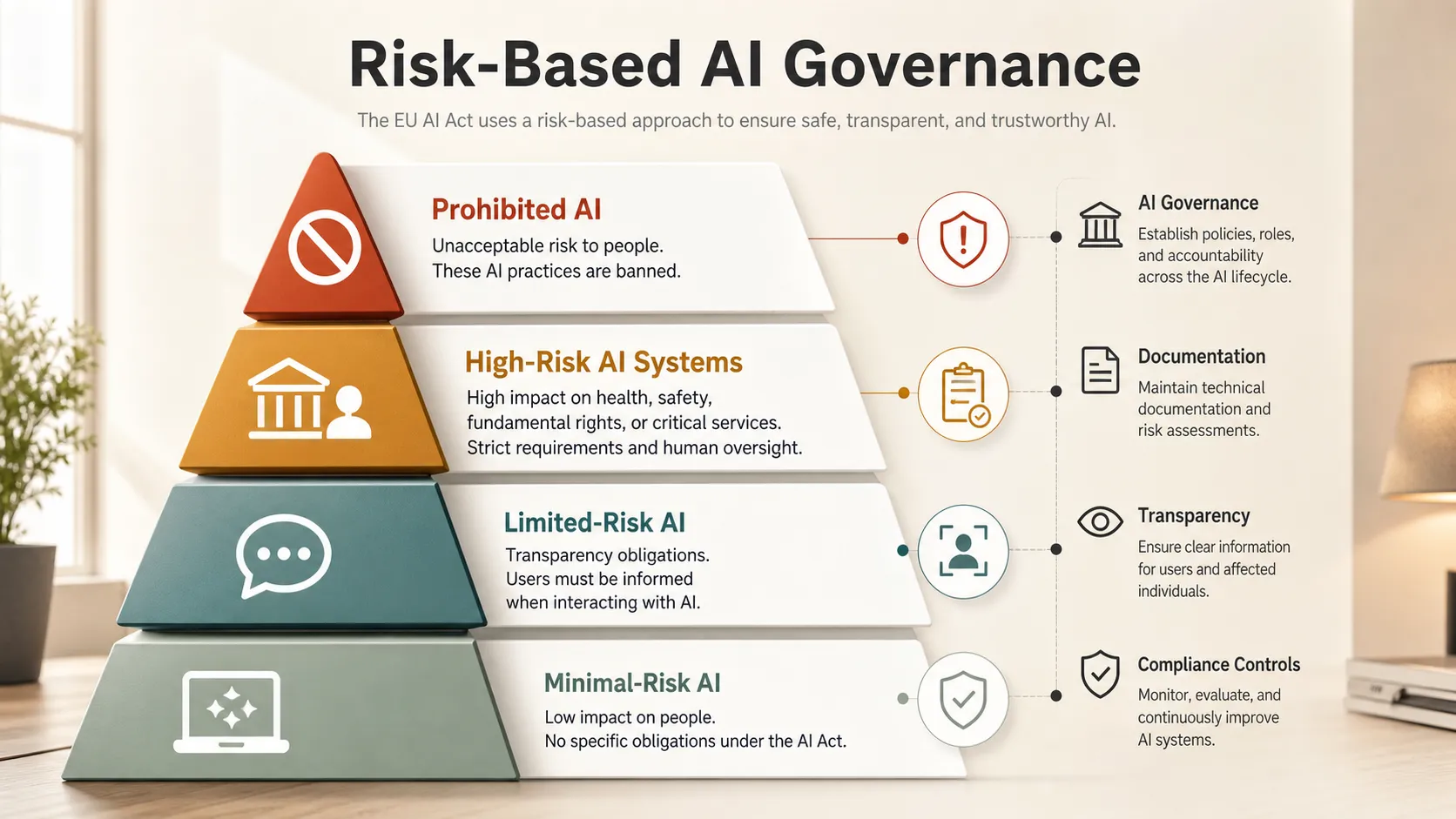
The EU AI Act uses a risk-based approach. Compliance obligations depend on how an AI system is used, not only on the underlying technology.
| Risk Category | Typical Business Examples | Compliance Impact |
|---|---|---|
| Prohibited AI | Manipulative systems, certain social scoring, some biometric uses | Generally banned |
| High-risk AI systems | Hiring, credit, education, healthcare, critical infrastructure | Strict obligations, with dates depending on the system type |
| Limited-risk AI | Chatbots, synthetic media, AI interactions | Transparency requirements |
| Minimal-risk AI | Productivity tools, spam filters, internal assistants | Lighter obligations |
This means businesses must map AI use cases carefully. The same model may be low-risk in one context and high-risk in another.
General-Purpose AI Rules Explained
General-purpose AI, often called GPAI, refers to models that can perform many tasks and may be integrated into downstream systems. Large language models and multimodal models are common examples.
Under the EU AI Act, obligations for GPAI providers started to apply on 2 August 2025. Requirements may include technical documentation, downstream provider information, copyright-related policies, and risk management for advanced models with systemic risk.
For companies using GPAI through APIs or third-party platforms, vendor due diligence matters. Teams should know which model is used, what documentation exists, how outputs are handled, and whether the provider supports enterprise AI governance.
Transparency Requirements for Generative AI
Transparency is a central theme of the EU AI Act. Users should know when they are interacting with AI or viewing AI-generated content in relevant contexts.
The European Commission states that transparency rules under the AI Act start to apply from 2 August 2026. For generative AI, this may affect customer-facing chatbots, synthetic media, documents, presentations, reports, and workflows where AI outputs influence decisions.
Transparency does not mean every AI feature needs a warning banner. It means businesses should avoid deception and provide appropriate context when AI is involved.
Requirements for High-Risk AI Systems
High-risk AI systems will face some of the strongest obligations under the EU AI Act, with key rules applying later than the general 2026 date depending on the system type.
These systems often affect rights, opportunities, safety, or access to essential services. Examples include employment, education, healthcare, credit, critical infrastructure, migration, and law enforcement.
Common requirements may include risk management, data governance, technical documentation, human oversight, accuracy measures, logging, monitoring, and clear instructions for use. Teams should prepare before the legal deadline because high-risk AI needs cross-functional governance.
Practical Compliance Checklist for Businesses
AI compliance should be treated as an operating discipline, not a one-time legal review. Companies preparing for 2026 should build repeatable processes that scale across products and teams:
- Create an inventory of AI systems, models, vendors, datasets, and use cases.
- Classify each AI system under the EU AI Act risk framework.
- Identify whether your company is a provider, deployer, importer, distributor, or downstream user.
- Review GPAI dependencies, API providers, and model documentation.
- Add transparency notices for AI interactions and AI-generated content where required.
- Establish human oversight for sensitive or high-impact decisions.
- Train relevant teams and update policies as guidance evolves.
The goal is to make AI adoption more durable, trusted, and enterprise-ready.
EU AI Act and GDPR: What Is Different?
The EU AI Act and GDPR are related, but they are not the same. GDPR focuses mainly on personal data protection, while the EU AI Act focuses on AI system risk, transparency, safety, governance, and accountability.
A company may need to comply with both. An AI hiring tool, for example, may process personal data under GDPR while also being treated as a high-risk AI system under the EU AI Act.
How the EU AI Act Affects AI Presentation and Productivity Tools
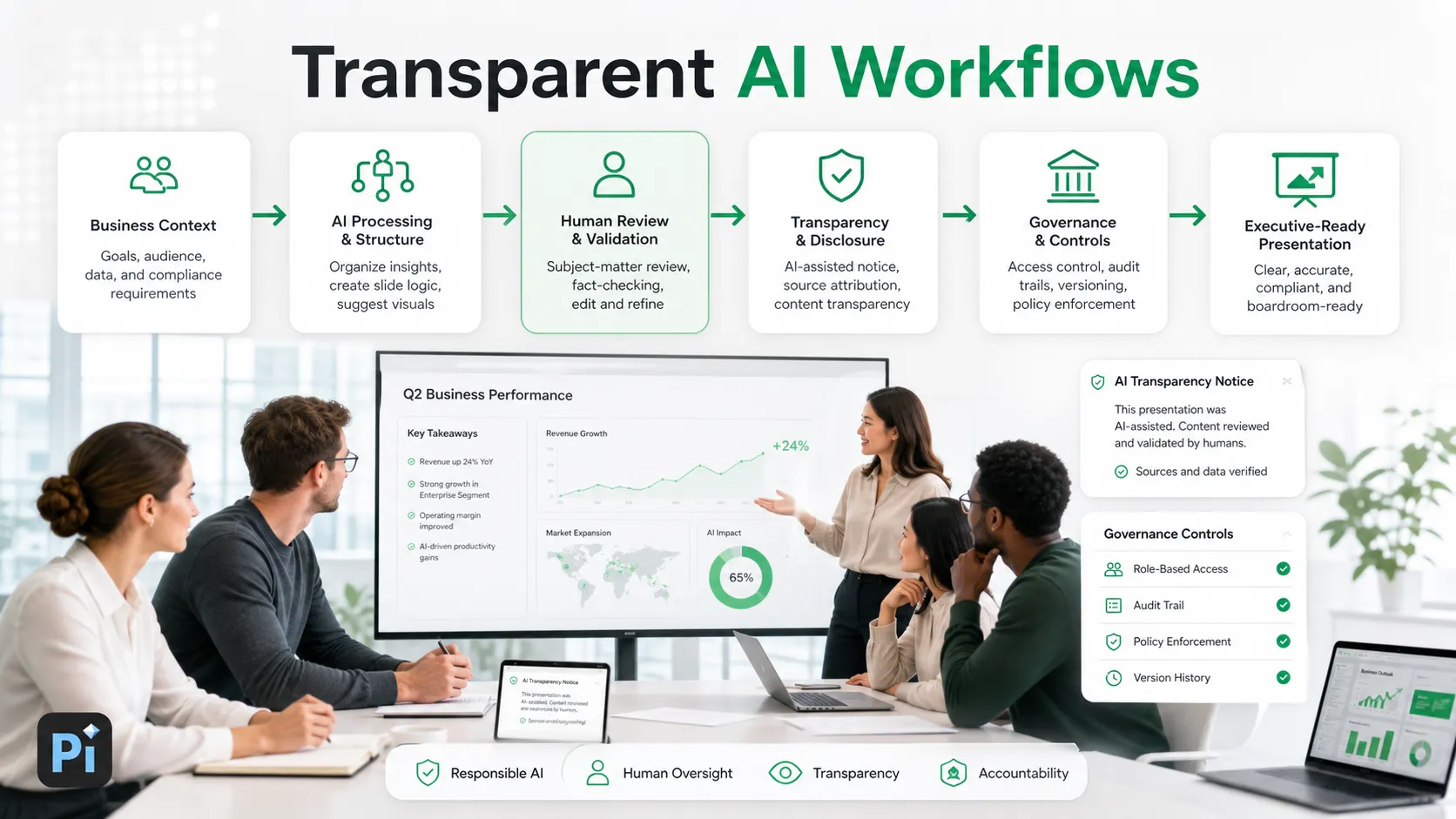
AI productivity tools are widely used for presentations, documents, images, customer support, research, and enterprise workflows. Many may fall into lower-risk or limited-risk categories, but they still need responsible design.
For AI presentation tools, responsible AI starts with helping users structure information clearly rather than simply generating polished visuals. A business deck may include market analysis, sales messaging, financial assumptions, or strategic recommendations, so human review remains essential.
Tools that generate slides, documents, or images should make AI involvement understandable. For AI presentation tools such as Pi, the stronger position is helping teams turn business context into structured, reviewable presentations while keeping human judgment in the workflow.
The Verdict
The EU AI Act is not only a European policy milestone. It is also a signal that AI governance is becoming a normal part of business operations.
Companies should start with visibility: know where AI is used, what it affects, who owns it, and what controls exist. The businesses best prepared for the EU AI Act will be those that build responsible AI into everyday workflows before customers, regulators, or procurement teams demand it.
Frequently Asked Questions (FAQ)
Q: What is the EU AI Act in simple terms?
A:The EU AI Act is a risk-based AI regulation that sets rules for how AI systems are developed, sold, and used in or affecting the European Union.
Q:Does the EU AI Act apply to companies outside Europe?
A:It may apply if a company places an AI system on the EU market, serves EU users, or produces AI outputs used in the EU.
Q:What are high-risk AI systems under the EU AI Act?
A:High-risk AI systems are AI applications used in sensitive areas such as employment, education, healthcare, credit, critical infrastructure, law enforcement, and access to essential services.
Q:How should SaaS companies prepare for EU AI Act compliance in 2026?
A:SaaS companies should inventory AI features, classify risk levels, review GPAI vendors, document model behavior, add transparency notices, establish human oversight, and create internal AI governance processes.ntrols, add transparency notices, and create internal AI governance processes.