Gemini 3.5 Flash Cyber: Why Google Built an AI Model for Cybersecurity
Google DeepMind’s launch of Gemini 3.5 Flash Cyber shows a clear shift in AI cybersecurity. Instead of relying only on general-purpose models, Google is building a lightweight model specialized for defensive work: finding vulnerabilities, validating risky code, supporting remediation, and helping security teams move faster.
This matters because software security is becoming too large and too fast for manual review alone. Modern teams manage huge repositories, frequent releases, open-source dependencies, cloud services, and alert queues. Traditional tools still matter, but defenders increasingly need AI systems that can reason across code, prioritize risk, and produce evidence for human review.
What Is Gemini 3.5 Flash Cyber?
Gemini 3.5 Flash Cyber is a cybersecurity-focused model built on Google’s Flash model family. Google says it is fine-tuned to find, validate, and patch vulnerabilities efficiently, making it more useful for security workflows than a generic model in certain tasks.
The “Flash” part is important. Security work often requires repeated analysis across many files, commits, dependencies, and tests. A smaller specialized model can be cheaper and faster to call many times, which makes it better suited for continuous scanning and agent workflows.
Google also connects the model to CodeMender, its AI code security agent. CodeMender is designed to scan code, verify whether vulnerabilities are real, and generate patches for developer review. This places Gemini 3.5 Flash Cyber closer to operational security infrastructure than to a normal chatbot.
Why Google Built a Cybersecurity Model
Cybersecurity is not just another coding task. A useful security model needs to understand vulnerability classes, exploitability, false positives, patch quality, and secure software design. It must also work within strict boundaries because cybersecurity AI is inherently dual-use.
A general AI assistant can explain a security concept or summarize a report. Gemini 3.5 Flash Cyber is aimed at a harder layer: inspecting code paths, comparing suspicious patterns, validating whether an issue is real, and helping teams prepare safer fixes. The best outcome is not fully autonomous security, but supervised acceleration.
That direction reflects a broader industry trend. Security teams are under pressure to respond faster while development teams ship more frequently. If AI can reduce the time spent on repetitive review, alert triage, and patch preparation, human experts can focus more attention on judgment, prioritization, and architectural risk.
CodeMender, CyberGym, and Big Sleep
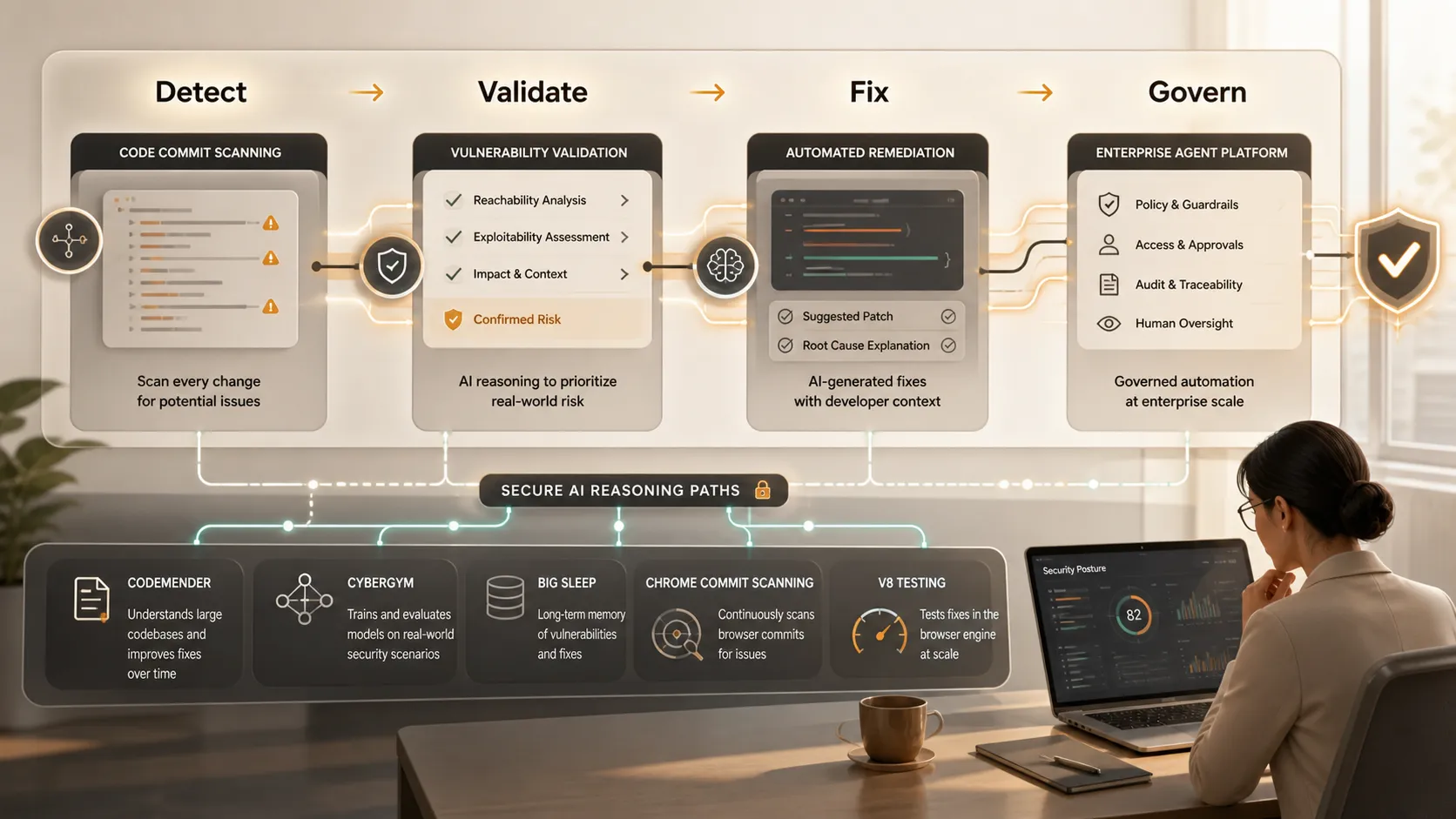
Google’s strategy is easier to understand as a pipeline. CodeMender handles code scanning and remediation. CyberGym evaluates AI agents on real-world vulnerability analysis tasks. Big Sleep, developed by Google DeepMind and Google Project Zero, explores AI-assisted discovery in complex software.
The goal is not a single impressive answer. It is a repeatable workflow: scan, reason, validate, patch, test, and report. Google also references Chrome commit scanning and the V8 JavaScript engine, which are strong examples because browser engines are complex, widely deployed, and security-critical.
| Security workflow | Traditional approach | AI-assisted direction |
|---|---|---|
| Code review | Manual inspection and static tooling | AI highlights risky changes for review |
| Vulnerability validation | Expert-led investigation | Faster evidence gathering and triage |
| Remediation | Developer patching after review | Suggested fixes with human approval |
| Benchmarking | Limited internal tests | Agent testing on realistic vulnerabilities |
| Reporting | Manual summaries | Clearer risk narratives for stakeholders |
Chrome commit scanning is especially relevant because vulnerabilities are often introduced through ordinary development activity, not only through obviously risky code. A model that can review changes continuously may help flag suspicious patterns earlier in the software lifecycle. V8 testing matters for the same reason: high-performance runtime environments contain complex behavior that requires deep, repeated analysis.
Why Lightweight Security Models Matter
Lightweight models matter because cybersecurity is repetitive. Teams need support across commits, dependency updates, tickets, alerts, release checks, and incident reviews. If a specialized model can be called frequently at lower cost, it can explore more code paths before producing a final report.
This is where Gemini 3.5 Flash Cyber may be strategically important. Large frontier models are useful for complex reasoning, but they can be expensive for high-volume workflows. A smaller model tuned for security tasks could make AI-assisted scanning practical across more repositories, more frequent builds, and more developer environments.
Google’s security ecosystem also benefits from real-world resources such as OSV.dev, an open-source vulnerability database, and OSS-Fuzz, Google’s continuous fuzzing project for open-source software. These resources help ground AI security work in authentic vulnerabilities instead of purely synthetic examples.
Gemini Enterprise Agent Platform and Operational Security
The Gemini Enterprise Agent Platform gives Google a way to place cybersecurity models inside broader agent workflows. In practice, that could mean security agents that monitor code changes, summarize risks, assign remediation tasks, or prepare evidence for approval inside enterprise systems.
For security teams, the attraction is speed. For developers, the attraction is earlier feedback. For CISOs, the attraction is scale: a way to support more software review without expanding headcount at the same pace.
However, operational value depends on integration. Security AI must connect with code repositories, ticketing systems, CI/CD pipelines, vulnerability management tools, and governance workflows. It also needs audit logs, permissions, approval gates, and clear ownership. Without those controls, automation can create new risk instead of reducing it.
Implications for Developers, Security Teams, and CISOs
For developers, Gemini 3.5 Flash Cyber points toward security feedback that arrives closer to the moment code is written or reviewed. Instead of waiting for a later audit, developers may receive targeted explanations, safer patch suggestions, and clearer evidence about why a change matters.
For security teams, the model could reduce time spent sorting through low-quality findings. Vulnerability detection is valuable only when paired with validation. If an AI security agent can help distinguish likely real issues from noise, analysts can spend more time on high-impact remediation.
For CISOs, the trade-off is more strategic. AI cybersecurity promises lower cost per analysis, faster response times, and broader coverage. But it also requires governance. Leaders will need to define when AI can act, when humans must approve, how sensitive code is protected, and how model behavior is monitored over time.
The dual-use risk is unavoidable. The same reasoning that helps defenders understand vulnerabilities could be misused in the wrong context. That is why defensive positioning, access control, sandboxing, usage monitoring, and human oversight are not optional features. They are part of the product’s security model.
Where Pi Fits Naturally
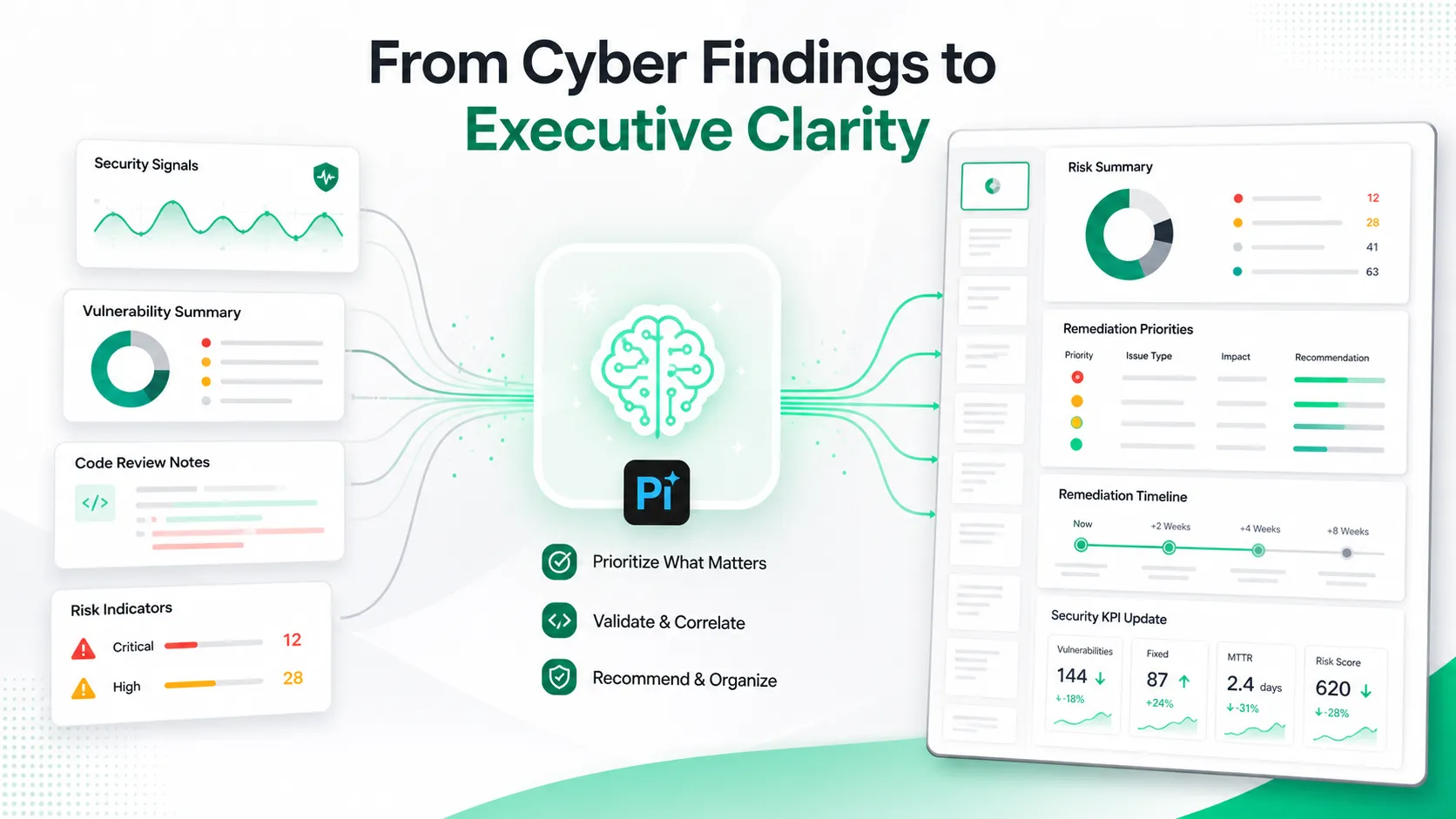
Pi is not a cybersecurity detection tool. It does not scan code, validate vulnerabilities, or replace security platforms. However, it fits the communication layer around cybersecurity work.
When AI security systems generate more findings, teams still need to explain those findings clearly. CISOs often need board updates, incident reviews, remediation plans, customer summaries, and internal security briefings. Pi can help turn dense technical material into professional presentations for executives and cross-functional teams.
This matters because cybersecurity outcomes are often decided outside the security team. Budget approvals, remediation timelines, customer trust, and executive prioritization all depend on clear communication. A technical finding must become a business narrative: what happened, what is at risk, what action is required, and how progress will be measured.
Guardrails and Governance
Cybersecurity AI must be governed carefully. The same reasoning that helps defenders can be misused if deployed without access controls, logging, sandboxing, approval workflows, and human review. Google’s limited-access approach reflects this dual-use risk.
Enterprises should evaluate both capability and control. The NIST AI Risk Management Framework is useful for thinking about trustworthiness, risk, and accountability. Security teams should also consider the OWASP Top 10 for LLM Applications, which highlights risks such as prompt injection, data leakage, insecure output handling, and excessive agency.
The strongest deployments will likely combine automation with restraint. AI can accelerate scanning, validation, summarization, and patch drafting, but humans should continue to own risk acceptance, production changes, and executive accountability.
The Verdict
Gemini 3.5 Flash Cyber points to the next phase of AI cyber defense: lightweight, domain-specific, agent-driven systems that can support real software security work at scale. The realistic future is not AI replacing security engineers. It is human-led defense accelerated by models that can detect, validate, summarize, and recommend.
For developers, this means earlier security feedback. For security teams, it means faster triage. For CISOs, it means a governance challenge: adopting AI that improves speed while preserving accountability, evidence, and control.
Frequently Asked Questions (FAQ)
Q: What is Gemini 3.5 Flash Cyber?
A: Gemini 3.5 Flash Cyber is a lightweight cybersecurity-focused AI model from Google DeepMind, designed to support defensive tasks such as vulnerability detection, validation, code analysis, remediation, and AI security agent workflows.
Q: Is Gemini 3.5 Flash Cyber a general-purpose AI model?
A: No. It belongs to the Gemini model family, but it is specialized for cybersecurity workflows rather than broad chat, writing, or productivity tasks.
Q: Does Gemini 3.5 Flash Cyber replace security engineers?
A: No. It is designed to assist human experts by speeding up triage, evidence gathering, and remediation planning. Human review, testing, and approval remain essential.
Q: Why is Pi mentioned in an article about AI cybersecurity?
A: Pi is relevant to the communication layer. It can help teams turn complex cybersecurity findings into executive presentations, board updates, remediation plans, and incident summaries.