AI Boom or AI Bubble? What the IMF Says
The question behind the 2026 AI market is no longer whether artificial intelligence matters. It is whether the current AI boom is creating durable economic value—or whether parts of the market are drifting toward AI bubble territory.
According to the IMF July 2026 World Economic Outlook Update, global growth is projected at 3.0% in 2026 and 3.4% in 2027.The IMF highlights advances in AI, technology investment, and AI adoption as contributors to global economic activity.
That does not mean the IMF has declared the AI market healthy in every corner, nor does it mean an AI crash is inevitable. The more practical question for businesses is whether AI investments are producing measurable productivity, revenue growth, and better decisions—or whether expectations are moving faster than results.
AI Boom or AI Bubble? The Question Everyone Is Asking
The current AI boom has real economic drivers. Companies are investing in AI software, data infrastructure, automation, and new workflows. Governments and enterprises increasingly view artificial intelligence as a strategic capability rather than a short-term experiment.
At the same time, the phrase AI bubble is gaining attention as capital flows rapidly into AI infrastructure, model development, enterprise tools, and public-market narratives. Recent Reuters market analysis has also highlighted growing concerns about the sustainability of Big Tech's AI infrastructure spending and rising capital expenditure.
A concise way to frame it is this: the AI boom is real, but AI bubble risk depends on whether productivity gains justify the scale of AI investment and market expectations.
The distinction matters:
- The IMF's projections show AI and technology contributing to economic activity.
- Market commentary focuses on valuations, investor expectations, and funding intensity.
- Businesses need to focus on measurable outcomes rather than hype.
What the IMF's 2026 Economic Outlook Says About AI
The IMF July 2026 World Economic Outlook Update projects global growth of 3.0% in 2026 and 3.4% in 2027. In that outlook, AI is part of a broader technology-led contribution to global economic activity.
The IMF is not suggesting that AI alone is carrying the global economy. Rather, advances in AI, technology investment, and adoption are among the forces supporting growth across sectors.
This matters because the AI economy now extends beyond software companies and chipmakers. AI is increasingly affecting business services, manufacturing, finance, healthcare, education, logistics, media, and professional work.
For executives, the takeaway is significant: AI has moved from an innovation budget topic to a broader productivity and investment story.
Still, economic growth forecasts are not market guarantees. A 3.0% global growth forecast for 2026 does not prove that every AI company is fairly valued or that every AI project will succeed. It shows that AI is becoming part of the economic growth story, while execution remains the real business test.
Why AI Is Becoming a Global Growth Engine
AI is becoming a growth engine because it affects both spending and productivity.
On the spending side, the AI boom is driving investment in chips, cloud capacity, data centers, networking, cybersecurity, software, and enterprise implementation. This spending creates activity across technology and infrastructure industries.
On the productivity side, AI tools are changing how work gets done. Teams can summarize research, analyze documents, generate code, draft proposals, automate support, personalize marketing, and improve forecasting.
The AI economy also creates second-order effects. As one company adopts AI, competitors may respond with their own investments. Software vendors add AI features, consulting firms develop AI services, and executives increasingly treat AI strategy as a core business issue.
Over time, AI becomes less of a standalone technology trend and more of a business operating layer.
The AI Investment Boom Is Changing Business
The AI investment boom is changing how leaders allocate capital and evaluate strategy. Companies are increasingly asking not whether they should experiment with AI, but where AI can create measurable advantage.
This affects:
- Capital allocation toward data, cloud, automation, and AI tools
- Hiring for technical, analytical, and AI-literate roles
- Software procurement and vendor evaluation
- Competitive positioning
- Executive communication with boards and investors
The challenge is that AI investment can appear strategically necessary even when ROI remains uncertain. Spending simply to follow the AI boom can lead to fragmented tools, unclear ownership, and weak adoption.
The strongest AI strategies connect investment to specific workflow improvements and measurable outcomes.
Could AI Expectations Be Running Too High?
This is where the AI bubble question becomes serious.This is where the AI bubble question becomes serious. Recent .
Market commentary—not the IMF outlook itself—is where concerns about AI valuations and investor expectations usually emerge. The debate centers on whether the revenue potential of AI companies can justify current investment, infrastructure spending, and market enthusiasm.
High expectations do not automatically create a bubble. Transformative technologies often experience aggressive investment before their full economic impact becomes visible.
But risks emerge when narratives outrun operating evidence. If companies spend heavily without adoption, productivity gains remain unclear, or AI products fail to generate durable returns, parts of the market could face pressure.
The balanced view is that AI can be a lasting growth engine while still containing pockets of overvaluation. Both can be true at the same time.
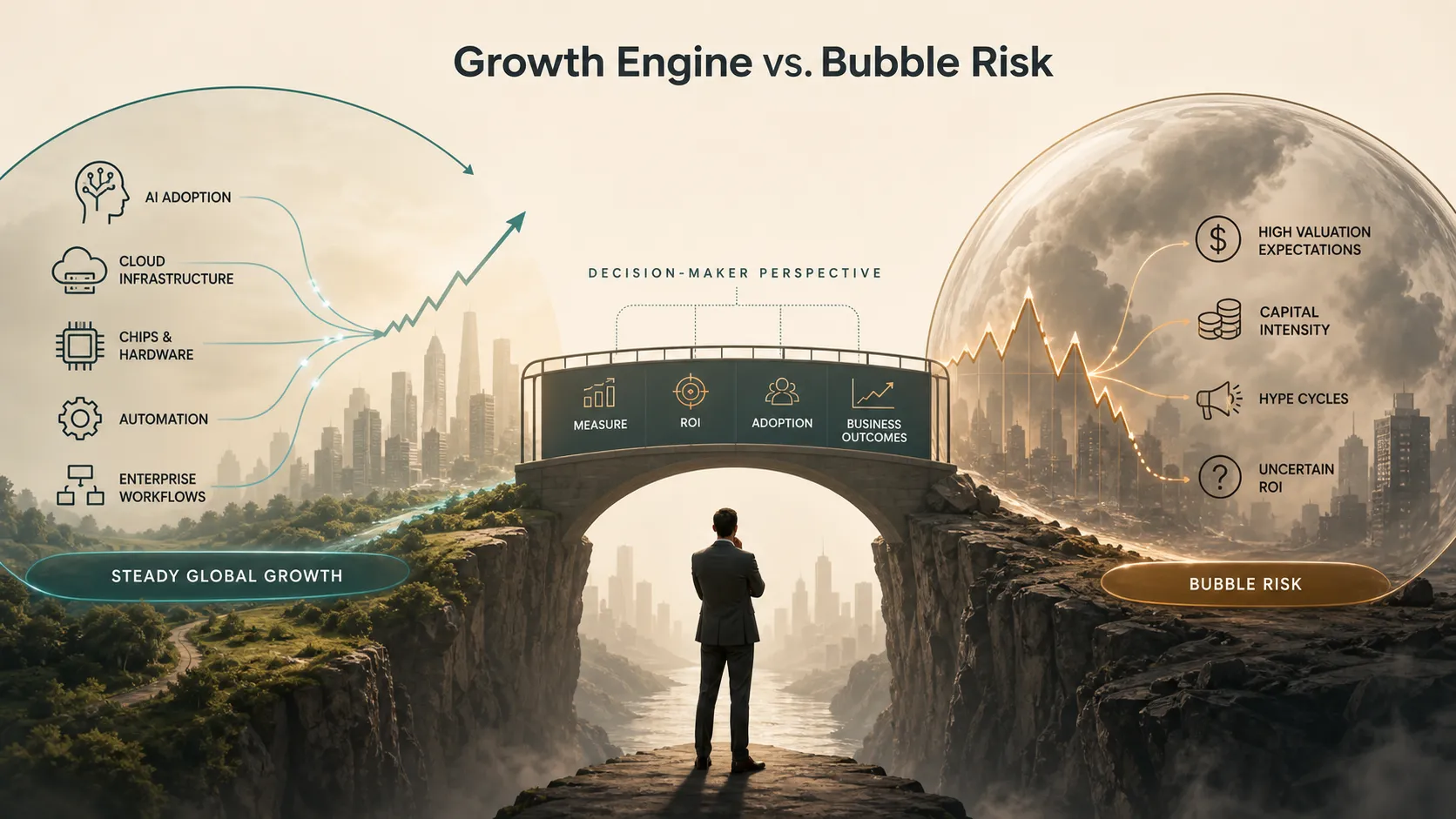
AI Bubble vs. AI Productivity: What Matters for Businesses
For most companies, the most useful question is not "Are we in an AI bubble?" It is "Are our AI investments improving performance?"
| Business Question | AI Bubble Lens | AI Productivity Lens |
|---|---|---|
| Main concern | Valuations and hype | Workflow impact |
| Key metric | Market expectations | ROI and adoption |
| Risk signal | Spending without proof | Tools unused by teams |
| Better response | Avoid speculation | Measure business outcomes |
Business leaders should evaluate AI with the same discipline applied to any major transformation. Strong AI use cases usually have clear metrics: time saved, costs reduced, revenue enabled, risks lowered, or decision quality improved.
AI productivity also depends on adoption. A powerful tool creates little value if employees do not trust it, use it, or redesign workflows around it.
What Companies Should Do Next
1. Prioritize High-Value AI Use Cases
Start with work that is frequent, expensive, slow, or strategically important. Examples include sales enablement, market research, customer support, knowledge management, financial analysis, and reporting.
A few well-measured use cases are more valuable than many experiments with no clear adoption path.
2. Measure ROI Before Scaling
Every AI initiative should have a business metric. This could include cycle time, conversion rate, support resolution speed, productivity, forecast accuracy, or cost per deliverable.
If the metric cannot be defined, the project should not yet be presented as proven transformation.
3. Build AI Literacy Across Teams
AI adoption is not only a technical issue. Employees need to understand what AI can do, where it can fail, how to validate outputs, and when human judgment is required.
Leaders also need enough AI literacy to challenge hype, ask better questions, and communicate strategy clearly.
The Verdict
The AI boom is real, and the IMF's latest outlook shows that AI, technology investment, and adoption are increasingly connected to the global growth story. But that does not mean every AI investment is justified or every valuation is sustainable.
The key dividing line is productivity. Companies that turn AI spending into measurable improvements in efficiency, revenue, and decision-making are more likely to create lasting value.
The real AI winners will not necessarily be those making the biggest promises. They will be the businesses that can prove their AI investments are producing results.
Frequently Asked Questions (FAQ)
Q: Is AI in a bubble in 2026?
A: It is not certain that AI is in a bubble. The AI boom has real economic drivers, including enterprise adoption and technology investment. However, parts of the market may face bubble risk if valuations and spending rise faster than measurable productivity and revenue.
Q: What does the IMF say about AI and global growth?
A: The IMF July 2026 World Economic Outlook Update projects global growth of 3.0% in 2026 and 3.4% in 2027. It identifies advances in AI, technology investment, and AI adoption as contributors to global economic activity.
Q: How does AI investment affect the global economy?
A: AI investment supports economic activity through spending on chips, cloud infrastructure, data centers, software, automation, and enterprise transformation. It can also improve productivity when companies use AI to reduce costs, speed up workflows, and improve decision-making.
Q: What should businesses do during the AI boom?
A: Businesses should focus on high-value AI use cases, measure ROI, avoid hype-driven spending, build AI literacy, and communicate AI strategy clearly. The goal is not to follow the AI boom blindly, but to turn AI into measurable business value.