Overcoming Stage Fright in Business Presentations: Practical Tips for Professionals
Nervous before a major pitch, client meeting, leadership update, or conference presentation? You are not alone. Presentation anxiety is common even among experienced professionals, especially when the audience is senior, the decision is important, or the message is complex.
The goal is not to eliminate every sign of speaking nervousness. A fast heartbeat, dry mouth, or tense shoulders do not mean you are failing. They mean your body recognizes that the moment matters. The practical challenge is to stay clear, focused, and credible while those nerves are present.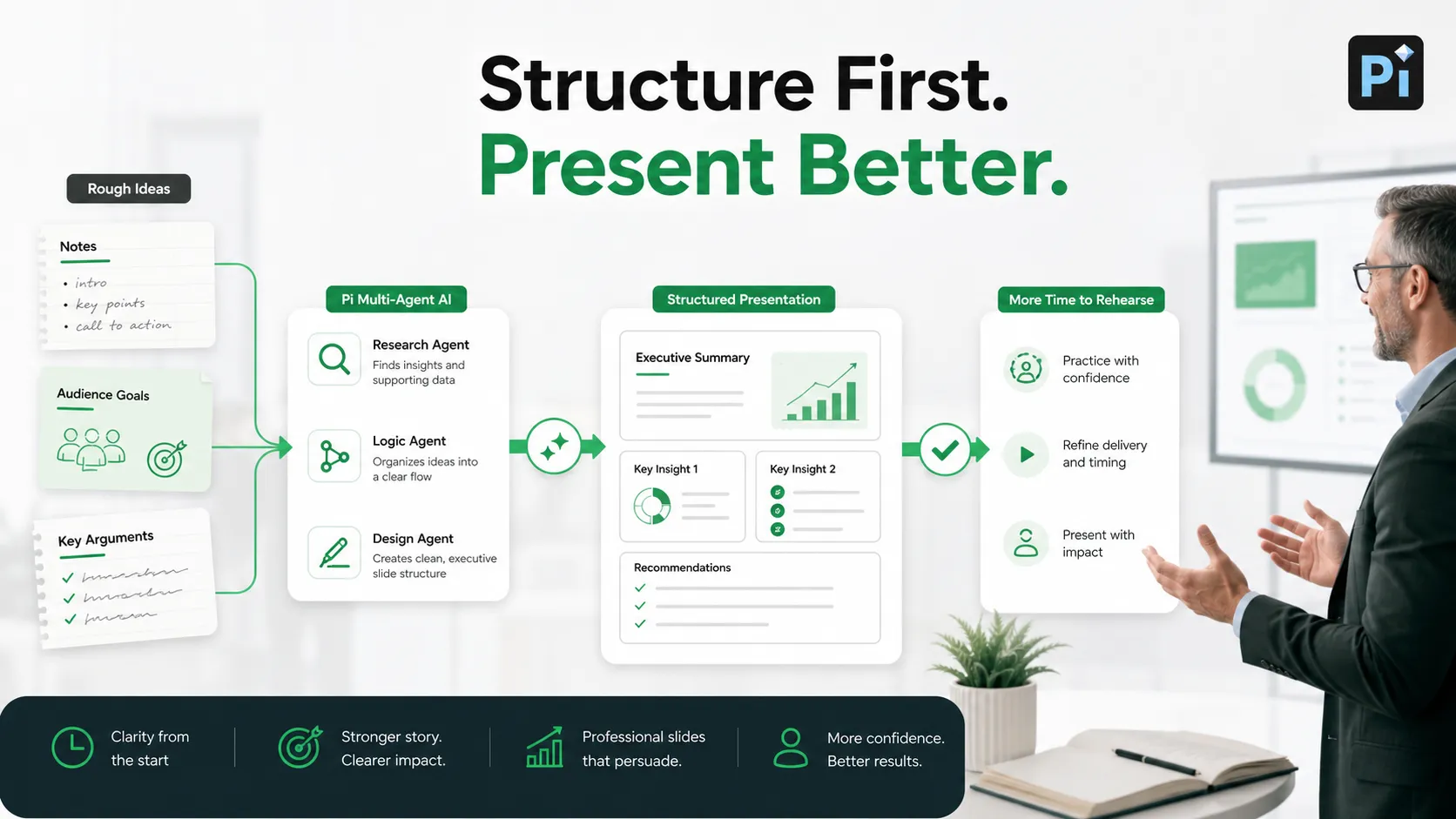
Overcoming stage fright in business presentations starts with a preparation system: a stronger message, a clearer deck, realistic rehearsal, physical calming techniques, and simple recovery moves for when anxiety appears in the room.
Why Stage Fright Happens Before Business Presentations
Stage fright is often a normal stress response. Your body prepares for pressure by increasing alertness, speeding up your heart rate, and narrowing attention. In a business setting, that response can feel stronger because the stakes are visible.
Presentation anxiety often increases when several pressures combine:
- The audience may judge your expertise, leadership, or credibility.
- The presentation may affect budget, approval, revenue, or career opportunity.
- The message may feel unclear or too complex.
- The deck may be crowded, unfinished, or visually inconsistent.
- The Q&A may feel unpredictable.
This is why generic advice like “just be confident” is rarely useful. Speaking nervousness is not only emotional; it is also operational. If your message, slides, timing, and likely questions are uncertain, your brain has more to manage under pressure.
Reframe Nervousness as Readiness, Not Failure
One of the most effective mindset shifts https://hbr.org/2014/06/try-to-get-excited-instead-of-anxious is to stop interpreting every physical symptom as a warning sign. A faster heartbeat can also mean energy. Heightened awareness can mean focus. A little tension can remind you to prepare carefully and speak with intention.
The professional goal is controlled confidence: staying functional, audience-focused, and adaptable even when you feel nervous. You do not need to feel perfectly calm to deliver a strong business presentation. You need to know where you are going, what matters most, and how to recover if you lose your place.
Try replacing “I am too nervous to present” with “My body is preparing for an important moment.” This does not magically remove anxiety, but it can reduce the second layer of fear: becoming anxious about being anxious.
Prepare the Message Before You Prepare the Performance
Many professionals rehearse delivery before the message is ready. They practice tone, gestures, or slide transitions while still feeling unsure about the core argument. That creates fragile confidence.
Before focusing on performance, clarify four things. What is the main point? What does the audience need to understand? What decision, action, or alignment do you want? What evidence supports your recommendation?
A clear structure reduces cognitive load. Instead of memorizing scattered content, you can move through a logical sequence: context, problem, insight, recommendation, proof, next step. This is especially important for pitch decks, sales decks, consulting reports, executive presentations, and brand proposals, where the audience expects both clarity and business logic.
Pi, short for Presentation Intelligence, can support this stage by helping professionals turn rough ideas into business-ready presentation structures. As an AI presentation maker, Pi is useful not because it removes all nerves, but because it reduces uncertainty around the deck itself. When the logic is clearer, rehearsal becomes more focused.
Use Breathing and Grounding Techniques Before You Speak
Physical preparation should be simple enough to use in a hallway, meeting room, or video call waiting screen. Slow breathing https://www.health.harvard.edu/mind-and-mood/relaxation-techniques-breath-control-helps-quell-errant-stress-response is a practical starting point. Before speaking, inhale gently, exhale longer than you inhale, and repeat for several cycles. The point is not to force calm, but to slow your pace and regain control of your attention.
Grounding through posture also helps. Place both feet on the floor, relax your jaw, drop your shoulders, and let your hands rest naturally. If you are standing, avoid locking your knees. If you are seated, sit upright without leaning into the screen.
Pauses are another useful tool. Many speakers rush because they want to escape the discomfort. A controlled pause before your opening line can make you look more composed and give your audience time to settle.
Rehearse for Realistic Pressure, Not Perfection
Rehearsal should make you adaptable, not robotic. Reading silently through slides is not enough. Business presentations happen out loud, with time limits, transitions, interruptions, and questions.
Practice the opening and closing until they feel familiar. Time the full presentation. Say transitions aloud so you know how one section connects to the next. Then simulate likely pressure: a senior leader interrupts, a client asks for evidence, or the meeting time is cut in half.
The goal is not to memorize every sentence. It is to know the path well enough that you can return to it after disruption. If you can summarize each slide in one sentence, you are less likely to freeze when your wording changes.
Reduce Slide Anxiety with a Clearer Deck
Slides can either support confidence or increase presentation anxiety. Crowded pages, weak hierarchy, inconsistent design, and unclear headlines force you to explain too much while the audience struggles to follow. That makes speaking nervousness worse.
A clearer deck gives you visual anchors. Strong slide titles remind you of the point. Clean layouts reduce distraction. Consistent design makes the presentation feel credible before you explain the details.
| Presentation Need | Unclear Deck Impact | Stronger Deck Support |
|---|---|---|
| Executive update | Message feels scattered | Key decisions stand out |
| Sales presentation | Value story is harder to follow | Client pain and proof connect |
| Pitch deck | Credibility may feel fragile | Logic and traction are clearer |
| Consulting report | Analysis overwhelms the room | Findings lead to recommendations |
1. Business Logic Comes Before Slide Styling
Pi helps professionals start with structure rather than decoration. Its Multi-Agent AI approach is built around business logic, so the deck can develop around the audience, objective, and storyline. This matters when the presentation needs to persuade, not simply look attractive.
2. Premium Visual Quality Reduces Avoidable Doubt
Visual polish does not replace preparation, but it can reduce one source of stress. When slides look professional, consistent, and business-grade, speakers can spend less energy worrying about whether the deck appears credible and more energy on delivery, pacing, and audience connection.
3. A Better Workflow Creates More Rehearsal Time
Stage fright often gets worse when slide creation consumes the hours that should be used for practice. By helping create structured, polished drafts for high-stakes business workflows, Pi can give professionals more time to rehearse aloud, refine their message, and prepare for Q&A.
What to Do If Anxiety Hits During the Presentation
Anxiety can still appear during the presentation, even after strong preparation. If it happens, do not fight it publicly. Pause, breathe, and return to the main message.
Look at one friendly or neutral face instead of scanning the entire room. If you are presenting virtually, look near the camera and slow your pace. Use a transition phrase such as, “The key point here is…” or “Let me bring this back to the decision we need to make.” You can also refer briefly to the slide: “This chart shows the main pattern.”
Most audiences do not notice small internal moments of panic. They notice whether you recover. A calm pause usually feels more professional than a rushed explanation.
A Practical Pre-Presentation Routine for Professionals
A repeatable routine helps reduce uncertainty before important meetings. Start by clarifying the objective: approval, alignment, funding, feedback, or next steps. Then finalize the deck early enough to rehearse, not minutes before the meeting.
Practice the opening, closing, and major transitions out loud. Review likely questions and prepare concise responses. Use slow breathing before the meeting begins. Arrive early or join the call early, check the setup, and remove small sources of friction such as missing files, weak audio, or unclear screen sharing.
Just before you speak, review only your key talking points. Do not overload yourself with every detail. Your job is to guide the audience through the argument, not recite the deck word for word.
The Professional Goal: Controlled Confidence
Overcoming stage fright does not mean becoming a person who never feels nervous. It means building a reliable preparation system that helps you perform under pressure. Confidence comes from knowing your message, understanding your audience, rehearsing realistically, calming your body, and having recovery tactics ready.
For professionals, this is especially important because business presentation confidence is tied to clarity. When the deck is structured, the argument is sharp, and the visuals support the message, the speaker has fewer avoidable problems to manage. AI-assisted preparation with Pi can be part of that workflow, especially when you need a business-ready presentation for a high-stakes moment.
Frequently Asked Questions (FAQ)
Q: How can I overcome stage fright before a business presentation? A: Start by clarifying your message, rehearsing aloud, preparing for likely questions, and using simple breathing techniques before you speak. The aim is not to remove all nerves, but to stay focused and functional.
Q: What is the fastest way to calm presentation anxiety right before speaking? A: Slow your breathing, relax your jaw and shoulders, place both feet firmly on the floor, and pause before your first sentence. A controlled start helps reduce rushing and gives you a steadier presence.
Q: What should I do if I get nervous during a presentation? A: Pause, breathe, look at one friendly face, and return to your main point. Use a phrase like “The key takeaway is…” to reconnect with your structure and continue without apologizing excessively.
Q: Can better slide preparation improve speaking confidence? A: Yes. A clear, professional deck can reduce uncertainty and give you stronger visual anchors. Tools like Pi can help create structured, polished business presentations so you can focus more on rehearsal and delivery.