The Pitch Deck 'Drop': Build Investor Urgency Like Streetwear Brands
Streetwear drops work because they compress attention. A limited sneaker release, athlete capsule, or exclusive collab creates a decisive moment: a clear product, a narrow window, and a compelling reason to act now.
Startup fundraising follows a remarkably similar psychology. Investors review dozens of pitch decks weekly, but they only write checks when an opportunity feels commercially urgent. If a pitch deck reads like an exhaustive product brochure, momentum disappears. In 2026, creating an effective investor urgency pitch deck requires communicating focus, timing, and traction within seconds.
Executing a hype drop fundraising strategy is not about fake scarcity. It is about disciplined narrative compression: one clear market inflection point, one high-contrast proof system, and one undeniable reason the startup matters today.
Why an Investor Urgency Pitch Deck Works Like a Streetwear Drop
Drop culture relies on scarcity, narrative timing, and rapid execution. The audience knows what is releasing, why it is exclusive, and why waiting means missing out. The best drops do not ask people to study a catalog. They make the moment instantly legible.
While startup fundraising carries different stakes, investors ask the same fundamental questions: *Why this company? Why this market? Why now?* A deck that answers those questions instantly builds conviction. Conversely, burying key proof points beneath dense text induces cognitive fatigue and invites investor skepticism.
The most effective VC FOMO pitch does not shout. It proves that demand is forming before the broader market recognizes it, whether through accelerated user adoption, favorable unit economics, a category-defining workflow shift, or a measurable change in buyer behavior.
This is why verbose decks underperform. They may contain strong facts, but the facts are not staged for urgency. A founder may have a powerful retention story, a widening market window, and an efficient acquisition channel, yet still lose attention if those signals are scattered across too many slides. The investor does not experience momentum. They experience homework.
3 Rules of the "Pitch Deck Drop" Strategy
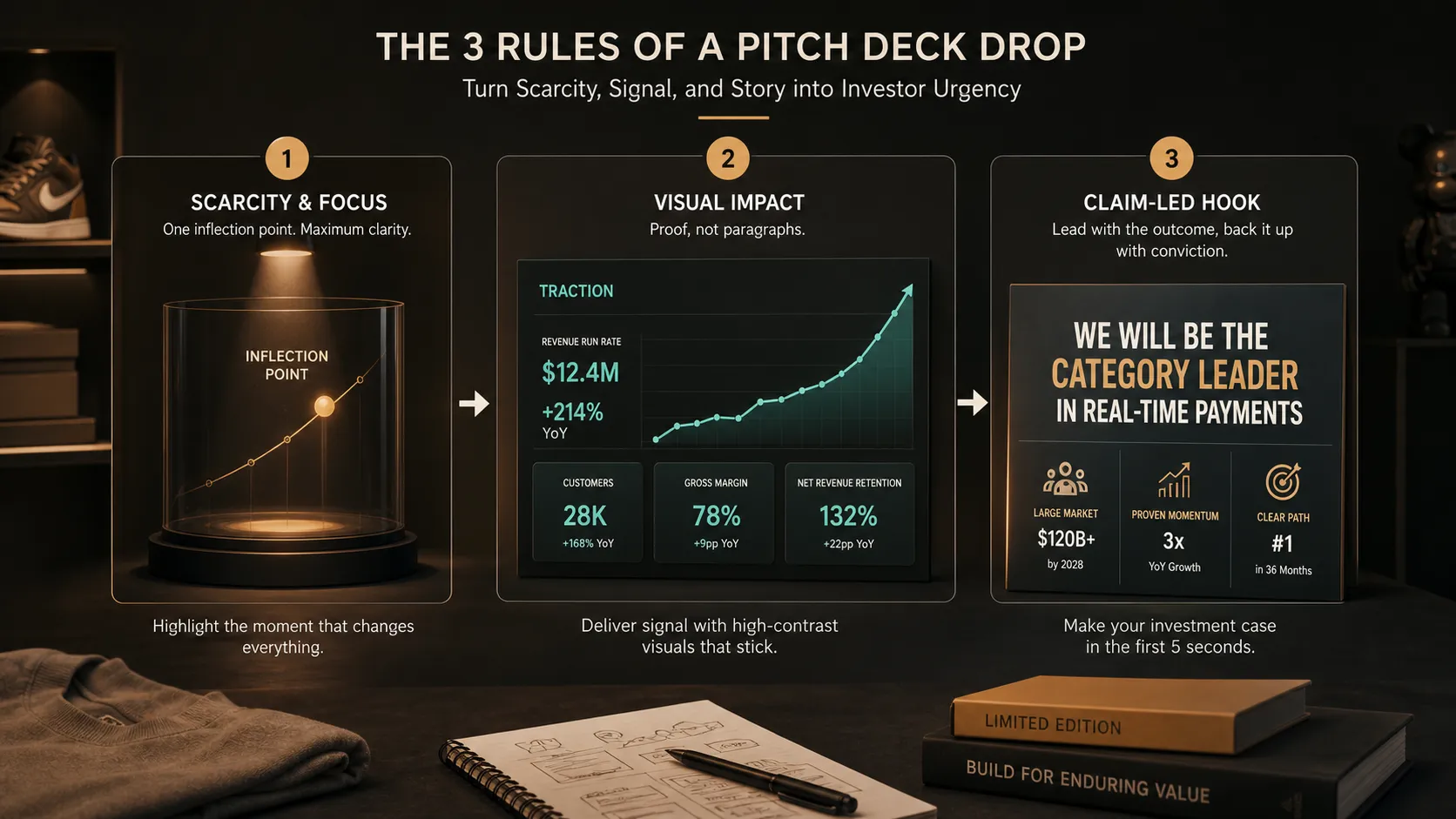
Rule 1 — Scarcity and Focus: Highlight the Inflection Point
Streetwear brands never display their entire warehouse archive during a drop; they spotlight the hero item that defines the moment. A fundraising deck must apply that same discipline to build its economic moat.
Scarcity in a pitch deck means strategic focus. Decide on the single insight investors must remember. Instead of a generic "Market Opportunity" label, lead with movement: *"Enterprise compliance spend is shifting rapidly from legal review to automated AI agent workflows."*
That type of claim narrows attention. It tells investors that the opportunity is not merely large; it is changing. When the deck then supports the claim with customer evidence, traction, or economics, the startup feels timely rather than theoretical.
Rule 2 — Visual Impact: Present Data Like a High-Contrast Campaign
Streetwear campaigns use bold contrast and sharp visual hierarchy to capture attention. Modern pitch deck design 2026 demands the same visual clarity to avoid information overload.
A modern startup pitch deck template must display metrics at a glance. High-contrast dashboards turn scattered data into an undeniable proof system. Clean visual hierarchy, prominent data callouts, and focused whitespace help growth curves, cohort retention, sales velocity, and margin improvements land instantly.
The goal is not decoration. The goal is faster comprehension. Investors should not have to search for the signal. The most important number on the slide should feel impossible to miss.
Rule 3 — The Claim-Led Hook: Win the First Five Seconds
Generic slide headers like "Product," "Market," or "Traction" waste prime real estate. They label the slide without making an argument.
A claim-led header turns each slide into a conclusion:
- *Generic:* "Traction Data"
- *Claim-Led:* "Paid pilots are converting 3x faster after finance teams see month-end time savings."
If an investor only reads the slide headers, the investment thesis should still be coherent. The best decks create a chain of claims: the market is shifting, the pain is urgent, the product is adopted, the economics are improving, and the team can scale. That chain is what turns a presentation into a persuasive fundraising asset.
How Pi Turns Startup Logic into High-Impact Investor Decks
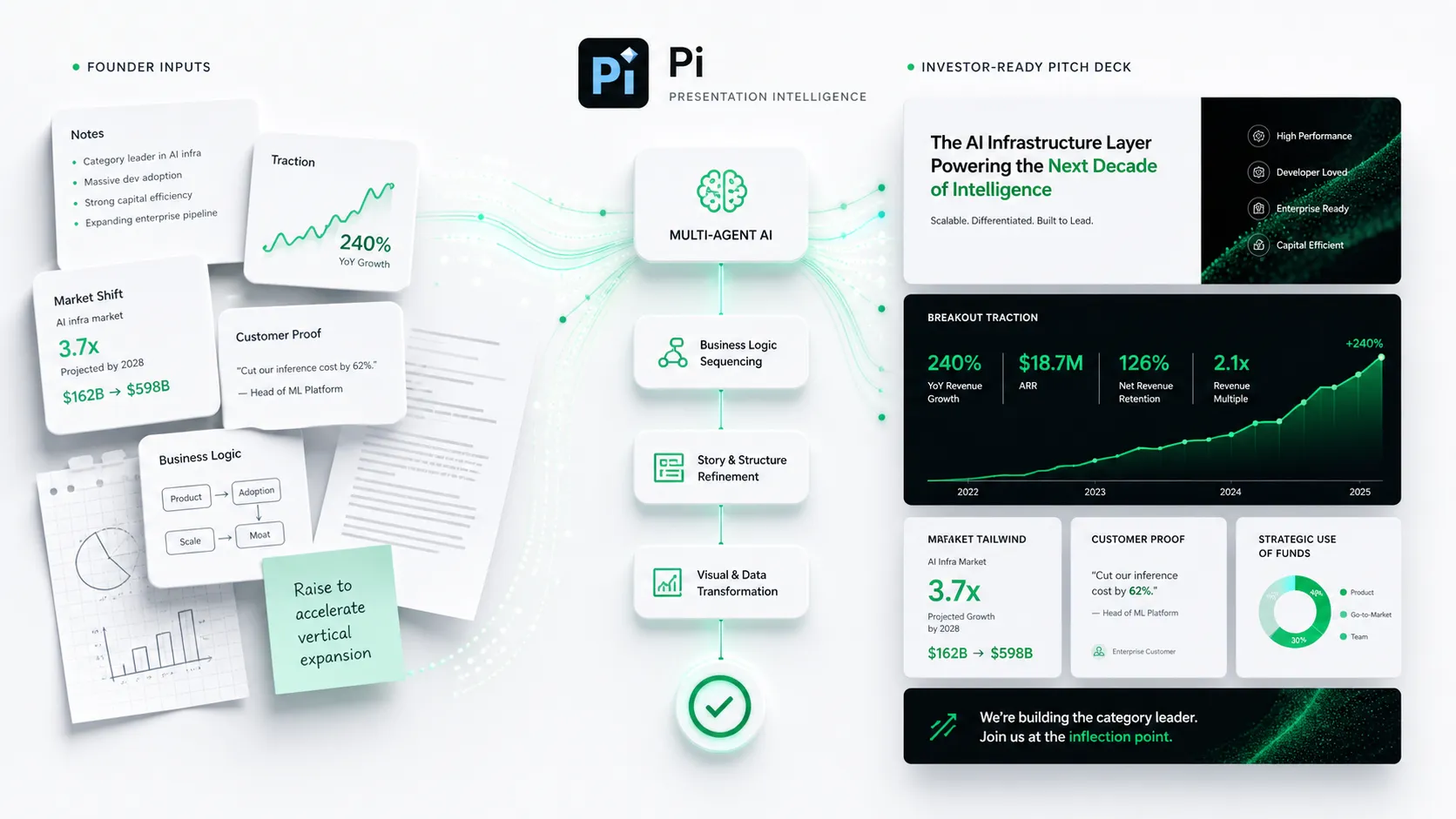
Transforming fragmented product notes into a polished, boardroom-ready presentation takes time founders often do not have. Pi (Presentation Intelligence) helps convert raw business logic, metrics, and strategic positioning into high-impact visual decks built for professional fundraising conversations.
1. Business Logic Before Slide Styling
Pi aligns inputs with investor decision logic before layout polishing begins. Founders can structure their fundraising thesis around market shifts, urgent pain points, competitive wedges, traction evidence, and the path to scale.
This matters because many pitch decks fail before design begins. The issue is not always bad visuals; it is unclear sequencing. Pi helps organize the story so each slide earns its place and advances the investment argument.
2. Claim-Led Header Generation
Pi converts descriptive section labels into assertive, evidence-backed headers. This ensures every slide explicitly proves demand, timing, defensibility, or scalability.
For a hype drop fundraising strategy, this is critical. The deck needs to feel like a sequence of sharp signals, not a collection of disconnected slides. Claim-led headers create continuity and make the pitch easier to remember after the meeting ends.
3. High-Contrast Dashboards for Investor Proof
Pi supports business-grade visual structures that help teams present traction with clarity. Instead of forcing founders to manually arrange charts, callouts, and metric blocks, Pi helps shape information into professional dashboards that match the seriousness of the fundraising context.
This is especially useful when a startup has multiple proof points: revenue growth, retention, pipeline expansion, customer logos, pricing power, or usage frequency. Pi helps the deck prioritize what matters most so the investor sees momentum quickly.
4. Eliminating the "Formatting Tax"
Manual slide tools slow teams down. Pi leverages Multi-Agent AI to reduce alignment drag and visual maintenance by applying consistent typography, professional color systems, executive-grade layouts, and structured slide logic.
That means founders can spend less time resizing boxes and more time sharpening the investment narrative. For high-stakes fundraising, this distinction matters. The deck must look polished, but it also has to think clearly.
Traditional Deck vs. Pitch Deck Drop Workflow
| Pitch Deck Element | Traditional Deck Workflow | Investor Urgency Pitch Deck & Drop Workflow |
|---|---|---|
| Strategic Focus | Covers endless features and roadmaps | Centers on one commercial inflection point |
| Opening Hook | Generic company introduction | Asserts an urgent, evidence-backed claim |
| Data Display | Spreads proof across dense paragraphs | Uses high-contrast proof dashboards for pitch deck design 2026 |
| Slide Headers | Labels topics without a point of view | Builds a connected investment thesis |
| Design Execution | Manual alignment and formatting drag | Automated, claim-driven visual hierarchy |
| Investor Takeaway | "Interesting technology" | "This opportunity requires immediate action" |
The Verdict: Urgency Comes from Focus
A pitch deck should not pretend a startup is a limited-edition sneaker release. Fundraising is rooted in evidence, performance, and trust. However, the streetwear drop framework reminds founders that investor attention is finite.
By elevating the core inflection point, displaying traction with high visual contrast, and leading every slide with a bold claim, founders build genuine investor urgency. Pi presentation intelligence accelerates this process by turning raw logic into structured, visually compelling slides that give momentum the spotlight it deserves.
The strongest fundraising decks do not overwhelm investors with everything the company could become. They make the present opportunity feel sharp, credible, and difficult to ignore.
Frequently Asked Questions (FAQ)
Q: What is an investor urgency pitch deck?
A: An investor urgency pitch deck is a focused presentation designed to show why a startup matters right now, using clear inflection points, high-contrast metrics, and claim-led storytelling.
Q: How do you create VC FOMO without artificial hype?
A: Build a VC FOMO pitch with evidence, not exaggeration. Show strong retention, customer urgency, category tailwinds, fast conversion, or improving unit economics with clear visual proof.
Q: What makes a startup pitch deck template effective in 2026?
A: An effective startup pitch deck template for 2026 uses claim-led headers, concise narrative sequencing, and high-contrast dashboards so investors can understand traction and timing quickly.
Q: How does Pi help with a pitch deck drop strategy?
A: Pi presentation intelligence uses Multi-Agent AI to turn raw business notes, metrics, and strategy into structured investor-ready decks with professional visuals, sharper logic, and less formatting work.