The Pyramid Principle in Presentations: Structuring Thoughts for Maximum Clarity
Confused audiences do not buy, approve, or act. They may appreciate your effort, but if they cannot identify your central message quickly, the presentation has already lost momentum. This is especially true in business settings where executives, clients, investors, and stakeholders need to understand the implication before they study the details.
A strong presentation rarely starts with slide design. It starts with structured thinking. The Pyramid Principle helps presenters organize ideas so the audience hears the answer first, understands the logic behind it, and sees the evidence in a clear sequence. For high-stakes decks, that structure can be the difference between a scattered update and a decisive business conversation.
Why Clear Presentations Start With Structure, Not Slides
Many presentations fail because they begin with everything except the point. The presenter opens with background, then explains the process, then shows data, then introduces caveats, and finally reaches the recommendation near the end. By that time, the audience has already started forming its own interpretation.
This is not only a public speaking https://hbr.org/2013/06/how-to-give-a-killer-presentation problem. It is a structure problem. Even a beautifully designed slide deck can feel unclear if the logic is buried. Strong visuals help, but they cannot compensate for a weak argument.
A presentation usually needs stronger structure when:
- The audience must make a decision, not just receive information.
- The message depends on several supporting arguments.
- The deck includes data, research, market analysis, or financial logic.
- The presenter needs to align senior stakeholders quickly.
- The recommendation must be understood within the first minute.
This is where a pyramid principle presentation becomes valuable. It makes the hierarchy of thought visible before the audience gets lost in details.
What Is the Pyramid Principle?
The Pyramid Principle is a communication method that starts with the main answer, then supports it with grouped arguments, and finally provides evidence beneath each argument. Often associated with the Barbara Minto method, it is widely used in consulting, strategy, and executive communication because it turns complex thinking into a logical structure.
At the top of the pyramid is the core message: the recommendation, conclusion, or answer. Beneath it are the major reasons that support that message. Under each reason are facts, analysis, examples, or data that validate the logic.
In simple terms, the Pyramid Principle says: do not make the audience wait for the conclusion. Give them the answer first, then help them believe it.
This does not mean every presentation should be blunt or oversimplified. It means the audience should understand the direction of the argument before being asked to process supporting information.
How the Pyramid Principle Changes a Presentation
A linear presentation often follows the presenter’s work process: “Here is what we studied, here is what we found, here is what it means.” That may feel natural to the person who did the work, but it can be demanding for the audience. They have to assemble the argument themselves.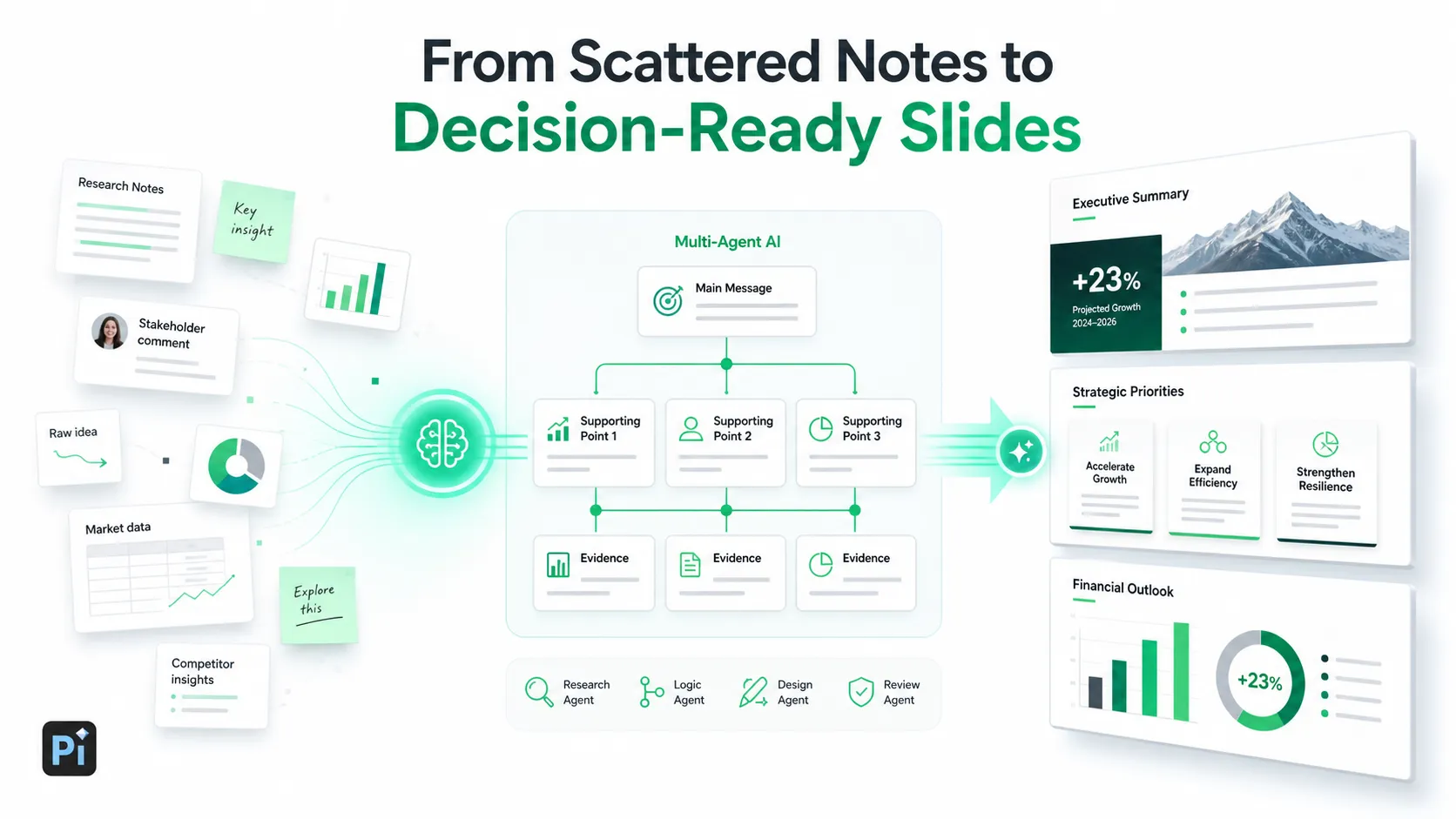
A pyramid-style presentation follows the audience’s decision process: “Here is what we recommend, here is why, and here is the proof.” It respects the audience’s time and gives them a mental map from the beginning.
| Presentation Need | Linear Information Dump | Pyramid Principle Structure | Pi Workflow |
|---|---|---|---|
| Opening message | Context first | Answer first | Clarifies the executive message |
| Argument flow | Chronological | Hierarchical | Builds business-ready logic |
| Evidence | Shown as collected | Linked to each point | Organizes support by purpose |
| Slide role | Stores information | Advances the argument | Turns logic into polished slides |
| Audience impact | Requires interpretation | Enables faster understanding | Supports decision-ready communication |
The rest of the deck then becomes validation. Each section exists to prove, clarify, or qualify the top message. This makes the presentation easier to follow and easier to remember.
A Simple Pyramid Principle Presentation Structure
A practical pyramid principle presentation does not need to be complicated. The goal is to create a clear hierarchy before writing slides.
Start with the top message. This should be a complete thought, not a topic label. “We should enter the mid-market segment in Q3” is stronger than “Market expansion strategy.”
Then identify the main supporting points. These should be distinct reasons that explain why the top message is true. For example, the market may be growing, the company may have a product advantage, and the sales motion may be economically viable.
Under each support point, place the evidence. This might include customer interviews, revenue models, competitor analysis, operational constraints, or case examples. Evidence should not float randomly in the deck. It should support a specific branch of the argument.
Finally, end with the action or implication. If the audience accepts the logic, what should happen next? A decision, a budget approval, a pilot, a revised roadmap, or a follow-up meeting should be clear.
Common Mistakes When Applying Structured Thinking
The Pyramid Principle is powerful, but it can be applied poorly. One common mistake is writing the conclusion first without testing the logic beneath it. A strong top message must be supported by real reasoning, not just confidence.
Another mistake is overloading each branch with too many ideas. If every support point contains five sub-points, the structure becomes heavy again. The purpose of structured thinking is to reduce cognitive effort, https://www.nngroup.com/articles/minimize-cognitive-load/ not create a more formal version of clutter.
Some presenters also force every deck into exactly three arguments. Three is often useful because it is memorable, but it is not a rule. Some recommendations need two strong reasons; others need four. The point is logical grouping, not artificial symmetry.
The Pyramid Principle also works best when clarity, recommendation, and decision-making are central. It may be less suitable for highly emotional keynote storytelling, open-ended creative exploration, or training sessions where discovery is part of the learning experience.
From Structured Thinking to Business-Ready Slides
Once the logic is clear, the slides should reflect the pyramid. Slide titles should communicate conclusions, not just subjects. A title like “Enterprise customers show higher retention and expansion potential” is more useful than “Customer Segment Analysis.”
Section headers should mirror the main support points. Chart captions should explain the insight, not merely describe the data. Executive summaries should present the top message and the supporting logic in a compact form.
This is where clear communication skills become visible on the page. The audience should be able to skim the deck and still understand the argument. If the slide titles alone do not tell a coherent story, the structure likely needs more work.
A good business deck is not a document full of slides. It is a sequence of claims, evidence, and implications.
How Pi Helps Turn Pyramid Logic Into a Professional Deck
Applying the Pyramid Principle manually can be difficult because business ideas often begin as scattered notes, research fragments, stakeholder comments, and half-formed recommendations. Pi, short for Presentation Intelligence, is an AI presentation maker built for professional teams that need to turn raw thinking into structured, business-ready presentations.
Pi does not replace strategic judgment. It supports the workflow between thinking and presenting, helping teams clarify logic, organize content, and produce premium slides that feel appropriate for high-stakes business communication.
1. Business Logic Comes Before Slide Styling
Pi helps teams move beyond simply generating attractive pages. Its workflow emphasizes the underlying argument: what the presentation is trying to prove, how the points connect, and where evidence should appear. This is especially useful for pitch decks, consulting reports, sales decks, market research decks, and executive presentations.
2. Multi-Agent AI Supports Deeper Structure
With Multi-Agent AI, Pi can support different parts of the presentation process, from content organization to narrative flow and visual execution. That matters because a strong deck is not only written or designed; it is reasoned, sequenced, and refined.
For a pyramid principle presentation, this means the top message, supporting points, and evidence can be developed as a coherent system rather than a loose collection of slides.
3. Premium Visual Quality Makes the Logic Easier to Read
Even the best structure needs clear visual execution. Pi helps translate business logic into polished slides with professional hierarchy, spacing, and visual emphasis. The result is not just a cleaner deck, but a presentation where the audience can see what matters first.
Used well, Pi helps teams move from “we have a lot to say” to “we have a clear argument worth presenting.”
A Practical Checklist Before You Present
Before presenting, review the deck from the audience’s perspective. Can they identify the recommendation in the first minute? If not, the opening may still be too indirect.
Check whether each supporting point is mutually distinct. If two sections are saying almost the same thing, combine or sharpen them. If a slide does not advance the argument, remove it or reposition it.
Also ask whether the evidence is attached to the right claim. Data without a clear purpose creates noise. Every chart, quote, example, or model should answer the audience’s natural question: “Why should I believe this?”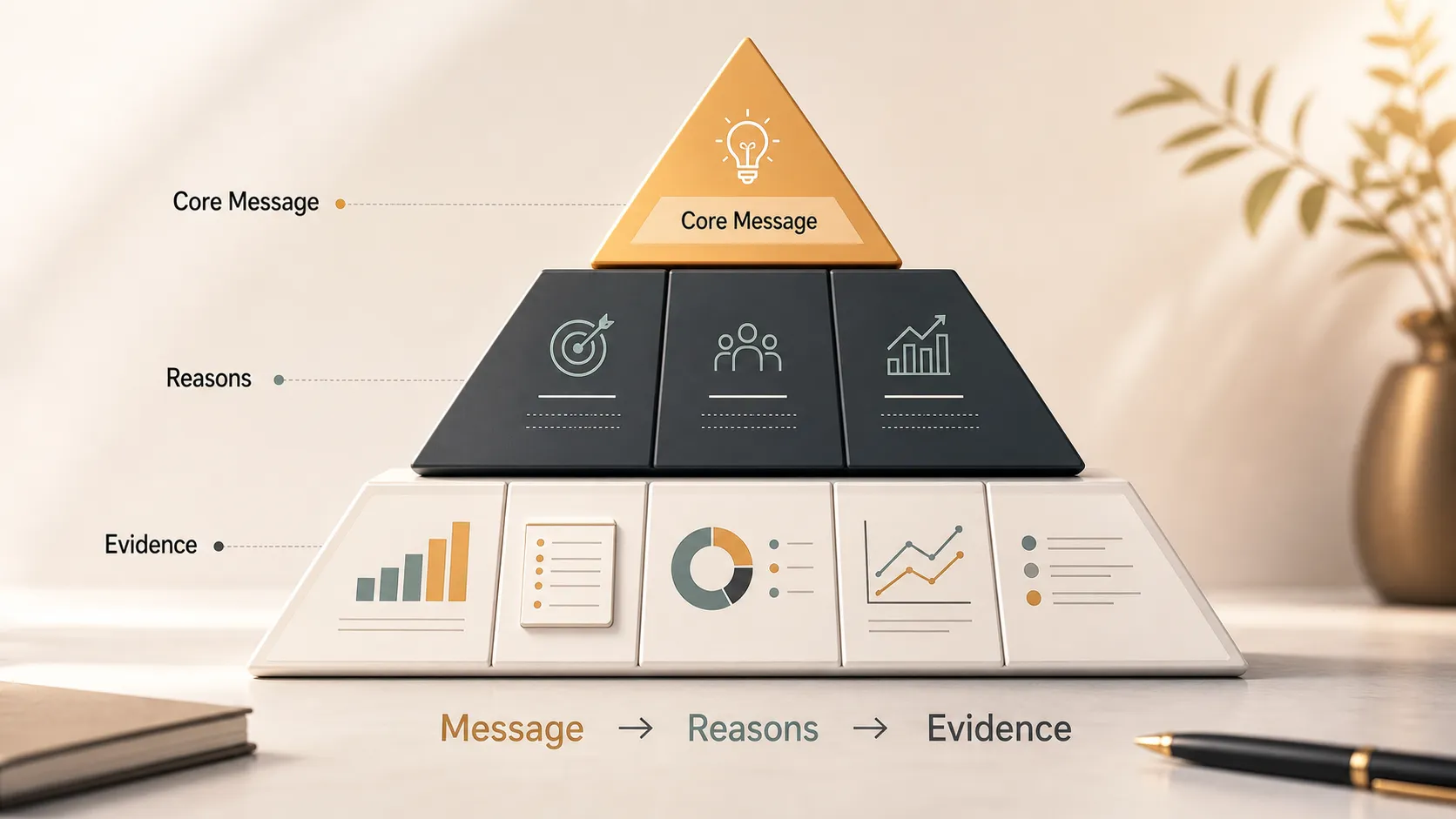
Finally, confirm that the next action is clear. A presentation built with structured thinking should not end with ambiguity. It should leave the audience knowing what decision, approval, or discussion is needed next.
Frequently Asked Questions (FAQ)
Q: What is a pyramid principle presentation? A: A pyramid principle presentation is a deck structured around a main answer or recommendation, supported by grouped arguments and evidence. It helps the audience understand the core message early instead of waiting until the end.
Q: How does the Barbara Minto method improve clear communication skills? A: The Barbara Minto method improves clear communication skills by forcing the presenter to organize ideas logically. It encourages answer-first communication, distinct supporting points, and evidence that directly connects to each claim.
Q: Is the Pyramid Principle only for consulting presentations? A: No. It is common in consulting, but it also works well for executive updates, sales decks, pitch decks, strategy presentations, market research reports, and any business deck where clarity and decision-making matter.
Q: Can Pi help create a structured business presentation? A: Yes. Pi helps professional teams turn scattered ideas into business-ready presentation structure, logical flow, and premium slides. It is especially useful when a deck needs both strong reasoning and polished visual execution.